Category: getting political

  • Comedia dell’arte. Comedia dell’yarn-te?

    Comedia dell’arte. Comedia dell’yarn-te?

    Down to clown in Venice

    I began indulging my love for harlequin motifs with my Junco Sweater, but at the end of last month, I got to visit the harlequin homeland: Italy!

    My partner, who is a freelance assistant camera operator, worked on Cover-Up, a documentary about journalist Seymour Hersh and directed by Laura Poitras and Mark Obenhaus. He was invited to attend its premiere at the Venice Film Festival, and I got to go with!

    This event was wild. Most of the time, I felt like I had snuck into the back door of a party I hadn’t been invited to. My partner noticed Mads Mikkelsen and was tempted to tell him how much he enjoyed his work in Death Stranding. I accidentally caught Tilda Swinton on camera trying to film an art installation. Willem Dafoe was hanging out in the hotel bar. I drank Negronis while watching people I can only assume were European royalty pass by in evening gowns. Guards walked around wearing military berets and machine guns. I was nervous to make sudden moves.

    The level of wealth was strange to me. It was strange to witness in person. It was especially strange considering that Cover-Up is about a guy who blew the top off multiple war crimes committed by American’s military, namely, the My Lai massacre during the US invasion of Vietnam, and the torture at Abu Ghraib prison during the invasion of Iraq. Hersh is a truly remarkable person who pursues the truth regardless of what people think, and what enemies he makes. He’s been accused of spreading conspiracy theories. He was the subject of angry, worried phone calls between Nixon and Kissinger. He’s on the left in this photo from Reuters.
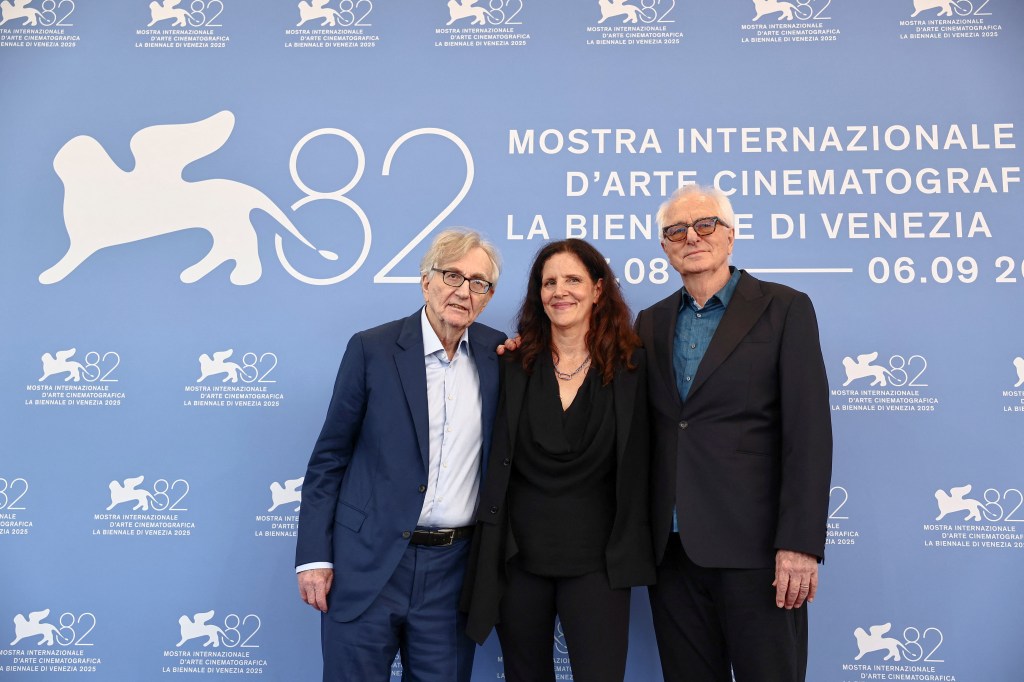
    Director Laura Poitras, director Mark Obenhaus and journalist and political writer Seymour Hersh pose during a photocall for the movie “Cover Up” out of competition, at the 82nd Venice International Film Festival, Venice, Italy, August 29, 2025. REUTERS/Yara Nardi

    The same day Cover-Up premiered, so did After the Hunt, a new Luca Guadagnino movie starring Julia Roberts and Ayo Edebiri. We passed the red carpet during their entrance but couldn’t see over the wall of photographers. But I do wish I had seen Roberts’s dress with my own eyes:
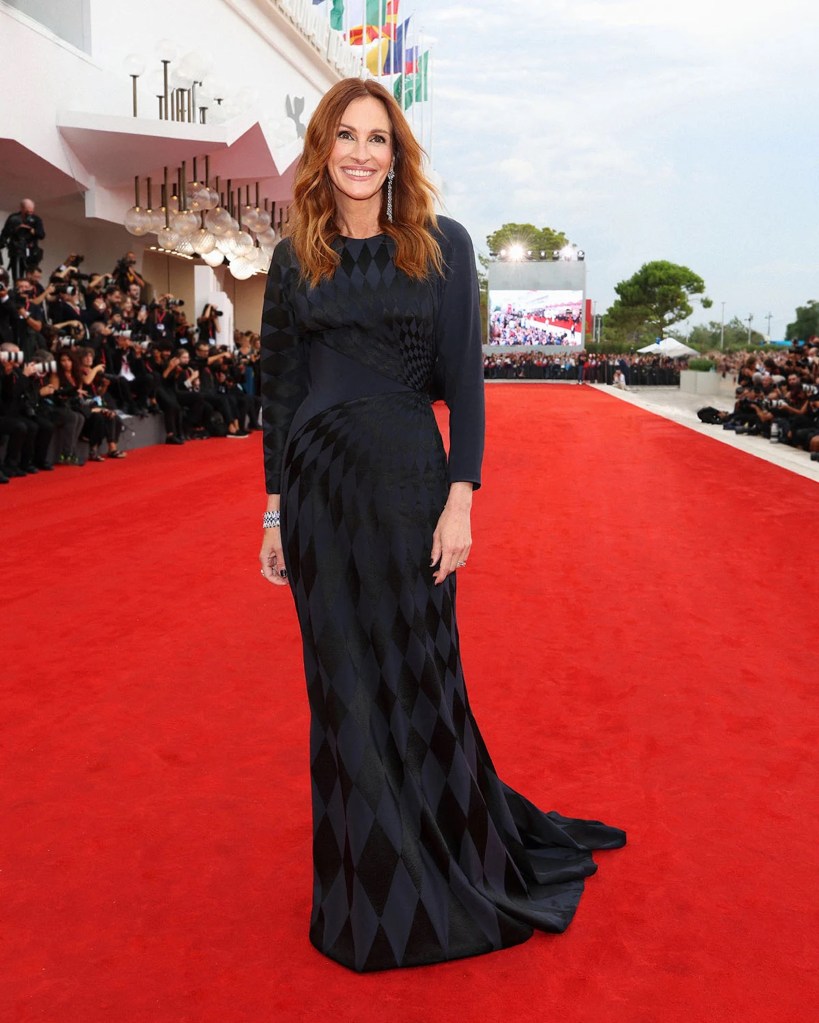
    Julia Roberts stands amiling on a red carpet. She is wearing a black gown with a low-contrast pattern of diamonds.

    Roberts wore Atelier Versace, a long blue-black gown with a low-contrast pattern of diamonds cascading down the skirt and rising up the shoulders. I thought this was a fashionable nod to the history of comedia dell’arte and Harlequin in its country of origin.

    In commedia dell’arte theater, Harlequin is a stock character, a servant and a trickster with two masters, undermining the authority of both. Which is also why Harley Quinn of DC comics makes such a good anti-hero: sometimes allied with the abusive Joker and sometimes Batman, she flips between her penchant for chaos and her moral agency.

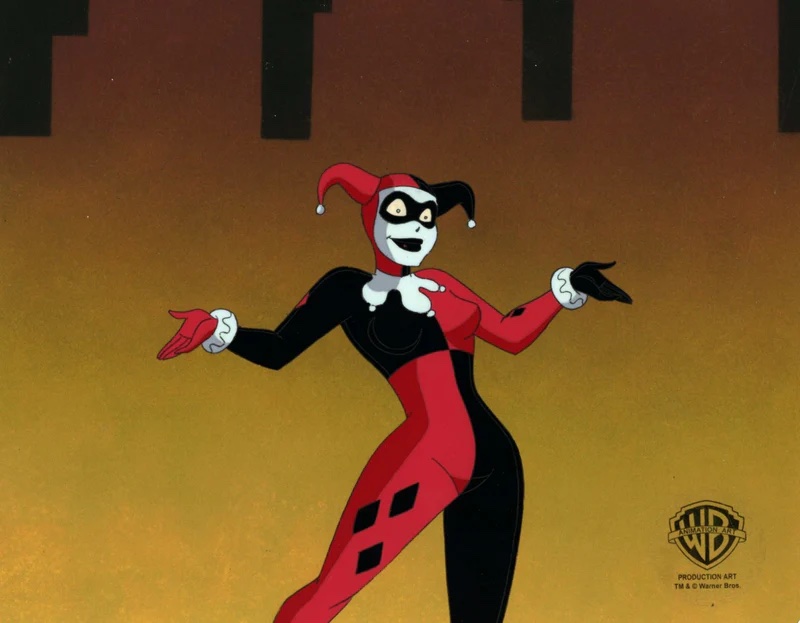
    Harlequin’s costume patterns range from diamonds to patchwork triangles, often colorful and bright, but sometimes black and red. And in Venice, those motifs manifest in Carnevale masks. As a former Catholic, I still feel drawn to the gilded imagery of Catholic religious ritual, and the way it has adapted (or appropriated, in many cases) pagan traditions. It’s catnip to a heathen like me.
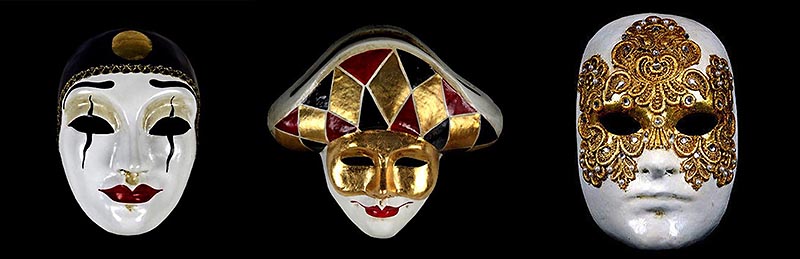
    A trio of Carnevale masks. On the left is a white mask with red lips and wavy lines crossing vertically over the eyes, and a black cap shape over the forehead. In the middle, a mask with red lips and a gold mask over the eyes - this figure wears a crescent-shaped headpiece with gold, black, and red diamonds. On the left, a mask that is completely white except for a large golden filigree covering the foreheard, eyes, nose bridge, and cheeks.

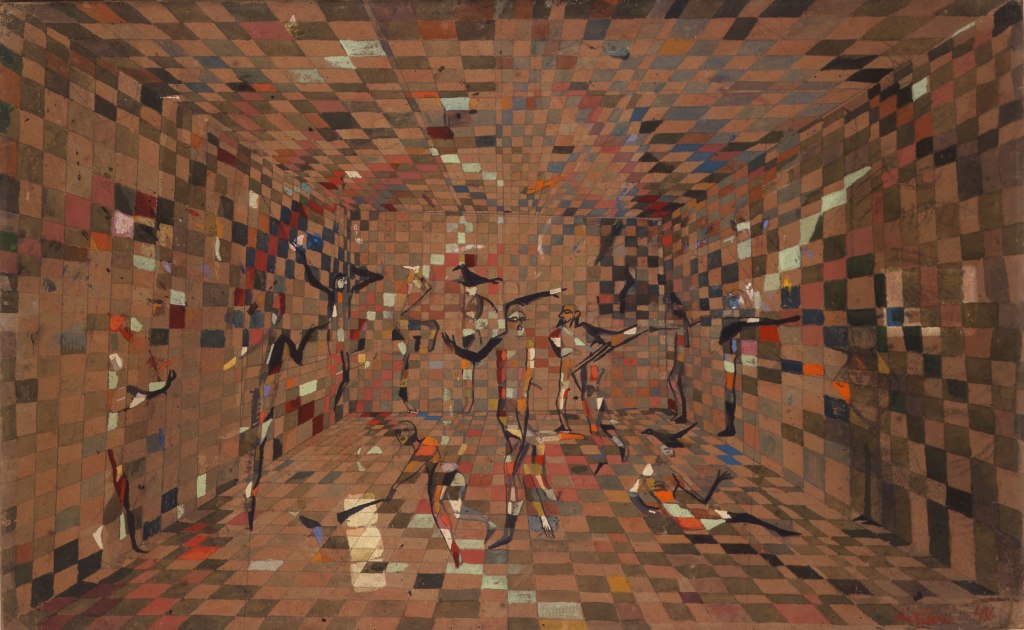
    I also got to visit the Peggy Guggenheim collection, where they happened to have a temporary exhibit featuring the work of Helena Maria Vieira da Silva, a Portuguese abstract painter who mapped space using grids of colorful squares. I was really taken by this exhibit and Vieira da Silva’s style, and I think it’s no coincidence that she also worked in tapestry and stained glass – the way those forms naturally lead toward geometry, pixelation, and abstraction probably had an influence on her painting style, the signature use of a grid to create depth and find form in her depictions of movement, cityscapes, and interiors.
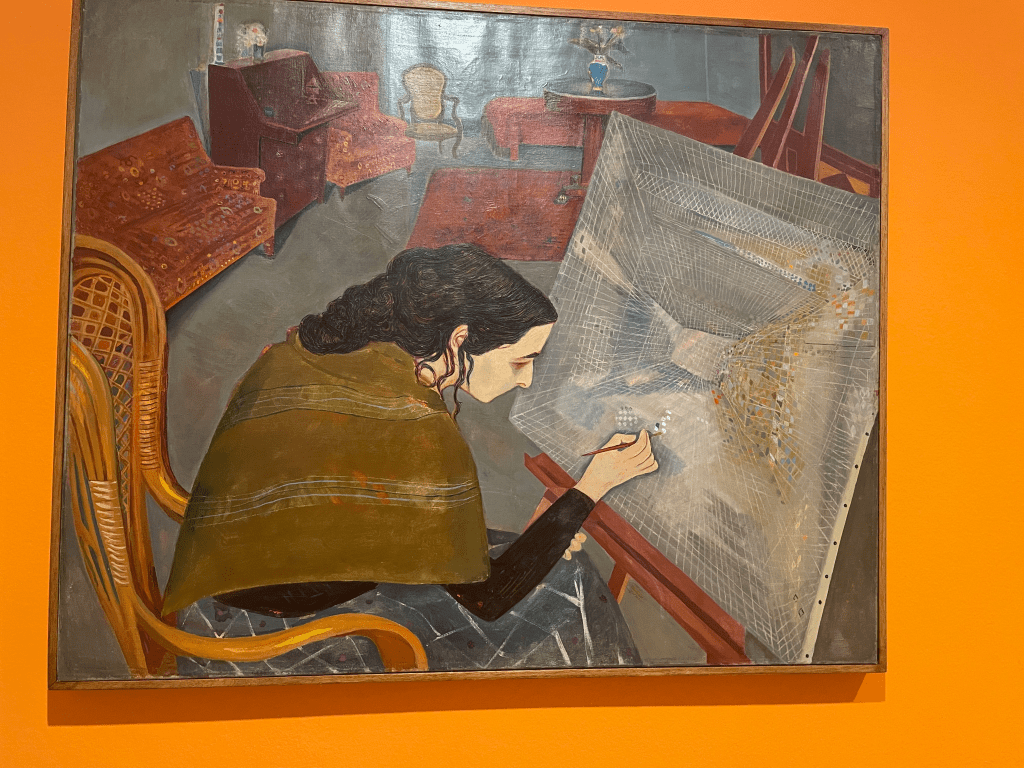
    Now that I’m back from Venice, I’ve been looking for ways to translate that interest in diamond motifs into knitwear. Through my searches on Ravelry, I came across this project by user SilasM.

    That was it, that was exactly what I wanted to make. The pattern is Harlequin Pullover by Anne Mieke Louwerens, an artist who has worked in textiles and knitwear design, painting, graphic design, and ceramics.

    But I had a small roadblock. I couldn’t find this pattern online anywhere, because it was originally published in the fall/winter 1988 issue of Vogue Knitting.
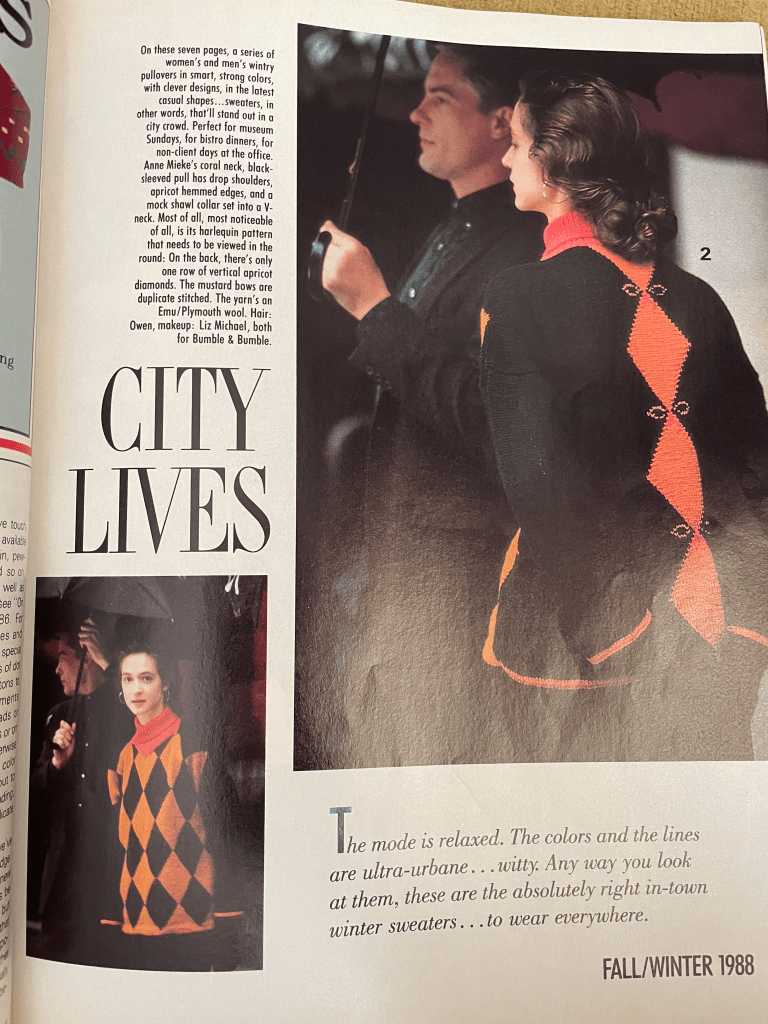
    A page from the issue of Vogue Knitting where the Harlequin sweater is modeled. Int he main photo, the model is acing away from the camera and a single line of orange diamonds on a black background is shown on the back. There are duplicate stitch bows adorning the tops of the diamonds. In the inset image on the bottom left, the models faces the front, showing the grid of orange and black diamonds and a coral cowl neck. In both photos, the model is standing next to a man in a suit, holding an umbrella. The model is a white woman with brown hair, wearing gold hoop earrings.
    The Harlequin sweater modeled in the Vogue Issue.

    But that’s why God made eBay, right? Luckily I found a hard copy of the issue from a seller on the site, who kept this magazine miraculously preserved for the last 36 years.

    After looking at the pattern directions, I’m already planning a couple mods. To feel truly in the piebald spirit of Harlequin, I want to make all the contrast color diamonds different colors. I’m also planning to add some shoulder shaping, and sleeve decreases to preserve some yardage. I’m split on the cowl neck. I love how it looks, but I’m partial to lower necklines. It’s added by picking up the stitches around the neck after the rest of the sweater pieces are grafted together, so I won’t have to make a decision until much, much later.

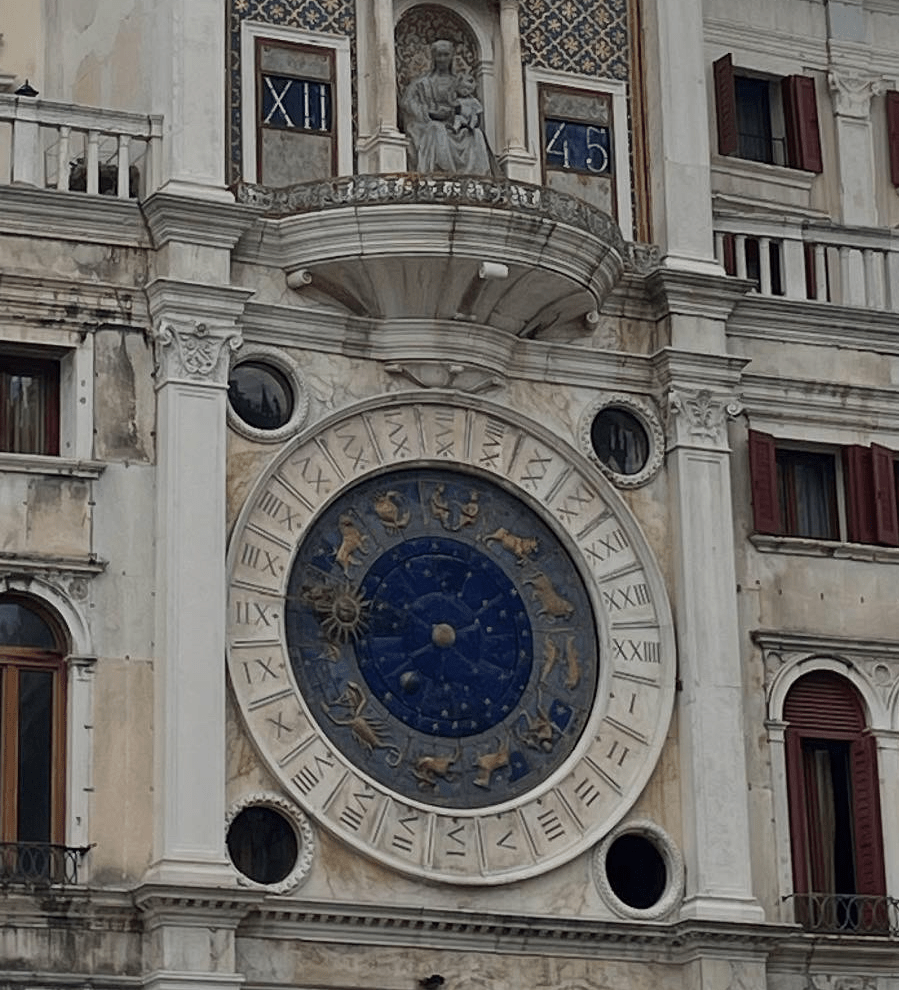
    The diamond motif wasn’t the only thing that caught my eye in Venice. Right now I’m also enamored with celestial imagery, which is all over the city (and other parts of Italy, according to my friend who has traveled more extensively there). So I was completely transfixed by the Torre dell’Orologio in San Marco Square, an astronomical clock tower depicting the 12 zodiac signs. It tells the time, and the positions of the moon, Mercury, Venus, Mars, Jupiter and Saturn, as well as the astrological position of the sun.
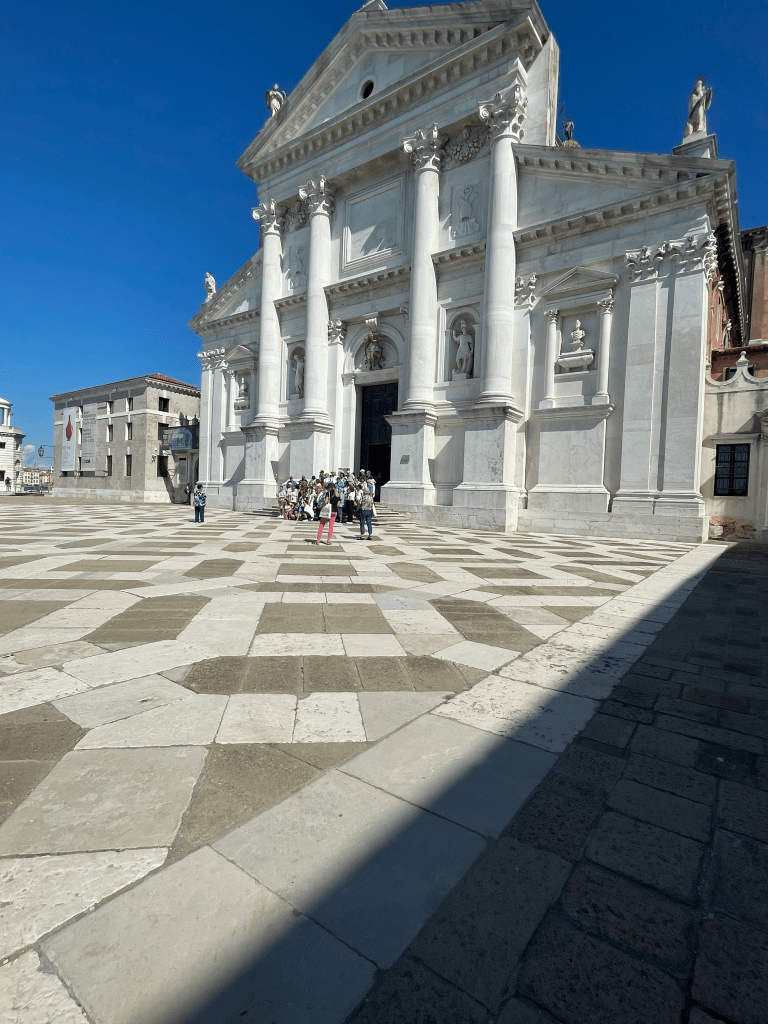
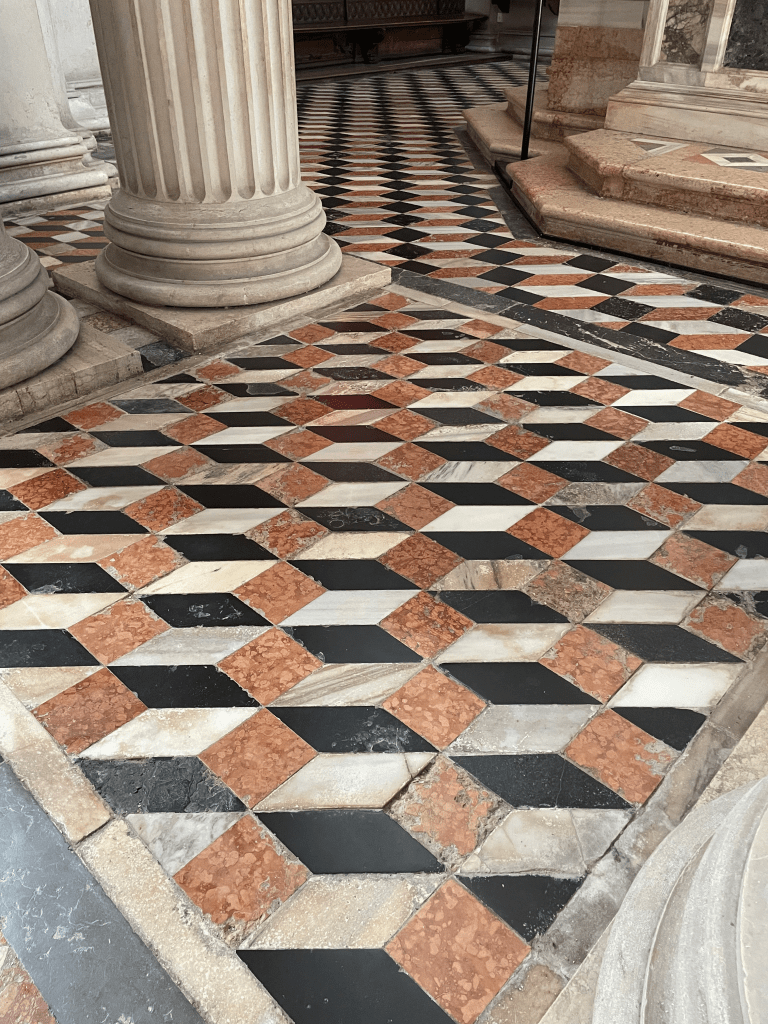
    I also found plenty of inspiration in the tile floors at San Giorgio, a church and monastery. The island, San Giorgio Maggiore, is also home to a photography gallery, which had an exhibit on Robert Mapplethorpe while we visited.
    In addition to Venice’s classic sights, we were invited by the Cover-Up production team to the Biennale Architetturra to see the installation “Calculating Empires” by Kate Crawford, a researcher who has been studying AI for the past decade, and artist Vladen Joler. I got to speak a little with Dr. Crawford, who was so extremely cool. The project is available to view online here.

    Also at the Biennale Architetturra was Necto, an installation made from knit fiber and LED lights. Read the full details here.
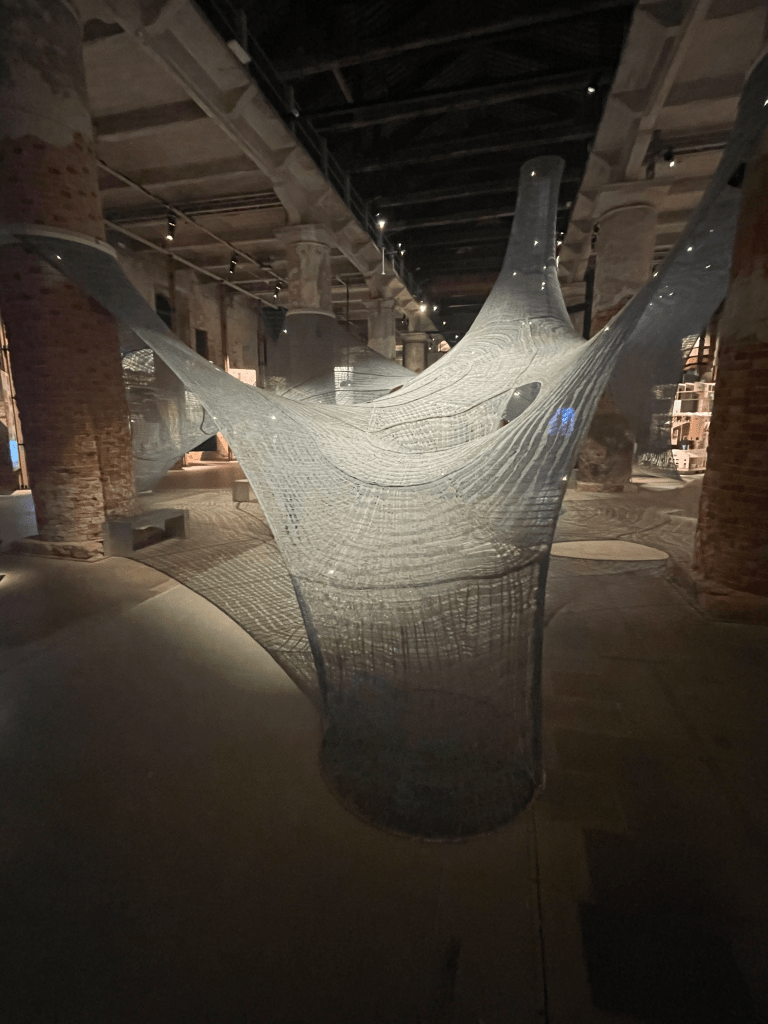
    A large knitted art piece is suspended on multiple brick columns in a large room, kind of like a giant spiderweb. Multiple lines of LED lights run through it, and dots of light can be seen throughout.
    This is what I was filming when Tilda Swinton’s tour group came through.

    And besides the “official” art, there were tons of murals and graffiti all around Venice. Much of it was anti-Amazon and anti-Bezos, since he had just completely shut down the city for his own wedding just a few months prior. Most of it was in support of a free Palestine and an end to the genocide in Gaza.

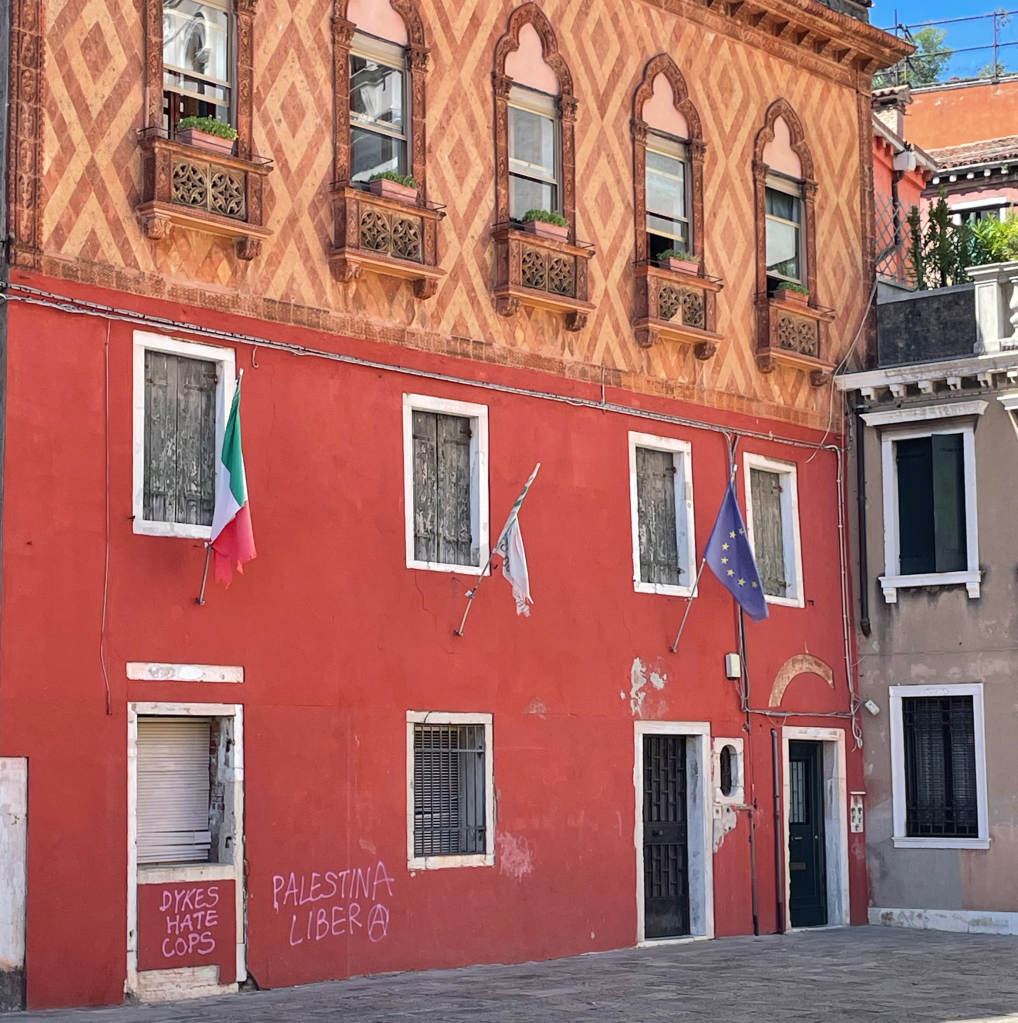
    And last, the two funniest images I took. On the left, a young man whose whole job is to carry a falcon around to scare pigeons away from this rooftop bar. On the right, a trio of suited, ear wire-wearing tough guy security guards at the Film Festival take a much-needed gelato break.

    There are worse gigs, probably.
  • Sympathy for the Karen

    Sympathy for the Karen

    A comprehensive guide to avoiding Karen behaviors and how deregulation contributed to them.

    This post contains a brief mention of suicidal ideation that I’ve witnessed.

    With lots of experience in retail and food service, I know how not to be a Karen. I’ve worked at a cafe, a bookstore, at a Michaels, and then the yarn store. I’ve had a full adult stomp their feet at me. Been called a bitch, and stupid. Dealt with harassment, and so much passive aggression that it’s now my policy not to respond to it at all.

    I have a not-so-secret secret: My real name (not Smitty) is very close to “Karen”. I don’t find its new meaning offensive, but sometimes I feel a little awkward introducing myself. I even give baristas a different name so I don’t scare them. I kind of wish the term wasn’t a name so that it could at least apply easily to men (who are often very, very bad Karens).

    Once my dad asked me if it bothered me, my name being so close to Karen, and my brother joked “Yeah, you should get on fixing that.”

    So I am!

    Have you had dozens of bad shopping experiences where it just seems like you can never get the help you’re seeking? Does your blood pressure rise every time you walk through a shop entrance? Do cashiers’ eyes widen when you approach? Well, you might be a Karen.

    Here are some common Karen behaviors.

    • Refusing to follow a worker’s directions about where to find something, how to pay, or how to access the thing you need because you believe it’s a waste of your time.
    • Asking for special allowances (an appointment when there’s no availability, expired coupon use, an unearned discount), and retaliating when the minimum wage worker cannot give it.
    • Saying “I shop here all the time, do you know how much money I’ve spent here?” when you are not acquiesced to. Nobody cares, or knows who you are.
    • Trauma dumping on a captive audience. This is pretty frequent for service workers. I’ve learned a shocking amount about a customer’s medical problems, divorce, family member’s death, addiction, and suicidal ideation in the time it takes to ring up their order.

    And these are just a few examples, before the escalation to name-calling, screaming, and throwing stuff. In extreme instances, it escalates to assault.

    If you recognize yourself in any of these examples (and the list is not exhaustive), here are some suggestions on how to better handle the situation.

    • Trust that the person knows what they’re doing. You may be a very smart person, but the worker is the expert on how things work. They know what is possible for them to help you. Be clear about what you need, and calmly ask follow-up questions if something is confusing.
    • Remember that you are not the only person in the store/restaurant/cafe, and that the worker has other people to help. They cannot offer specialized service to every person who walks in the door. Take a deep breath and accept that you are but a drop in the ocean that is the universe, and take comfort in the zen of anonymity and insignificance.
    • Relinquish the idea that you have status as a regular or a big spender. Sometimes the barista or the cashier will recognize you, but most of the time they won’t! They also could not give less of a fuck how much you spend, especially at a chain establishment, because your big spending has never increased their wages. They are required to be there because it is their job, not because they are a personal servant.
    • If you feel the need to share life updates or personal issues with the worker, consider if it would be better shared with a good friend, or even a therapist. The worker is likely not trained to help you with a personal crisis or chronic medical problem.

    But this post is not just to punish or kvetch. Part of me is sympathetic to the Karens. Some of them are purely out to make people miserable, that is certain. But I think a lot of them simply still expect a customer service experience that they grew up with. Once upon a time in America, you shopped at stores owned by your neighbors and run by their families. The cashier did know you and what was going on in your life. Business owners had some authority over prices, what they stocked, and shop policy. They started those businesses with knowledge a specific field, and staffed them with people who were similarly knowledgeable. A business was likely small enough to be dedicated to one category of good/service that the owner was an expert in, as opposed to large chain department stores like Walmart or Target, where it can’t be expected that an employee can be an expert on workout equipment and cell phones and baby supplies and whatever else that business is selling.

    During my first food service management job, I dealt with a lot of turnover and no-shows, often working 11+ hour days to cover shifts, and constantly training people I was certain would not stay in the position for more than a couple of weeks. My conclusion: “What can I expect? These people are only making minimum wage. They just don’t make enough to care what happens here.”

    So what happened? Chains stores and restaurants grew, their protection from failure and ability to provide cheap goods compounded forever by their growth, growth achieved by paying their employees less and less, making many people more and more dependent on the cheap prices they provide.

    And aren’t we seeing this happen with our beloved LYSs? Natural fiber yarn is at a price point many can’t afford, but is necessary to keep an independent business open and pay their employees a livable wage, but then fewer can afford to shop there. Add in some of the other problems that LYSs have been diagnosed with (haughtiness and racism, namely) and we find ourselves with a declining customer base despite it seeming like knitting and crochet are getting more and more popular (a statistic that is admittedly hard to quantify). Younger crafters tend to find yarn online instead of in store, speaking to the convenience of online shopping for a generation largely accused of being less social. But the internet offers more possibility for affordability, and big retailers like Hobbi and Knitpicks offer cheaper yarns in smaller units. No hate to people who shop there, I do too (though not at Knitpicks since I heard they were being accused of a carpet beetle infestation).

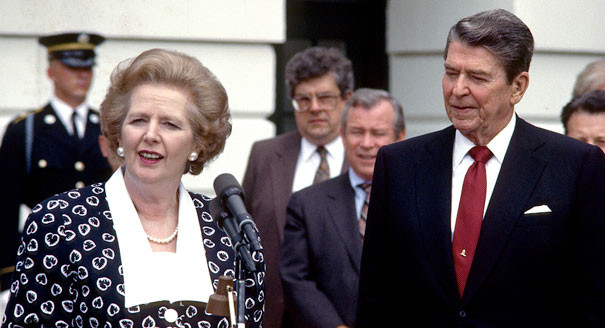
    I am far, far from being any kind of economic expert, so I had to do some research about the decline of small businesses. The rise of large businesses has been happening since the 19th century, when the first department stores were established, and when transcontinental shipping infrastructure allowed for easier transport of supplies and products. According to Piketty in his book Capital in the Twenty-First Century, the growth of wealth during the turn of the 20th century went largely unregulated, reaching a peak in 1913, until that growth was flattened by two world wars and concentrated government policy meant to help the citizens of those countries recover from the physical destruction and financial devastation of war. Piketty’s research shows a significant 10% decrease in the amount of wealth owned by the top decile during the years between 1945-1975. But that percentage started climbing again in the late 70s and early 80s with the deregulation movement, which has two notable mascots: Thatcher and Reagan.

    Margaret Thatcher stands on the left wearing a dark blue printed garment with a wide white collar. She's wearing a pearl necklace and large pearl earrings and is standing in front of a microphone. Ronald Reagan stands to her right, wearing a dark blue suit and a red tie.
    FUUUUUUUUUUUCK YOOOOOOOUUUUUUUU

    To be fair, it wasn’t just America and the UK pulling the rug out from rising wealth equality. In France, where Piketty is from, a economic liberal parliament defeated socialists who favored greater regulation during the Trente Glorieuses period when France bounced back after WWII.

    A result of this deregulation and lack of oversight is the emergence of an isolated class of wealth managers skyrocketing to an echelon that can’t be reached by other people who work for a living. Those managers, as Piketty writes, “have the power to set their own remuneration, in some cases without limit and in many cases without any clear relation to their individual productivity.” This trend in income equality is mirrored by wealth inequality – assets are increasingly owned by a smaller and smaller number of people who happened to already be wealthy from inheritance. In the current economic climate, these conditions are caused when the rate of return on investment is greater than economic growth. The rich get richer while wages and job opportunities stagnate. You know how people say the Kardashians are famous for being famous? The same goes here – some people are wealthy because they’re wealthy.

    Once a person or entity reaches that point, it seems that the money just makes itself. They can dodge taxation by attributing profits to subsidiaries in zones with lower tax rates, for instance. They can out-compete new, smaller businesses simply by having the capital to absorb business costs for longer. As long as rate outpaces growth, they have a smaller pool of competition because the first step to wealth ownership becomes more and more insurmountable. And they are guarded by wealth managers who need deregulation in order to make their own money, much like remoras who live in the slipstream of sharks.

    And here’s where my sympathy for the Karen ends, because in my experience, many a Karen has voted in favor of these conditions, and the only thing that has trickled down to them is a jaded labor force. But what makes a Karen a Karen, is that they punish the worker in front of them, the person who’s just trying to survive, instead of the owners of companies that put their neighbor’s shops and restaurants out of business. Unless, of course, their neighbors stay open by underpaying their employees.

    I’ll end my rant with a Karen anecdote for my own community of knitters and crocheters. A few years ago I attended a large fiber event at a convention center with the company I worked for. We often ate in the hotel restaurant/bar, which was filled with convention attendees. As we left one evening, we thanked our excellent server and explained what the event was.

    “I hope our people are treating you right”, I said.

    “Uh well…”

    “Are they at least tipping you like they should?” I asked, horrified.

    “Not exactly.”

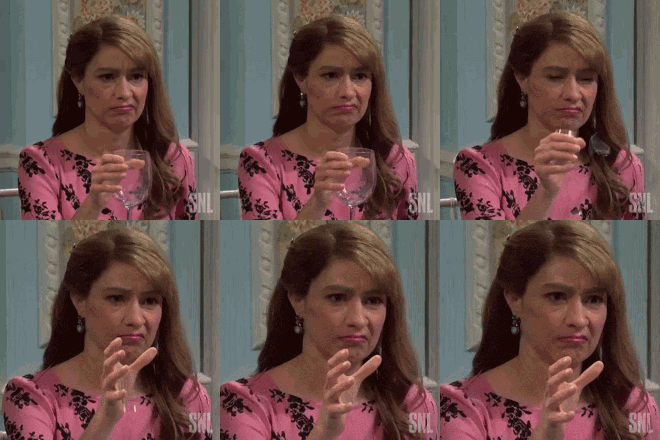
    Gif of Melissa Villaseñor squeezing a wine glass so tightly with rage that it shatters in her bare hand. From an SNL skit. The camera slowly zooms in on her as she wears an expression of anger and disgust.

    Having been to multiple industry events like this, I know that the people who can attend them and shop at them can afford to tip at least 20%. Do fucking better, Fiber Karens.

  • De-influencing you (and me)

    De-influencing you (and me)

    A close up of circular knitting needles with live stitches on the cable. An aluminum can tab is being used as a stitch marker to mark the beginning of the round. The yarn in the foreground is beige and in the background is purple.

    One of the things that made me most uncomfortable about my yarn job was being a salesperson. Sometimes I would be in the middle of talking to a customer – maybe while I was recommending a yarn, or telling a stale joke – I would see myself from the outside and think: “God look how fake I’m being. They can totally tell I’m full of shit.”

    It got very uncomfortable when the items people were interested in buying were out of their price range, because a lot of times I’d agree that something was a little ridiculous to spend money on. Not necessarily the yarn, but notions. Of course, I could never say “yeah, I get it, $17 is a lot to spend on scissors and the pair in my junk drawer at home work just fine for cutting yarn.” Because both of us knew it’s my job to sell things, and that the customer was there to buy things, and at the end of the day I needed the business to make money in order to keep my job.

    I never got sleazy. I never lied about a product being able to do something it couldn’t, or promised that the experience of having it would make someone a better crafter. Once a pair of young sisters, somewhere between 14-18 year olds, came in because they wanted to make one of those mega jumbo blankets that are knit on, like, US 50 needles.

    A blanket knit from extremely thick white yarn spills out of a basket in a sunny room with a wooden floor. Beige-core at its finest.
    You know ’em from being every other pin on Pinterest for years.

    They were asking about using roving to make one of their own. I was completely honest. Roving would have fallen apart immediately, and would have been prohibitively expensive. It was one of the only times I said to someone that Michaels carried a yarn specifically manufactured for this trend and they’d be better off going there. And it’s not like I would have made a sale on roving anyway, because who’s going to shell out upwards of $500 on the amount of roving they’d need.

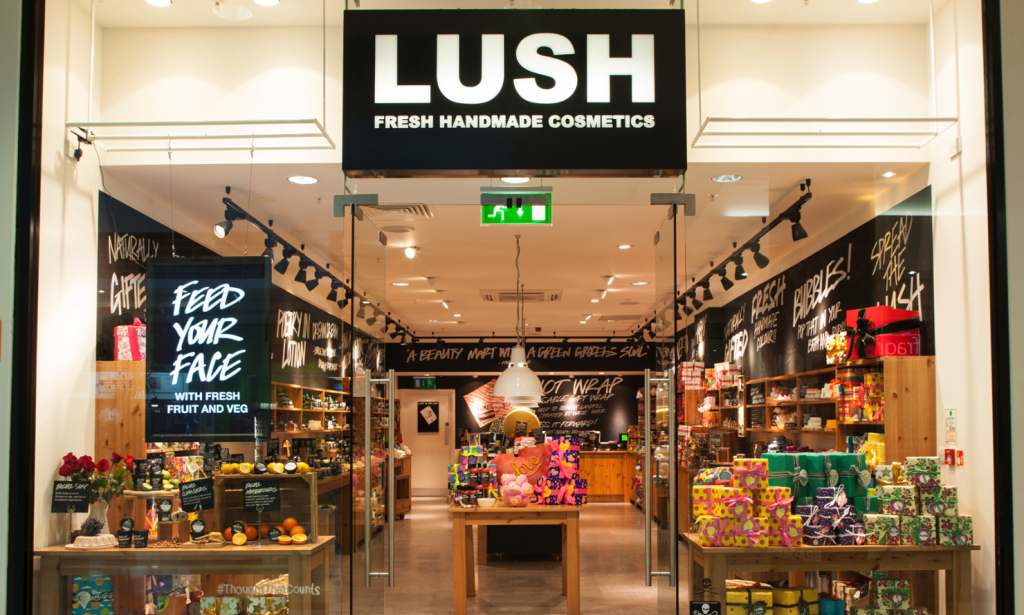
    I also think of my own experiences as a customer. It was hard for me to be an engaging salesperson because I HATE attracting the attention of a salesperson while I’m shopping. The affect of selling repels me, and I assume it’s just as uncomfortable for the salesperson to pretend to be my friend as it is for me. Which is why as much as I like Lush and its products, I dread shopping there.

    A storefront of Lush, which sells skin and hair care products as well as perfumes and bath bombs. The signage is black with white text, the interior is made entirely from wood, and the displays are filled with colorfully wrapped soaps and boxes.
    Inside this store is a 20-something waiting to sell you soap with a CIA-level intensity

    I’m currently job-hunting, and I’m really hoping to not find myself in retail again, even though that’s where my professional skill-set is. With that in mind, I want to use this post to do the opposite of selling you something. Let’s deinfluence.

    Deinfluencing is a reaction to overconsumption. It’s a reaction against “hauls”, unboxing videos, sponsored content, and ads in general. It’s why I always link to the designers whose patterns I use, but never the yarn. I want to give people credit, but I’m not trying to sell you anything. And I’m extremely aware of how expensive yarn can be, because I have spent too much of my own money on it over the years.

    One of the hardest things to explain to non-knitters or crocheters is the amount of brand loyalty people have for certain yarn brands. One of the oldest jokes I would have to pretend to laugh at is that “buying yarn and using it are two separate hobbies.” People buy yarn not just just because they’re excited to use it, but just to have. I’m one of those people, and I’m trying not to be. But then there’s people who buy yarn from a company just because it’s rom that company. They collect yarn from premium brands like each skein is a Berkin. Yarn, in this subculture, has become a status symbol.

    It brings to mind a time I visited a yarn shop in my city, which has been closed for a long time. The location was on the edge of a trendy neighborhood with lots of walking traffic, boutiques and bistros. Across the street from the shop was a housing project. I got talking to the owner about her selection, and she let me know that despite many potential customers from that project wishing they could shop there, they simply couldn’t afford the brands she carried. Instead of listening to them, the owner told me she just couldn’t imagine stocking acrylic. Again, this store is no longer in business, probably because the owner was catering to imaginary big spenders instead of her very real neighbors and their needs.

    The glamorization of name brands, aspiration to buy, the flooding of new products into the market are not unique to the fiber world, but it is as pervasive here as it is anywhere. So here are my alternative, low- or no-cost alternatives that I have personally used.

    Indie dyers and LYSs

    Supporting small independent businesses is wonderful, I’m not arguing that. But again, not everyone can afford the selection at these places. For an alternative, sustainable option, I suggest the growing number of consignment craft stores. SCRAP USA is a nonprofit with multiple locations, for instance, but there are plenty of smaller 501(c)(3)s with the same model. Jess Crafts compiled an extremely thorough list of over 60 locations on her site.

    Notions

    Here are some of the re-used alternatives to new tools that I’ve personally used. They might not be as fancy, or have all the bells and whistles, but they work just as well. You might already have them in your house.

    Project Bags

    • My regular purse
    • Reusable shopping totes
    • Zip-lock plastic bags – if you ever shop online for clothes, chances are you’ve gotten a ton of these.
    • Bedding packaging – new bedsets often come in clear, plastic bags, and they often come with handles!

    Stitch Markers and progress markers

    • Paperclips (classic option)
    • Safety pins (progress marker)
    • Can tabs – I drink a lot of seltzer and boy have these come in handy when I’ve inevitably lost all my stitch markers to my couch cushions.
    • Yarn scraps – just tie off a tiny loop in a contrasting color.

    Stitch Holders

    • Any scrap yarn, string, or thread you have hanging around.

    Pattern Stands

    • A clipboard and a post-it note so you can keep track of what row you’re on.
    • Your computer – I don’t own a printer and very rarely use physical copies of patterns. I usually just scroll so my row is right at the top of the screen. Obviously a computer is expensive, but since I have one for other purposes anyway, it’s what works for me.

    Blocking Boards

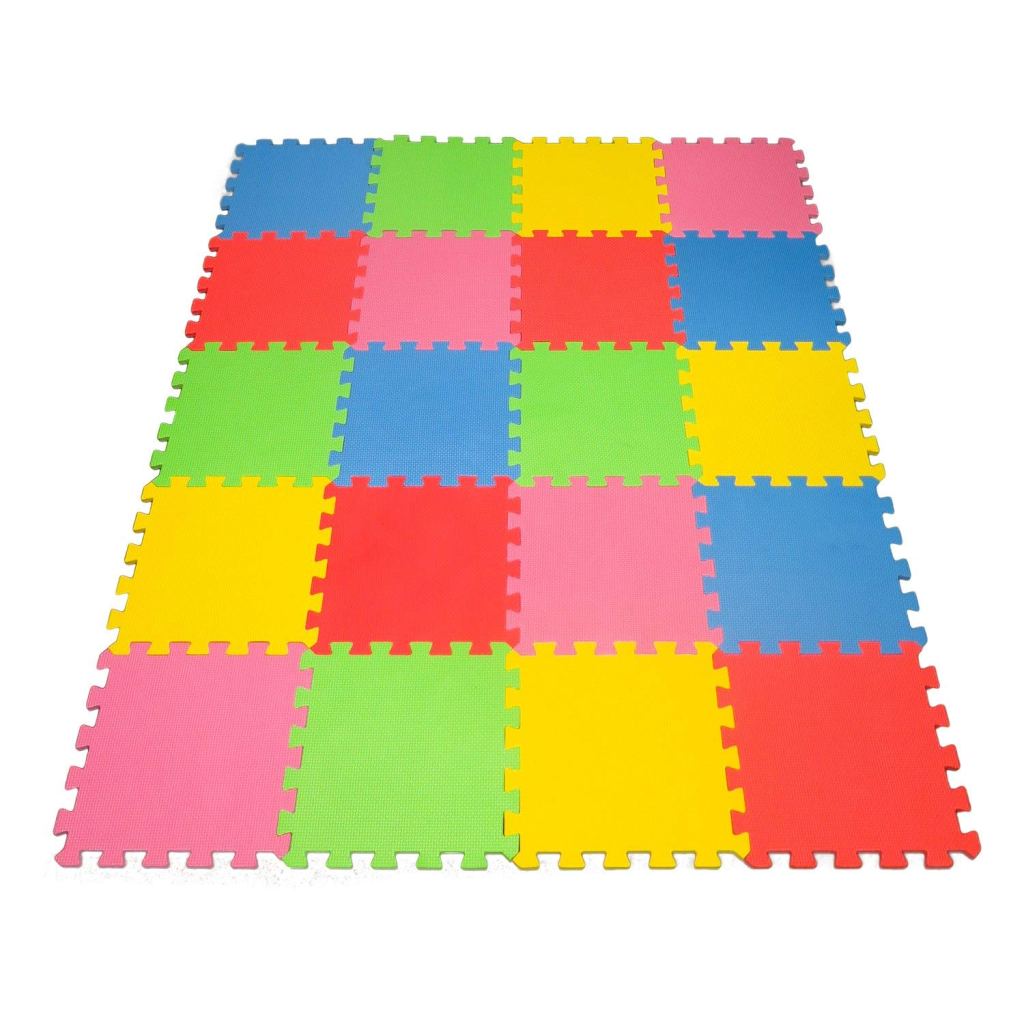
    • Interlocking playmats for kids – they may not be printed with a grid of lines 1″ part, but they do the job and are usually the same size (and a lot cheaper than the ones sold by knitting brands).
    A play mat consisting of 20 foam tiles lies on a white background. The tiles are red, blue, yellow, pink, and green.

    Stitch Stoppers

    • Save your wine corks and stick ’em on!
    • Poster putty

    There’s nothing wrong with buying notions or yarn that you know you’re going to use. As my own stash shows, I’m not one to judge. I love my needle gauge earrings, I have a strong preference for steel needles, and my swift/ball winder combo is pretty sweet. But the fanciness or aesthetics of yarn or notions will not make anyone a better crafter than they are, and that’s the most important thing to remember. And as I look at my own spending habits (especially in my time of voluntary unemployment), I think twice before pressing “checkout”.

    While I’m here, maybe I can influence you about something else.

    This past week Donald Trump made an unconstitutional decision to bomb Iran, threatening millions of innocent people with death and war. If you’ve read this far, I beg you to contact your representatives and ask them to oppose all further military action toward Iran and to stop arms sales to Israel, who instigated this conflict by attacking Iran. We also need to pressure our reps to impeach Trump. Again.

    Our government has been hanging the vague threat of Iran’s development of nuclear weapons for decades, and there’s never been evidence of it. Even if Iran did have nuclear warheads, so does the US, and we’re the only country who has every used one in war. Does that mean it’s justified to invade our country?

    It’s the same excuse we used to invade Iraq in 2002. After hundreds of thousands of Iraqi casualties and over 4,000 American servicepeople killed, we cannot fall for this lie again. I was 9 years old when 9/11 happened. Over the last 24 years, the consolidation of power under the executive office has been allowed to grow and grow, eroding our checks and balances system. Bush, Obama, Trump, and Biden are all guilty of using this power to bomb 8 countries between 2001-2025. I don’t care about governments, but I care about people, and peace should be nonpartisan.

    Find your representatives in the House and Senate here. While you’re there, you may also be interested in asking them to oppose putting 250 million acres of public lands up for sale to private corporations.

  • Craft, Trade, and Labor

    Craft, Trade, and Labor

    Luddites, labor organization, and why you should be able to get yarn and plumbing supplies in the same place.

    With the total closing of Joann stores around the US, there’s been much discussion about where sewists can go to get fabric. Sure, Michaels has just announced that they’ve bought Joann’s brand IPs and are beginning to carry more fabric in stores, and I hope that will help crafters, especially those who don’t live near independent fabric businesses or dislike shopping online for materials. In the big box craft store war, I’m team Michaels, and I believe the only reason to step foot in a Hobby Lobby is if you’re planning to steal.

    A Joann store front.
    RIP girl we’ll miss you

    I have another suggestion: hardware stores should start carrying craft supplies.

    I think it’s a natural progression. I should be able to get every kind of tool for a DIY project at a Lowes. If you’re building furniture, shouldn’t you be able to buy upholstery fabric in one stop? If you’re painting your living room, why not get materials to make your own decorations as well? There’s nothing less cosmetic about picking a lighting fixture as there is in picking hardware for a hand-sewn dress.

    And don’t get me started on the cosplayers. Sewing, hammering armor, shaping foam, 3D-printing, engineering electronics into a mech suit – they would eat this shit up.

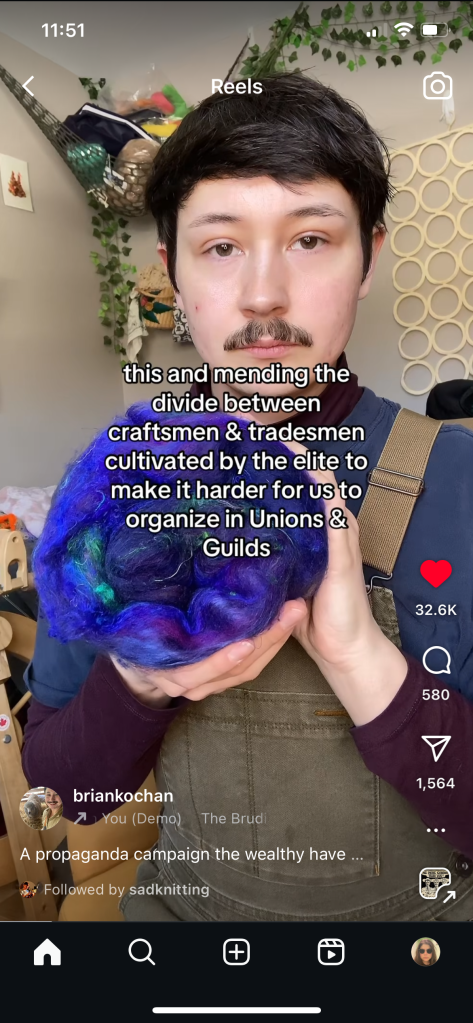
    But most importantly, I’m invested in the idea of dissolving the borders between “trades” and “crafts”. I follow the delightful Brian Kochan, a fiber artist and content creator, and he posted a video recently that really struck me.

    The caption of the video reads “A propaganda campaign the wealthy have been running since the Industrial Revolution…Divides among the working class are not accidental and do not benefit us.”

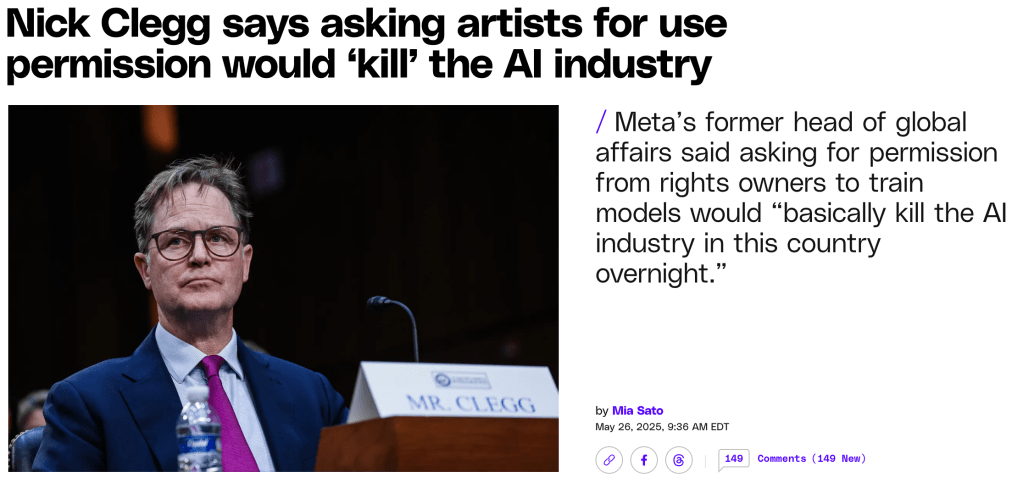
    The Industrial Revolution-era brought machine-made textiles and with it, a class of working people who were losing their livelihoods. This created the Luddite movement, made of anti-mechanization textile workers who would protest their disenfranchisement by destroying textile machinery. The Luddites were named for Ned Ludd, who is mythologized as having lost his job as a textile apprentice, was whipped for being a “vagrant”, and then took a hammer to a mechanized loom (McGaughey, 2018). Even if it is a myth, a man who was replaced by machines and then punished for having been replaced by machines is a powerful symbol of the movement, and still feels relevant 250 years later as corporations promise that generative AI is the answer to everything.

    A screenshot of an article whose headline reads "Nick Clegg says asking artists for use permission would 'kill' the AI industry" and the subtitle reads "Meta's former head of global affairs said asking for permission from rights owners to train models would 'basically kill the AI industry in this country overnight.'" The article is by Mia Sato, and is accompanied by a photo of Clegg, a white man with graying hair, wearing glasses and a suit and tie. He is sitting behind a podium with a microphone, and was probably photographed at an event for his book release.
    Get fucked, Clegg

    In school, I was usually taught that the Industrial Revolution was a universally good thing. It did have benefits, namely, fomenting a working class consciousness that give us many rights that we enjoy today like weekends, work breaks, 8-hour shifts, overtime pay, labor unions, OSHA, and child labor laws. Of course, these things only came after incredible tragedy and deadly working class struggle (The Battle of Blair Mountain, The Haymarket Riot and ensuing unjust executions, and many other protests that drew brutal policing and state military interventions). The rights most Americans enjoy now are the work of the people in labor unions, Marxists, anarchists, and undercover muck-raking journalists – not a direct result of the Industrial Revolution itself.

    Another promise of the Industrial Revolution was cheap goods. Items previously only accessible by the wealthy could now be mass-produced and sold at lower prices. Isn’t that nice? The poors can have things too. But as the Luddites had the skills to make the same things at home (and at better quality) that steam-powered machines were now being used to fabricate, had they really gained anything?

    This is the trick: We have to recognize when new technologies are being used to disenfranchise us and then sell us worse versions of our own productivity. And we have to consider what share of resources these new technologies require. If the machinery demands more raw material – let’s say, thread and yarn – because it can create products faster and those products break down faster because they’re worse quality, it becomes more difficult and more expensive for a craftsperson to obtain those same materials. It becomes more difficult and expensive for that craftsperson to even maintain their craft.

    The most obvious contemporary example is fast-fashion grindmills like Shein. The promise of looking cool for cheap, constantly being on trend without breaking the bank, has been advertised as a solution for those who can’t afford quality or designer names. But these clothing items are still handmade by craftspeople. If you have one person sitting at a sewing machine in their craft room or at their dining room table, who has bought fabric and a pattern from a boutique shop, making clothes for themselves or their kids, and another person (most likely a woman) sitting behind a sewing machine in a factory where their working hours, air quality, safety, and pay is totally at the mercy of their bosses and the insatiable demand of the customer – what really is the difference between them? That person in the factory is not less skilled, less creative; they’re using the same equipment as the sewist who would call themselves an artisan or a maker. But while the US attempts to celebrate itself for workers’ rights, its companies have simply moved production to countries whose imperialism-created poverty and unstable governments promises them cheap labor and a higher profit margin. Those companies have not been forced to become more ethical or compassionate following the labor movements in the US, they’ve simply moved their Industrial Revolution-era exploitation to places we don’t care to think about.

    So when the Trump administration tries to promise the return of factory jobs and manufacturing to the US by levying tariffs, don’t think for a second that those jobs will be well-paid, union, safe, or equitable across race and gender. Hand-in-hand with Republican economics is the philosophy of deregulation, and they would have us working 16-hour days 7 days a week if they could. Nothing trickles down except for their bullshit.

    Listen, I’m no working class hero. I went to private school, I have two degrees, both of my parents worked at high schools and colleges my entire life. But as I think of how to relearn crafting as labor, I look to trade unions for inspiration. Welding, carpentry, electrical engineering, plumbing – these are occupations whose practitioners have long protected themselves through unionization, and are unlikely to be replaced by automation (it’s hard to imagine inviting a robot into your home to fix or clog or painstakingly bring your wiring up to code). These are people from a legacy of hard-won battles over workers’ rights, but what has protected these while textile workers still face major exploitation and danger?

    Again, I believe gender has a lot to do with it. Trades are still largely male-dominated, fomenting a culture hostile to non-men (Bridges et al., 2020). But then women are also challenged to find dignity and liberation in female-dominated labor sectors that were once at the heart of the labor movement. On top of the retaliation owners and management tend to take against striking and organizing workers, female workers are at much higher risk for gender-based violence, sexual assault, and sexual harassment, and firing a person once they become pregnant is commonplace (Robertson, 2024), leaving parents without income to support their kids and creating generational poverty. The different ways women are discriminated against makes the stakes much higher, and they can be potentially traumatized in more varied ways than their male counterparts. This is a global issue, happening here and America and the countries with even less labor regulation – countries we allow companies to operate in so they can squeeze out larger profits. And much of it, culturally, is because we don’t find “women’s work” as valuable as men’s.

    I know that much of the language I’m using about gender is very binary. It’s difficult to include the labor experiences of non-binary people when labor is so separated along a binary, and that binary makes it easier to privilege the labor of one gender over all others. As women can often face gendered and sexual violence from men, TLGBQ+ workers are deal with queerphobia on top of other intersecting identities that are often discriminated against.

    That’s not to say the cultures of trades isn’t changing. The IWW has a page outlining its inclusion policies. According to data recorded in 2021, more women than ever were working in the trades. While one survey by the UK Construction Industry Council showed that 1% of workers identified as gay, lesbian, or bisexual, this survey did not seem to include verbiage about trans or nonbinary people. I also couldn’t find comparative data on LGBTQ+ people in the trades that showed an increase or decrease over time.

    Unfortunately, cruelly, disgustingly, though, this progress is being undone by the current administration. As they seek to demonize DEI policies, gut Medicare that allows people to get affordable health care, and actively abduct workers off the street, they attempt to erode our solidarity with one another.

    To the last point, ICE is a threat to everyone, undocumented or otherwise, in the US. They’ve detained US citizens without cause, arrested people who were complying with ADP (alternative detention programs), and arrested people whose visas were cancelled with no warning. Mohsan Mohdawi was arrested at his citizenship interview. ICE does this without identification, while masking their faces so that they can’t be identified and held accountable. They don’t care if a person is attempting to become a citizen “the right way”, a phrase I hear so often from people trying to qualify their fear of immigrants to only the “illegal” kind. This is race-based, state-sponsored terrorism, and it’s not new. Our governments have always deployed military-level policing to shut down progressive movements, from the early days of industry to now.

    So as I write to you, fellow crafters, sewers, knitters, crocheters, weavers, I beg you to activate in favor of working people. As you engage with the hobby you love, remember the workers forced to use their crafting skills in dangerous factories for pennies. Support unions, and support the power they gain through diversity. Protect your neighbors, whoever they are, because they are not your enemy.

    With LA under siege and many more cities likely to start protesting against ICE, I have to speak on this because it’s a matter of urgency. I highly recommend the Freedom for Immigrants organization and the National Immigration Law Center for more information, as they operate nationally and I don’t know where you could be reading from.

    Stay safe, stay crafty, and know your rights.

  • Craft, Art, and Gender

    What does my knitting have to do with my gender? More than I’d like. Less than you’d think.

    I sometimes wonder what people assume about me when I knit in public. I wonder, and worry, if it’s assumed that I’m invested in the sort of traditional femininity that knitting seems to represent. I’ve discussed this a little in a previous post – do these so-called “alpha” manosphere assholes see knitting as a sign of the kind of woman they believe we should all be.

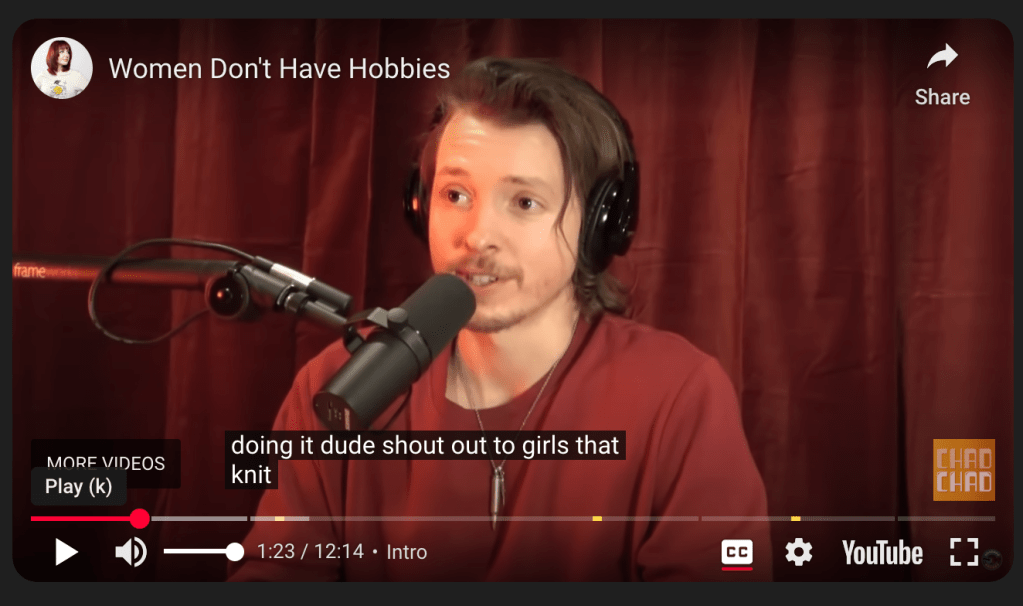
    A screen shot of a Youtube video. The frame is of a man in a red shirt against a red curtain background talking into a podcast microphone. The closed caption reads "dude, shout out to girls that knit"
    A clip from a manosphere Youtube channel where two men wonder if women actually have hobbies, and decide that knitting is an acceptable hobby for a woman to have because it’s “nurturing” and feminine. Don’t worry, I didn’t go to their actual YT channel to get this screenshot because I would never give them the views to poison my algorithm. Thanks to Chad Chad for taking that one for the team.

    I don’t knit because I’m a woman. I don’t knit in a feminine way. I also don’t knit in a feminist, reclaiming-the-power-of-the-craft way. I knit and crochet because I like it (and probably because I’m stimming, but that’s another blog post). I look at pretty much anything I do and wonder how much of it has to do with me being a woman.

    I feel best about myself when I feel feminine, but I recently realized that what I have been conditioned to understand as feminine is also what I have been conditioned to understand as beautiful. And chat, I do not feel beautiful. I also don’t feel nurturing, or supportive, or emotionally intelligent. I’m not motherly. I’ve never found traditional fulfillment in these traits or any power.

    So when we think of knitting and crochet, or any fiber craft, as a feminine activity, I question if my aversion to that is personal or if there really is a larger societal misattribution happening.

    Earlier this month I read an article in Art News about the burgeoning presence of fiber in the arts scene this year. “Fiber Art Has Officially Taken Over New York’s Museums and Galleries” by Alex Greenberger covers multiple exhibits, features, and retrospectives of fiber as painting and sculpture, at commercial galleries and museums like the MOMA.

    Almost all the artists mentioned and profiled in the article, as might be expected, are women. Greenberger credits the phenomenon of fiber-centered exhibits to a cultural correction of misogynist exclusion:

    Why so much fiber all of a sudden? The simple answer has to do with the changing face of recent art history. Weavings, embroideries, and the like have long been awarded an asterisk in the canon—if they’ve been accepted into the canon at all. Typically, art in those mediums has been classed separately as craft in the West or denigrated as “women’s work.” Thanks to the work of dedicated scholars, curators, and critics, fiber art has finally come in for reassessment.

    I wrote briefly in my post about chromatic politics about the shoehorning of women artists in the Bauhaus school to textile-based art forms. And how while fiber arts and decorative arts are often relegated to the superficial, their influence on the so-called “fine arts” is hard to ignore, like that of the mostly-female weavers of the Aymara on the aesthetics of architect Freddie Mamani.

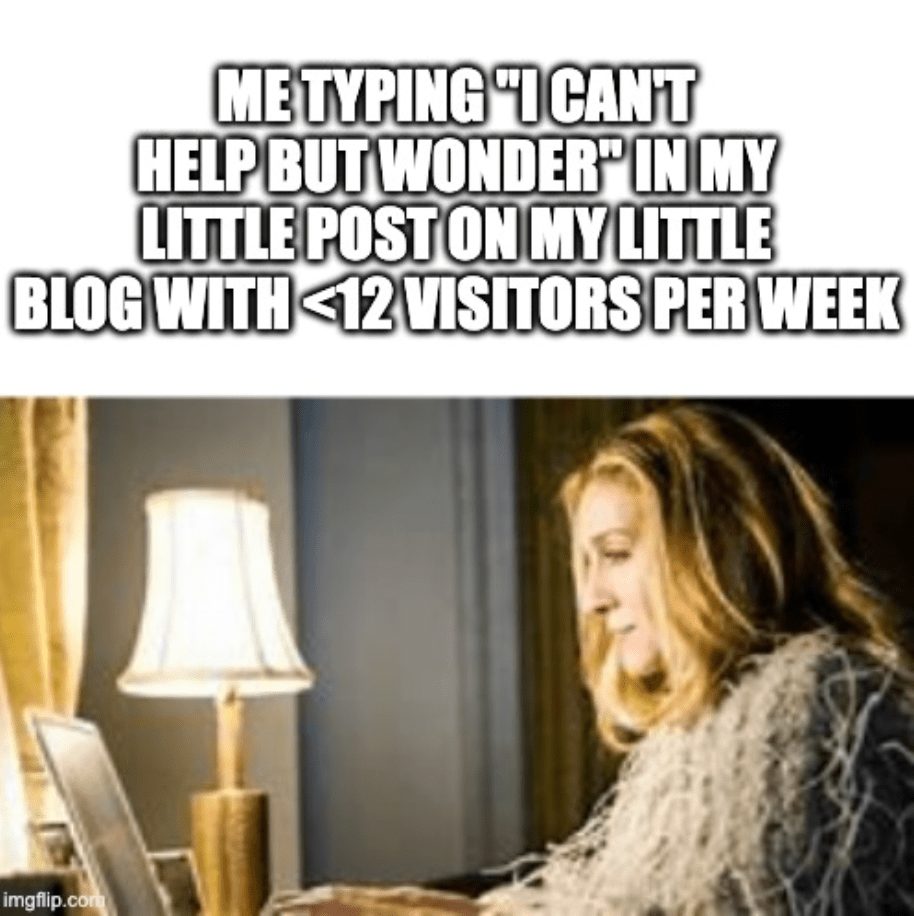
    I don’t disagree with Greenberger’s theory of the gender pendulum swinging back in the direction of equity, and that the fiber art rage has been part of that. The way that the binary genders – men and women – have been separated and tiered has a lot to do with the way “art” and “craft” has been separated and tiered, which has given men a lot of fame and status and women a lot of obscurity. But I can’t help but wonder (!) what a gender utopia, a world where misogyny and queerphobia don’t exist, looks like.

    I have a list of evolving, circular desires for gender and art – a gender ouroboros maybe.

    • I want to see women included in “fine art” – painting, sculpture, architecture, etc. because women are capable of doing whatever they pursue.
    • I love seeing “craft” and the women artists who practice it included in the genres of fine art, because craft requires the same level of technique and intellect that the traditional “fine arts” require. It’s important to me that the disciplines and materials we associate with fine art gets expanded in order to perforate the gender separation that’s been engineered in the art world.
    • I don’t want to see fiber “craft” forever associated with women because not that all fiber artists are women and not all women are naturally fiber artists, and to believe so is gender essentialist in a way that gives me hives.
    • To call craft “women’s work” at all is colonial. Craft exists across the globe, in virtually every culture, and not all cultures divide labor along the same gender lines. For instance, textile crafters in West Africa were often men (Osborne, 2024), but during the trans-Atlantic slave trade, the white slave-owning class demanded that enslaved women perform it because it was more in line with the white/European division of labor by gender (Golden, 2023).
    • Not everyone lived by a gender binary like Christian Europeans did. Numerous cultures around the world recognize more than two genders, and the various nonbinary genders in those cultures also fulfilled traditional roles. Nonbinary people have also existed in binary gender cultures forever without being recognized. To only be talking about the elevation of women’s art erases the many trans nonbinary identities that are currently under attack, even by people claiming to be feminist*.
    • Even as objects previously tiered as “craft” are elevated to “art”, and artists working with materials often thought of as “craft supplies” instead of “artist materials”, are being curated for the fine arts scenes, will women and nonbinary artists be fairly represented alongside male artists without their gender or cultural background novelized alongside the medium?

    *If your brand of feminism aligns with Republican/right-wing politics or if you find that Nazis are agreeing with you, then you’re not a fucking feminist.

    To the last point, Greenberger makes a poignant criticism of the Woven Histories exhibit at the MOMA:

    The exhibition is unclear about the ties that bind many of its artists: what, for example, links an abstract painting from the ’70s by Jack Whitten and a raffia net from the ’60s by Ed Rossbach?…The exhibition also stumbles when presenting artists awaiting canonization such as Yvonne Koolmatrie, a Ngarrindjeri weaver who makes sinuous sculptures from sedge, a type of grass. These works are…lumped together with baskets by Indigenous artists, an awkward, reductive gesture that makes them feel like an afterthought.

    Here, Koolmatrie’s artistry is hitched to that of other indigenous artists with, as Greenberger suggests, no real curation as to why. Is it enough to say that “we all weave”, or does this decontextualize the places and cultures these individual artists come from? The importance of cultural specificity to art and craft cannot be overstated, and it is frequently missing from a lot of discourse about art and gender that I’ve seen and read. Race and gender are linked in systems of oppression, so they have to be discussed together in cultural criticism. After all, the Western/European art institutions that have displayed stolen precolonial indigenous art have historically not challenged the binary thinking of gender by acknowledging nonbinary artists.

    I grew up near the Baltimore Museum of Art, and even as a child I could understand the way most of the exhibits were organized. These rooms, the impressionists. Over here, the impressive collection of Matisses. In this stark white and angular wing, the contemporary exhibit. And over here… “African Art.” All the art the museum had from across the continent, from across centuries, in cramped glass display cases instead of mounted on walls or installed like the European and American paintings and sculptures. Looking back on it now, this exhibit was distinctly anthropological, archeological, in nature. These were not meant to be considered cerebrally like the Monets and Warhols. I wasn’t meant to think about the objects’ makers as individuals. It was just a room full of things with a single tenuous connection between them: the 11.7 million square mile continent of origin.

    Decades later, the BMA has gone through a total overhaul. That vague exhibit no longer exists. The new curators have gone full force into featuring living artists whose works they can fully contextualize. They’ve sold a number of extremely famous works (to the rage of many white patrons) to fund the acquisition of art by Black, indigenous, and queer artists. Last year, they installed “Walk a Mile in My Dreams” an exhibit dedicated to the work of Joyce J. Scott, a Baltimore artist who works in a plethora of different mediums and techniques, including fiber, weaving, and crochet. Scott’s work explores race, sexuality, violence, and natural destruction, and she’s as influenced by the cultures and artistic techniques of the many places she’s traveled as she is by her own family’s long history of making.

    I haven’t visited the Woven Histories exhibit myself, so I can’t speak personally to the level of explanation provided by the curator as to the connection between the different works, but it sounds like more specific context is needed to draw these connections. Maybe it takes an artist-specific installation, like “Walk a Mile in My Dreams”, to fully do justice to any artist.

    I have been thinking about my relationship to my gender for my entire life, and Greenberger’s article gave me a great vehicle to talk about it in relationship to the fiber crafts that have become such a big part of my day-to-day life (and my livelihood, at one point). This hobby, once necessary labor in a preindustrial age, taken for granted as “women’s work”; this women’s work that my own 94-year-old meat-and-potatoes mans’ man Navy veteran grandfather was taught as a boy; this women’s work that I have seen loved by cis men, gay and straight; this women’s work that I have seen relished by trans and non-binary people at fiber festivals.

    Even though us cis women are overrepresented in fiber arts, they don’t belong to us, and that makes me feel free. It’s not enough that I should feel empowered by the things that make me “feminine” – I want a femininity that demands nothing of me. The gender utopia I hope for is a decolonized one, a non-binary one. One where every singular person is recognized for their skills and artistry no matter their identity, without it having to reflect on anyone else.

  • WIP Wednesday: Knitting the Pivoine Cardigan

    WIP Wednesday: Knitting the Pivoine Cardigan

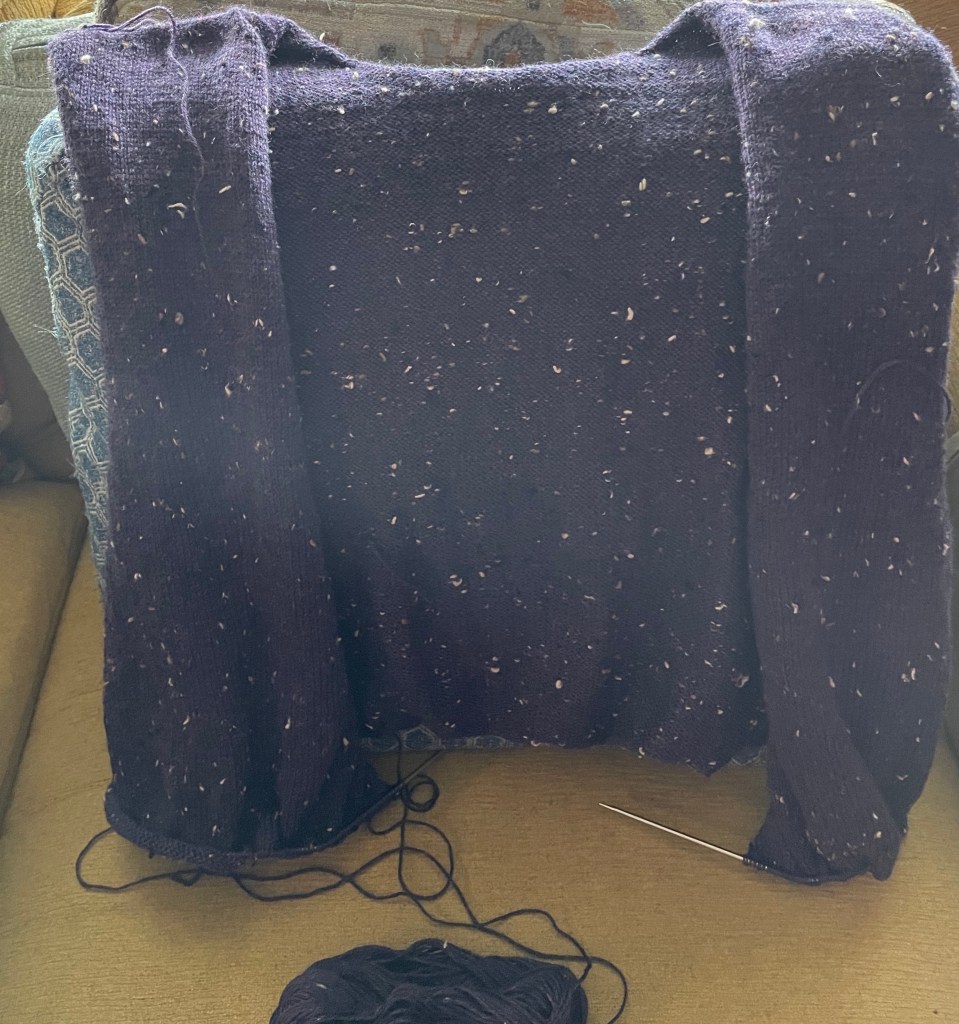
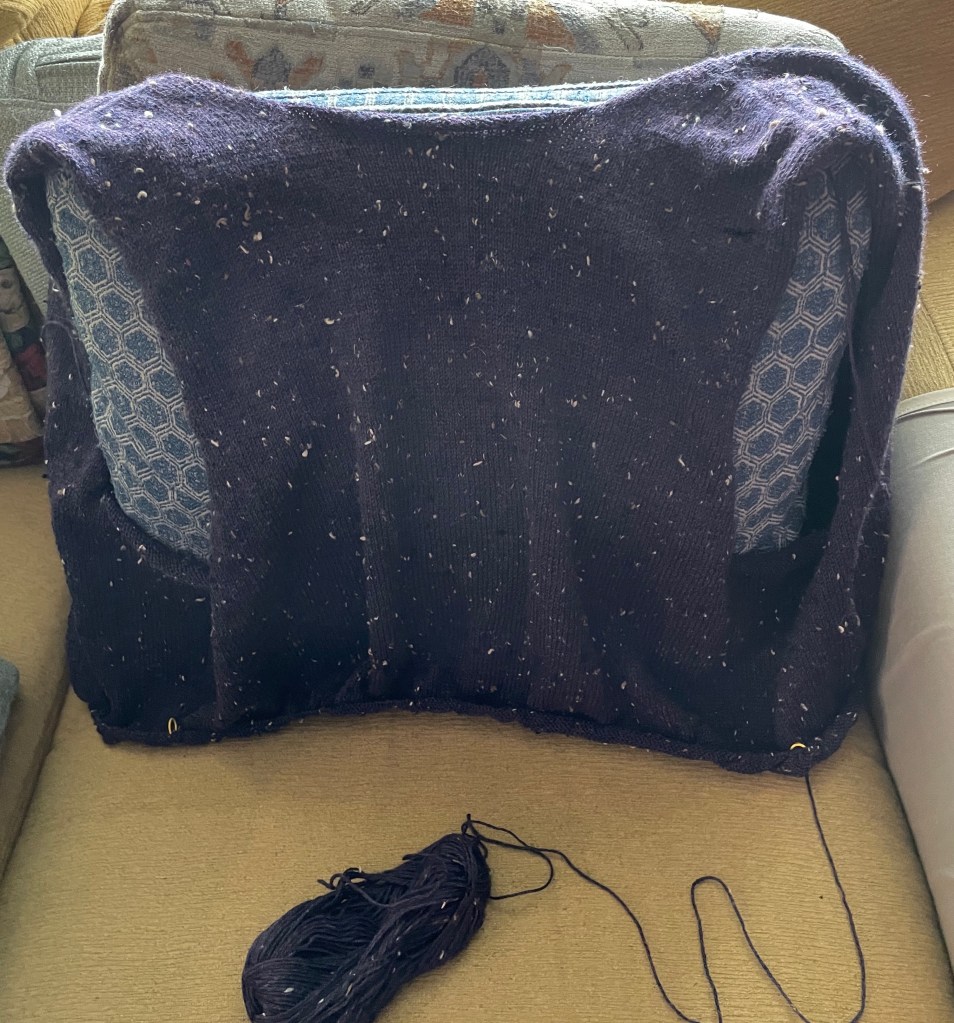
    It’s WIP Wednesday and this week’s theme for #showmeyourknits is cardigans! Fortunately my wip this week is the Pivoine Cardigan by Audrey Borrego, a drop-shoulder cardi with lovely lace detailing at the bottom of the torso.

    Borrego recently stepped away from the knitwear design game a few months ago, and very generously made all her patterns free on Ravelry. When I checked Ravelry that day and saw that she was all over the first three pages of the Hot Right Now feed, I had the same thought as some other folks: “Holy shit, did something happen to her?” Nope! Just a voluntary change in life direction. Hero portfolio of 100+ patterns is an amazing gift from a very prolific designer, and I hope she’s having a wonderful time in the next chapter of her life.

    I’m using Knit Picks Stroll Tweed, which I picked up a few years ago during a Halloween sale (they discounted all their black, orange, green, and purple yarn). The pattern calls for sport-weight, but considering the suggested needle size for the body is US 3, a fingering like this is working nicely as a substitute. I’m knitting size 7, and the depth of the armholes is perfect – I really like wearing big t-shirts, and there’s plenty of room for my tee sleeves to fit without weird bunching at the shoulders.

    I also plan to add significant length to the body so it covers my butt, and now that I’ve passed my natural waist I’m adding increases to accommodate my hips circumference. I’m adding increases at the same rate as the pattern calls for decreases in the sleeve, and I’ll just have to make sure I stop when my stitch count reaches the correct multiple for the lace pattern.

    There’s a possibility I’ll run out of the yarn before I get to the sleeves, but honestly, I’m hoping that will be the case. I have plenty of other fingering-weight skeins in my stash that need to be used, and I think contrast sleeves would be very striking for this project. The stash bust continues!

    And now, a lightly cuss-seasoned rant about generative AI

    While on Ravelry this week I came across a “design” whose picture was clearly generative AI and reported it. As far as I can tell, it’s been taken down. I figured Ravelry wouldn’t be AI-friendly (I was not the only person to report the page) but it would be great if the mods could make a policy statement about AI use, if only to encourage its users to take a broader critical stance against generative AI.

    Obviously AI in knitting patterns is a problem. If the “designer” can’t even produce a finished object from their own written pattern, they’re clearly a scammer and unable to write a pattern to begin with. There’s no reason to trust that the pattern will be any more real than the generated image they’re using to advertise. But generative AI is a much larger problem that has infiltrated pretty much everything we interact with on a daily basis. I believe it poses extremely bleak outcomes for creativity and critical thinking.

    Before I go off I want to point out that I’m not immune to the draw of AI and how it can be used. When I was studying creative writing, I wrote an experimental poem using the predictive text AI on my phone. I presented it to my workshop, completely transparent that I had used predictive text, because I was intrigued that the data my phone had stored about my typing history created a digital mirror of my personality. I called it “Runecasting with Predictive Text”. This was back in 2017, when generative AI was still producing eye-burning fractal nonsense images that could never be confused with a photograph or human-made artwork. Now I look back at that little experiment and shudder. I want to share my shame with you.

    Generative AI is way more refined now. It’s replacing human labor, especially creative jobs like writing, art, and design. It’s widely used in political campaigns to smear opponents and create propaganda. It’s even being used to write public policy that we’re all supposed to live under. NYC Mayoral Candidate and sexual predator Andrew Cuomo faced criticism for using ChatGPt to write parts of his campaign’s housing policy. And yet our social media networks, job hunting sites, even this blogging platform I use proudly advertise how they’re “harnessing the exciting potential of AI” or some such bullshit to appear cutting edge to its users. The little sparkly AI icon is menacingly ubiquitous.

    Left: WordPress invites me to generate an image with AI instead of using this screenshot. Right: The aforementioned sparkle icon.

    AI provides no new information to us. It plagiarizes artists and writers. It only reflects, and all it reflects is existing human thought, including our worst prejudices and bigotries; it just delivers them back to us faster. And if it’s used by elected officials that are too fucking smooth-brained and lazy to come up with new ideas or to think critically, then I don’t want to live here anymore. And we probably won’t live here for long anyway, because generative AI is pumping massive amounts of CO2 into the atmosphere and sucking up our water supply.

    Last, I want to address the argument that generative AI helps people be creative. Nothing could be less true. Artists love the process. They love practice. That’s why great masters’ sketches are valued by art collectors and museums, not just their finished works. That’s why there are so many musical compositions called “etudes” (studies). It’s why dancers and athletes and musicians and anyone who uses their body to do anything has to spend so much time conditioning their muscles and joints for performance. If you have an idea for an image and want it to exist, and you use AI to make it exist immediately, then that isn’t artistry – it’s spectatorship.

    There’s nothing wrong with being a spectator. But the ethical thing to do is hire an artist. Support artists and writers who are using their brains and bodies, who are making truly creative and critical decisions about art. Or do it yourself! Actually do it yourself. Accept that your first try at a creative endeavor might be messy, poorly executed, or embarrassing. No one needs to be perfect. We just need each other to try.

    If you’re newer to the concept of generative AI or just want some help spotting it, here are things I look out for.

    In images

    • Look at any letters, fingers, or (in the case of knitting and crochet patterns) stitches. AI has a harder time generating fine details like these; words will often be illegible, hands will have too many/too few fingers, and stitches will not make any physical sense.
    • The depth of focus is really shallow. Gen AI will often blur backgrounds and even the edges of a subject to reduce the amount of detail it has to create.
    • Everything is oddly smooth. If the image looks like it’s lacking texture and human figures look like they have silicone for skin, it might be AI.

    In videos – many of the above red flags apply

    • Multiple people seem to have the same face or look extremely similar.
    • People moving toward the “camera” do not appear to be getting any closer.
    • A person’s face is moving but their body is not, or the head and body are moving out of sync with each other.
    • A celebrity starts talking like they’re an SEO-optimized ad – they start talking using words like “viral”, “Hollywood”, “diet” in relation to a specific product. It’s likely a deepfake using actual footage of the celebrity with a generated voiceover. Obviously anybody could actually be saying these words, but if it’s in relation to a weight loss plan or beauty product, exercise caution.

    In writing

    • The author’s portrait appears AI-generated. Unfortunately publications are faking writers along with plagiarized writing.
    • The same ideas are repeated in re-worded phrases or sentences.
    • The sentence structure is repetitive.
    • There are a lot of words over-used by AI; this Reddit thread has a good compilation of examples.
    • The website or publisher has recently laid off large portions of its staff; it’s likely they’ll rely more on AI now that they’ve cut their human workforce.

    I think that’s all for this week. Until the next WIP Wednesday, my dudes, and watch out for that AI slop!

    A gif of a person with a mustache and shoulder-length hair, wearing swimming goggles and a Spiderman costume. In the first frame the caption reads "It is Wednesday, my dudes." In the second frame the person stands in a doorway and screams, the caption reading "AAAAAAAAAAAAAAAAA"
  • FO Friday: The Junco Sweater

    FO Friday: The Junco Sweater

    I’ve talked about my appreciation for Junction Fiber Mill on here before, and specifically their colorway “Constellation”. I picked up a sweater quantity with no plan during the Maryland Sheep & Wool Festival in 2024, but when I returned to their booth last weekend I was proud to show them what I had made with it: Andrea Gaughan’s Junco Sweater.

    I was first turned onto Andrea Gaughan from knitwear designer Ellen Coy of Knithow, who is a knit-fit expert and part of a network of designers committed to size and shape-inclusivity. While I was going through Andrea’s portfolio, Junco’s diamond mosaic motif popped out to me immediately. Particularly because the sample in her pattern photos was in black and white natural wool, I was reminded of harlequins.

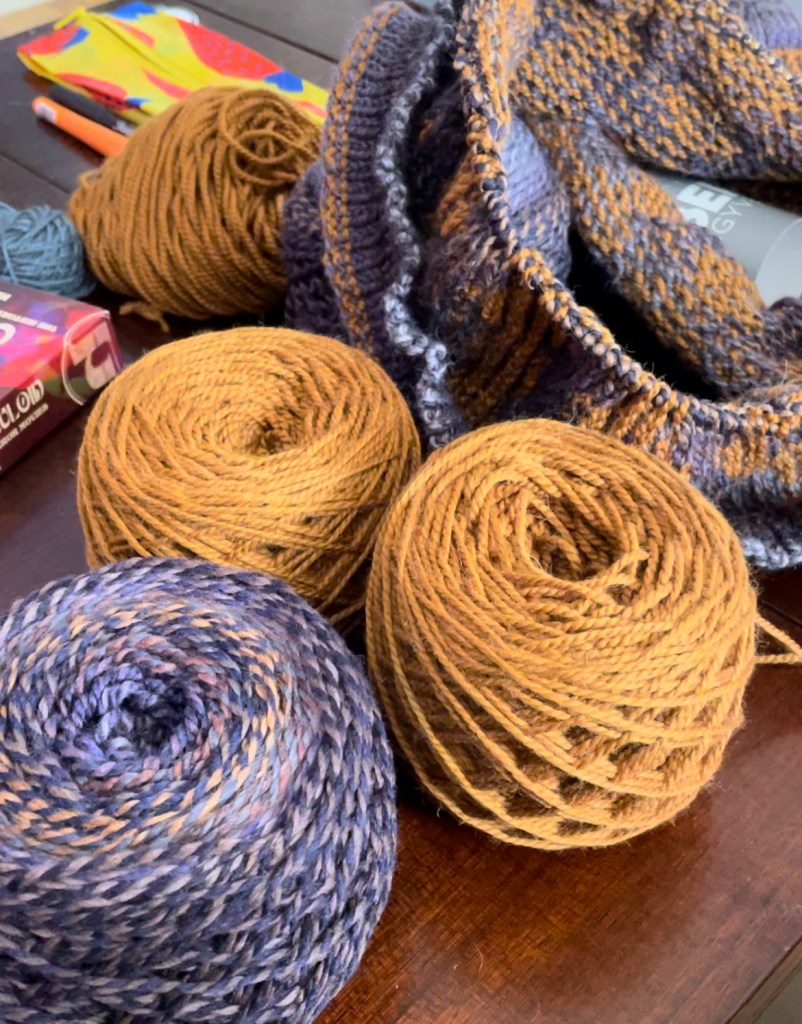
    As striking as the monochrome was, I knew my DK-weight from Junction Fiber was perfect for this project. While mostly purple and gray, “Constellation” has some splashes of ochre and orange, so I wanted to find a rich, warm earth tone to pair with it. I found that at Rhinebeck later in the year from Fiber MacGyver, who was a new vendor at the 2024 festival; their color “Roasted Pecan” was a great complement.

    Some wound up cakes of “Constellation” and “Roasted Pecan” sit next to my work-in-progress on Junco

    I also adore mosaic knitting; while I want to improve my skill at stranded colorwork, it’s just so nice (and gentler on my knuckles) to only be managing one yarn at a time. Mosaic knitting shows off fractal-spun yarns like Making Tracks so well, and there’s a pixelated, 8-bit charm to the motifs this style creates; I appreciate the juxtaposition between my digital association with mosaic knitting and the millenia-old tile art that it’s named for.

    For this project I sized up because I wanted this sweater to be roomy. As I have a 48″ bust circumference, this meant a big investment in the amount of yarn I was using and the time it would take. I also knew I wanted to add length to the body so the sweater would at least hit my hips. This bottom-up design uses an tubular long-tail cast-on for the hem and sleeves, and unfortunately my tension for this part was kind of loose, resulting in a flared silhouette. Instead of redoing it all, I sewed some elastic thread into the wrong side of the hem and sleeve cuffs, which both neatened up my ribbing and provided a stretchy edge, so I can it wear down at my hips or tuck it up under itself at my waist for a cropped look.

    I’ve knit bottom-up patterns before, but this was the first raglan I knit bottom-up instead of top-down. At first I wondered what the benefit was, but I have to say it was nice getting the sleeves done before the yoke. It really felt like I was approaching a finish line when I was casting off the collar, with the rounds getting shorter and shorter as I went.

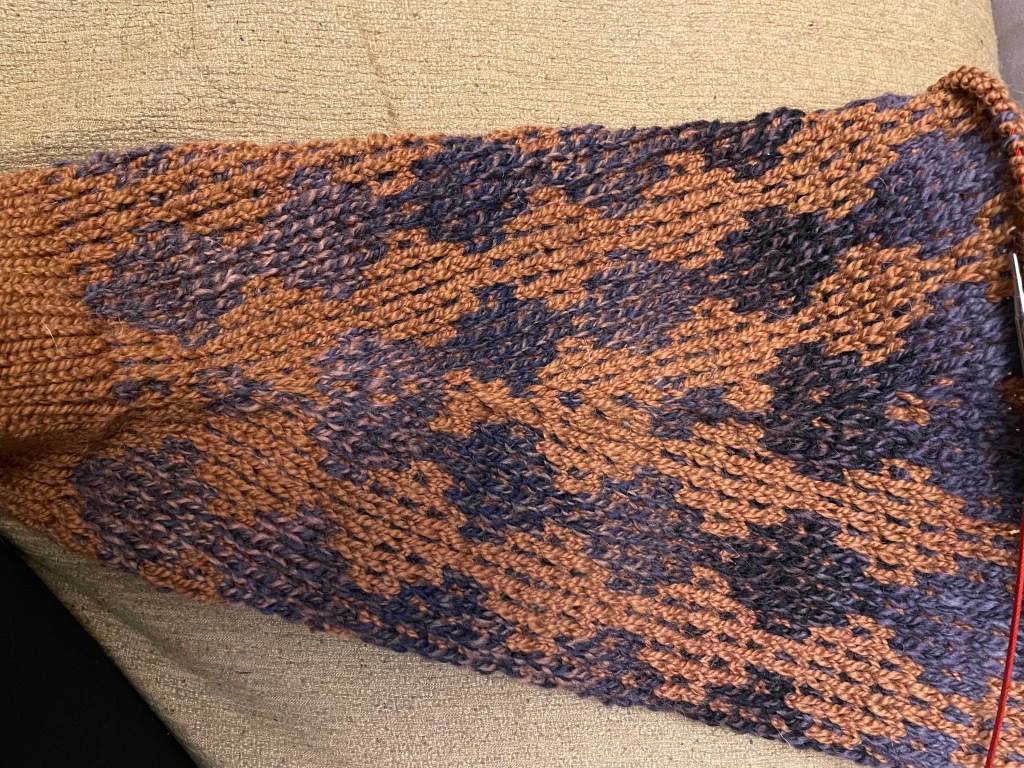
    A photo of an unfinished knitted sweater sleeve made with multicolor purple yarn and brown yarn. The pattern is a diamond motif, and as the sleeve increases in size, more diamonds are added and appear to "burst" from the origin point where the increases occur in a symmetrical pattern.
    A close-up of the sleeve in progress. I think the increases look particularly cool.

    From cast-on to blocking, Junco took me about 6 weeks to finish. The way the motif creeps from the increases of the sleeves and disappears again into the raglan decreases in the shoulders is psychedelically eye-catching, as is the shifting of colors in the yarn. I really couldn’t be happier, and I think it’s one of the projects I’m most proud of.

    Apologies for the awkward/poorly-lit photos. My partner usually photographs my modeled pics and he’s out of town, so I had to take selfies.

    Yarn

    • Junction Fiber Mill, Making Tracks in “Constellation” (MC); I used the leftover yarn in my Bookkeeper Cardigan
    • Fiber MacGyver, Merino Alpaca in “Roasted Pecan” (CC)

    Mods

    • Added 3 repetitions of the chart to the body
    • Sewed elastic thread into the hem and sleeve cuffs for fit and stretch
    • Did a flat collar instead of a folded collar

    What I’m Watching

    *CW: I discuss medical procedural shows in this section, and they deal with plotlines involving overdose and addiction, suicide, gun violence, and transphobia.

    I binged The Pitt in a day and loved it. The performances from the entire ensemble were outstanding, and I’m not surprised Noah Lyle is getting Emmy buzz. Because the season takes place over the course of a single ER shift, there’s an equally compelling supporting cast of patients and visitors who enter the ER, leave, move to other hospital wings, or tragically pass.

    Once I finished the season I caught the bug for medical procedural. My family used to watch House every week while it was airing so in addition to the exciting tension of a medical mystery, this genre is also pretty nostaligiac for me. So I started ER, which also stars Noah Wyle, de-aged from traumatized ER chief to wide-eyed intern.

    Watching the two shows back-to-back is an interesting way to compare the cultural attitudes and anxieties of today versus 30 years ago. In ER‘s first season, the writers include with gang-related gun violence perpetuated by teenagers and younger, patients with AIDs and HIV, and crack cocaine addiction. The Pitt handles a mass shooting, the fallout of Covid-19 and the collective trauma of healthcare workers, and accidental opioid overdose. ER has a recurring beat cop who flirts with one of the nurses and endearingly rushes a dog he accidentally hit with his cruiser to the OR, adopting the saved dog afterward; in The Pitt, a positive relationship with police is never guaranteed – some are helpful, some are patients, some are active obstacles to the doctors’ jobs. The Pitt portrays anti-maskers and anti-vaxxers with no patience for their nonsense, and explores a vignette of an aunt trying to secure an abortion for her niece before being interrupted by the pro-life mother; we watch the doctors perforate contemporary abortion restrictions and try to honor the pregnant patient’s choice to terminate while contending with the guardianship of her mom.

    One of the hardest ER storylines to watch was that of a transgender woman being treated for injuries following a car crash, which is later revealed to be a suicide attempt. As soon as Rena’s doctors learn she is trans, they treat her with obvious contempt: nurses jokingly use slurs, and Carter, Lyle’s character, refuses to even speak to her if not necessary. Not one character on the medical staff ever challenges these attitudes, or treats Rena with dignity.

    Rena speaks about her life experience as a trans person, describing the treatment she now faces from her doctors, but in the end she is written as a lurid interest story and not as a person. The character is played by a cis male actor, a miscasting problem that persists today – it privileges cis actors for roles when trans actors are already marginalized, and reinforces the idea that trans women are just men in women’s clothing. None of the doctors are shown to be even compassionate, let alone understanding, to her physical or mental health. At the end of episode, Rena completes suicide. Instead of coping with the fact that his mistreatment exacerbated Rena’s dysphoria, Carter is comforted by his supervisor and told that it was a simple oversight that they didn’t flag her ideation earlier. Then they go have Thanksgiving dinner together.

    I understand that this episode is 30 years old and I’m watching it with a very different perspective on sex and gender. Apparently there are other instances of transphobic writing still to come. I also know that this kind of horrible treatment is commonly experienced by trans people in real life. But this is TV, and it’s not reality, it’s not real people making real decisions. It’s writers making the conscious choice to convey something to the viewer, and in this instance, it’s that trans people are inherently tragic, doomed, and unworthy of time and attention.

    The Pitt also features a patient who is trans. Tasha, played by Eva Everett Irving, comes to the ER for a deep cut in her arm. She’s misgendered when her deadname is called to be seen, and corrects the ward clerk before going to get stitches from Dr. McKay and intern Javadi. As they clean and stitch her wound, they ask Tasha medically necessary questions, but also make small talk about her job as a high-end sommelier (Tasha’s cut is from a broken decanter). It’s cordial, relaxed, and friendly. At the end of the treatment, Javadi corrects Tasha’s medical record to reflect her name and gender so she won’t be deadnamed at future appointments, and apologizes for the error. Tasha thanks her for this, and Dr. MacKay praises Javadi’s attention to detail and empathy.

    Here, the writers want to show a trans woman who is successful and content while representing how medical settings can be fraught settings for trans people. Tasha’s medical record outed her, which can be very dangerous if she was treated by a transphobic doctor – it was fixed. There was deadnaming – Tasha didn’t stand for it. Speaking of the writers, this episode was written by Noah Lyle. I don’t know if he included this patient interaction because of ER‘s track record of trans representation, but it was good to see the 180 turn in an episode that was already very personal for him.

  • What is a knitting community

    Reckoning with the pussy hat and engaging with art activism in Trump’s second term

    I want to talk about a customer I met when I worked at the yarn store. She was telling about a project that she was working on, or recently finished, I can’t remember. It was a stranded colorwork hat that spelled “Fuck Trump” in morse code. It was hard for me to stop myself from saying that this was useless.

    Who was it for? Who was she signaling to? How many people on the street know morse code? This is emblematic to me of a snickering cosplay mischief that many white liberals find themselves employing with a hashtag resistance. I remember thinking “At least spell out Fuck Trump in plain English. The least you could do is get in an actual confrontation.” But how would she feel like a Katniss Everdeen or a Hermione Granger, forced to use code and subterfuge under an imagined threat of censorship? Because of course, no one would question her right to free speech or citizenship, or mine.

    Years later during Trump’s second term, it’s Black and Brown people, Muslims, immigrants both documented and undocumented who are targeted for writing about and protesting genocide. Mahmoud Khalil, Rumeysa Ozturk, and more since I’ve started writing this post have been disappeared by agents, or had their green cards suddenly voided by Trump’s government. Two planes’ worth of people were flown to CECOT prison in El Salvador under suspicion of being in a gang, without due process or evidence other than having tattoos. They were used as set dressing by Kristi Noem, looking lovely with her hair extensions, designer jewelry, and fillers in the middle of a prison. She’s allowed these feminizing procedures and accessories, of course, because she was born with a vagina, unlike the incarcerated trans women who have been sent to men’s prisons over the past several months. Us cis women can have all the gender affirmation we want.

    Both during Trump’s first administration and now, crafters have loved to point to times when crafts were used to subvert fascism and oppression – anti-Nazi resistance spies carrying messages encoded in knitting patterns, for instance, or the more obscure history of Black and allied quilters using specific patterns or colors to signal to people escaping slavery on the Underground Railroad. The pussy hat of 2017 was an attempt to pay homage to the interesting ways “women’s work” was used for good and to unite crafters as a community against Trumpian fascism. It was a flashpoint that drew media attention to knitting and crochet: criticism from the right that I will not entertain, and earned criticism from the left for its dominating presence at the Women’s March without the leadership or input of Black and trans women.

    I didn’t wear a pussy hat that day. I did, however, carry a sign that said “pussy grabs back” and depicted a vulva as a bear trap. I, like a lot of other cis and white feminists, were directly responding to Trump’s “grab ’em by the pussy” line and the shameless joy he took in the sexual assault of cis women. Cis women felt attacked. It was an attack. But then our response to this attack swallowed every other way Trump was attacking marginalized people. The pink pussy hat and its symbolism became a black hole, spaghettifying all other insights, experiences, and needs in that moment. It’s true that there was immense fervor for the image of thousands of women wearing pink pussy hats. It’s also true that the kind of person who wears one is the kind of person the media is more likely to pay attention to. I also think it was very emblematic of the way knitters tend to “build community”: through sameness and FOMO.

    Obviously knitting is important to us, so when it has a big global moment, we want to be involved. When the Women’s March was being planned, it attracted many people who had never been to a march or protest in their life, which is a success. And a lot of freshly enraged knitting people saw the pussy hat project and thought, “here is another way for me to belong in this movement, with other people with this same skill”. And then the pussy hat attracted people who didn’t knit or crochet, but got their pussy hats from donation stations set up at yarn shops or from crafting friends. Maybe these non-crafty enraged people saw the media attention around the pussy hat and thought, “hey, maybe I should try this too.” A success for knitting, but what about for organizing?

    I see the popularity of the pussy hat, and the avenues used to popularize it, as the same as any other hit knitting pattern. It was being made by many big-name designers, whose orbits of fans then made their own. KALs and CALs were organized, and how could we miss out on that? About a year and half after the Women’s March is when I got my job in the yarn business, and I saw the same enthusiasm for the pussy hat applying to so many other patterns and designers. The same dozen or so designers on the first page of Ravelry’s “Hot Right Now” search; hundreds of people gathered on the hill at Rhinebeck in the same sweater. There’s a commonality created by a shared art and interest, but not necessarily community.

    The pussy hat, or any handmade object, can’t accomplish what its creators wanted: solidarity. People have to do that. An object a just a symbol, and a symbol has to stand for something that already exists. In that way, the pussy hat was the cart placed before the horse.

    I am not writing off crafting’s potential for community-building. But stitches alone don’t foster solidarity, and knitting communities are just as good at excluding as including. Black yarn crafters have frequently reported being followed in yarn shops, a problem of racist profiling common across the retail industry, or just treated as though they don’t know what they’re doing. Ruth Terry’s article “Black People Were the Original Craftivists” points out the harsh irony that white Americans exploited the textile expertise of enslaved people, just to push their descendants from craft spaces once knitting and sewing became leisure activities after WWII. A meaningful resistance movement in crafting, or any discourse, cannot be fomented without direct, vocal anti-racism. There are a lot of crafters willing to ignore racism, or any criticism levied against them about race, for the illusion of unity.

    Another problem with trying to publicly proclaim crafters as the resistance is that we are largely not. There are plenty of highly traditional “alpha males” who might see me knitting and agree that’s what I should be doing with my time because I’m a woman. They might assume that I am interested in a narrow role of homemaking and motherhood because knitting is symbolic of “good old days” that never really existed. They might assume I share values of gender essentialism, natalism, patriarchy, and white supremacy. And there are certainly women who knit who do share those values.

    I notice the incredible spectrum people at fiber festivals: the highly conservative women and their husbands, the visibly queer, the feminists who feel artistic pride in “women’s work”, rural livestock farmers who symbolize a pastoral America, even as the country becomes increasingly hostile to their livelihoods. Don’t forget, too, that agriculture in this country is hugely supported by immigrants’ intense labor. Fiber festivals have an amazing ability to pull all these different people together based on a shared interest/hobby/career/trade. To actually build solidarity there, I return to my thoughts on the morse code Fuck Trump hat: we need to use our words.

    I was sounding out my ideas for this blog post with a friend, about how crafting can create community, or if it even can. They suggested I look outside of fiber to zines, and I have found zine culture to be particularly inspiring. While zines exist in many scenes and for many reasons (sharing creative writing, art, comics, political manifestos) they’re probably most heavily associated with punk and riot grrl subculture. Zines are works of art in themselves that also take advantage of art-centered gatherings for dissemination. I wrote about Shotgun Seamstress a few weeks ago, a zine started by musician and artist Osa Atoe to platform and unify other Black punks and musicians. The scene existed, but Atoe was tired of punk being presented as a largely white subculture, and therefore fraught with racism and implicit bias against Black musicians and fans. Just being at the shows and enjoying the music isn’t enough for a strong community – ideas and the leadership of the most marginalized are essential for creating the solidarity left-leaning crafters want to celebrate. Zines can be an excellent model for idea-sharing in the fiber world, a way to make the most of packed gatherings of fiber crafters to find new coalitions and allies.

    This is why my post is so front-packed with the issues that are crucial to me and my friends at this moment, and why I don’t see fiber crafts, this thing that brings me so much joy, as an escape from the worries of the world. The phrase “stick to knitting” doesn’t just feel condescending, it feels impossible. I can’t extract anything I love doing from who I am or what I believe in. So when I enter fiber festivals, knitting/crochet/quilting/sewing circles, yarn stores, craft guilds, I want to make it 100% clear where I stand and who I want to unite with.