Luddites, labor organization, and why you should be able to get yarn and plumbing supplies in the same place.
With the total closing of Joann stores around the US, there’s been much discussion about where sewists can go to get fabric. Sure, Michaels has just announced that they’ve bought Joann’s brand IPs and are beginning to carry more fabric in stores, and I hope that will help crafters, especially those who don’t live near independent fabric businesses or dislike shopping online for materials. In the big box craft store war, I’m team Michaels, and I believe the only reason to step foot in a Hobby Lobby is if you’re planning to steal.
I have another suggestion: hardware stores should start carrying craft supplies.
I think it’s a natural progression. I should be able to get every kind of tool for a DIY project at a Lowes. If you’re building furniture, shouldn’t you be able to buy upholstery fabric in one stop? If you’re painting your living room, why not get materials to make your own decorations as well? There’s nothing less cosmetic about picking a lighting fixture as there is in picking hardware for a hand-sewn dress.
And don’t get me started on the cosplayers. Sewing, hammering armor, shaping foam, 3D-printing, engineering electronics into a mech suit – they would eat this shit up.
But most importantly, I’m invested in the idea of dissolving the borders between “trades” and “crafts”. I follow the delightful Brian Kochan, a fiber artist and content creator, and he posted a video recently that really struck me.
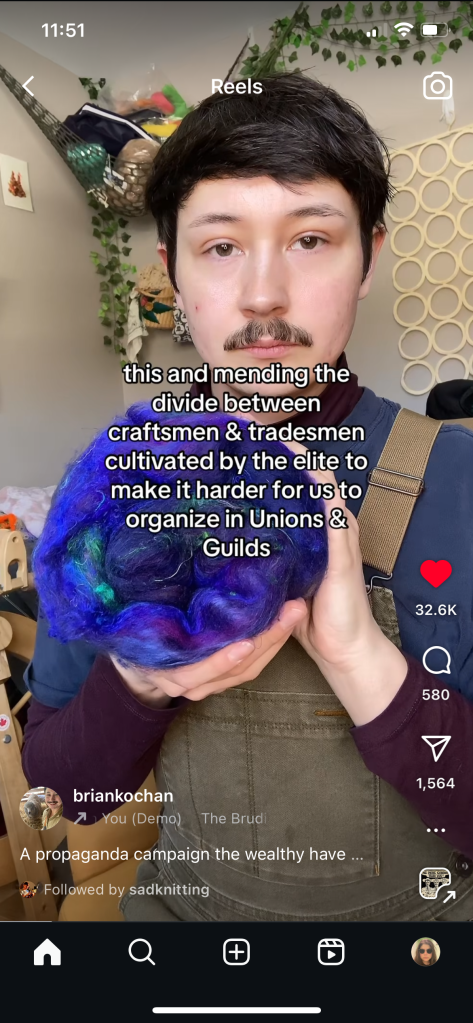

The caption of the video reads “A propaganda campaign the wealthy have been running since the Industrial Revolution…Divides among the working class are not accidental and do not benefit us.”
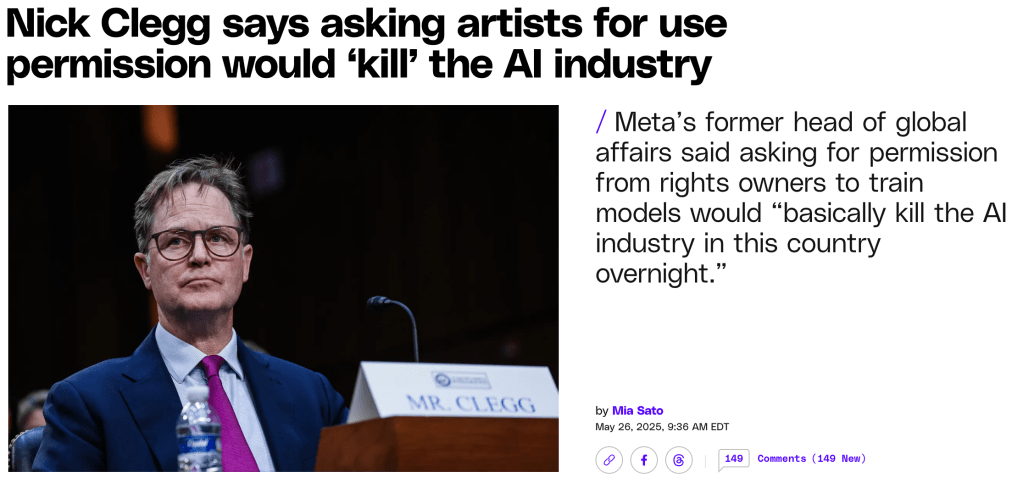
The Industrial Revolution-era brought machine-made textiles and with it, a class of working people who were losing their livelihoods. This created the Luddite movement, made of anti-mechanization textile workers who would protest their disenfranchisement by destroying textile machinery. The Luddites were named for Ned Ludd, who is mythologized as having lost his job as a textile apprentice, was whipped for being a “vagrant”, and then took a hammer to a mechanized loom (McGaughey, 2018). Even if it is a myth, a man who was replaced by machines and then punished for having been replaced by machines is a powerful symbol of the movement, and still feels relevant 250 years later as corporations promise that generative AI is the answer to everything.
In school, I was usually taught that the Industrial Revolution was a universally good thing. It did have benefits, namely, fomenting a working class consciousness that give us many rights that we enjoy today like weekends, work breaks, 8-hour shifts, overtime pay, labor unions, OSHA, and child labor laws. Of course, these things only came after incredible tragedy and deadly working class struggle (The Battle of Blair Mountain, The Haymarket Riot and ensuing unjust executions, and many other protests that drew brutal policing and state military interventions). The rights most Americans enjoy now are the work of the people in labor unions, Marxists, anarchists, and undercover muck-raking journalists – not a direct result of the Industrial Revolution itself.
Another promise of the Industrial Revolution was cheap goods. Items previously only accessible by the wealthy could now be mass-produced and sold at lower prices. Isn’t that nice? The poors can have things too. But as the Luddites had the skills to make the same things at home (and at better quality) that steam-powered machines were now being used to fabricate, had they really gained anything?
This is the trick: We have to recognize when new technologies are being used to disenfranchise us and then sell us worse versions of our own productivity. And we have to consider what share of resources these new technologies require. If the machinery demands more raw material – let’s say, thread and yarn – because it can create products faster and those products break down faster because they’re worse quality, it becomes more difficult and more expensive for a craftsperson to obtain those same materials. It becomes more difficult and expensive for that craftsperson to even maintain their craft.
The most obvious contemporary example is fast-fashion grindmills like Shein. The promise of looking cool for cheap, constantly being on trend without breaking the bank, has been advertised as a solution for those who can’t afford quality or designer names. But these clothing items are still handmade by craftspeople. If you have one person sitting at a sewing machine in their craft room or at their dining room table, who has bought fabric and a pattern from a boutique shop, making clothes for themselves or their kids, and another person (most likely a woman) sitting behind a sewing machine in a factory where their working hours, air quality, safety, and pay is totally at the mercy of their bosses and the insatiable demand of the customer – what really is the difference between them? That person in the factory is not less skilled, less creative; they’re using the same equipment as the sewist who would call themselves an artisan or a maker. But while the US attempts to celebrate itself for workers’ rights, its companies have simply moved production to countries whose imperialism-created poverty and unstable governments promises them cheap labor and a higher profit margin. Those companies have not been forced to become more ethical or compassionate following the labor movements in the US, they’ve simply moved their Industrial Revolution-era exploitation to places we don’t care to think about.
So when the Trump administration tries to promise the return of factory jobs and manufacturing to the US by levying tariffs, don’t think for a second that those jobs will be well-paid, union, safe, or equitable across race and gender. Hand-in-hand with Republican economics is the philosophy of deregulation, and they would have us working 16-hour days 7 days a week if they could. Nothing trickles down except for their bullshit.
Listen, I’m no working class hero. I went to private school, I have two degrees, both of my parents worked at high schools and colleges my entire life. But as I think of how to relearn crafting as labor, I look to trade unions for inspiration. Welding, carpentry, electrical engineering, plumbing – these are occupations whose practitioners have long protected themselves through unionization, and are unlikely to be replaced by automation (it’s hard to imagine inviting a robot into your home to fix or clog or painstakingly bring your wiring up to code). These are people from a legacy of hard-won battles over workers’ rights, but what has protected these while textile workers still face major exploitation and danger?
Again, I believe gender has a lot to do with it. Trades are still largely male-dominated, fomenting a culture hostile to non-men (Bridges et al., 2020). But then women are also challenged to find dignity and liberation in female-dominated labor sectors that were once at the heart of the labor movement. On top of the retaliation owners and management tend to take against striking and organizing workers, female workers are at much higher risk for gender-based violence, sexual assault, and sexual harassment, and firing a person once they become pregnant is commonplace (Robertson, 2024), leaving parents without income to support their kids and creating generational poverty. The different ways women are discriminated against makes the stakes much higher, and they can be potentially traumatized in more varied ways than their male counterparts. This is a global issue, happening here and America and the countries with even less labor regulation – countries we allow companies to operate in so they can squeeze out larger profits. And much of it, culturally, is because we don’t find “women’s work” as valuable as men’s.
I know that much of the language I’m using about gender is very binary. It’s difficult to include the labor experiences of non-binary people when labor is so separated along a binary, and that binary makes it easier to privilege the labor of one gender over all others. As women can often face gendered and sexual violence from men, TLGBQ+ workers are deal with queerphobia on top of other intersecting identities that are often discriminated against.
That’s not to say the cultures of trades isn’t changing. The IWW has a page outlining its inclusion policies. According to data recorded in 2021, more women than ever were working in the trades. While one survey by the UK Construction Industry Council showed that 1% of workers identified as gay, lesbian, or bisexual, this survey did not seem to include verbiage about trans or nonbinary people. I also couldn’t find comparative data on LGBTQ+ people in the trades that showed an increase or decrease over time.
Unfortunately, cruelly, disgustingly, though, this progress is being undone by the current administration. As they seek to demonize DEI policies, gut Medicare that allows people to get affordable health care, and actively abduct workers off the street, they attempt to erode our solidarity with one another.
To the last point, ICE is a threat to everyone, undocumented or otherwise, in the US. They’ve detained US citizens without cause, arrested people who were complying with ADP (alternative detention programs), and arrested people whose visas were cancelled with no warning. Mohsan Mohdawi was arrested at his citizenship interview. ICE does this without identification, while masking their faces so that they can’t be identified and held accountable. They don’t care if a person is attempting to become a citizen “the right way”, a phrase I hear so often from people trying to qualify their fear of immigrants to only the “illegal” kind. This is race-based, state-sponsored terrorism, and it’s not new. Our governments have always deployed military-level policing to shut down progressive movements, from the early days of industry to now.
So as I write to you, fellow crafters, sewers, knitters, crocheters, weavers, I beg you to activate in favor of working people. As you engage with the hobby you love, remember the workers forced to use their crafting skills in dangerous factories for pennies. Support unions, and support the power they gain through diversity. Protect your neighbors, whoever they are, because they are not your enemy.
With LA under siege and many more cities likely to start protesting against ICE, I have to speak on this because it’s a matter of urgency. I highly recommend the Freedom for Immigrants organization and the National Immigration Law Center for more information, as they operate nationally and I don’t know where you could be reading from.
Stay safe, stay crafty, and know your rights.




 Smitty is Knitting