Tag: crochet

  • De-influencing you (and me)

    De-influencing you (and me)

    A close up of circular knitting needles with live stitches on the cable. An aluminum can tab is being used as a stitch marker to mark the beginning of the round. The yarn in the foreground is beige and in the background is purple.

    One of the things that made me most uncomfortable about my yarn job was being a salesperson. Sometimes I would be in the middle of talking to a customer – maybe while I was recommending a yarn, or telling a stale joke – I would see myself from the outside and think: “God look how fake I’m being. They can totally tell I’m full of shit.”

    It got very uncomfortable when the items people were interested in buying were out of their price range, because a lot of times I’d agree that something was a little ridiculous to spend money on. Not necessarily the yarn, but notions. Of course, I could never say “yeah, I get it, $17 is a lot to spend on scissors and the pair in my junk drawer at home work just fine for cutting yarn.” Because both of us knew it’s my job to sell things, and that the customer was there to buy things, and at the end of the day I needed the business to make money in order to keep my job.

    I never got sleazy. I never lied about a product being able to do something it couldn’t, or promised that the experience of having it would make someone a better crafter. Once a pair of young sisters, somewhere between 14-18 year olds, came in because they wanted to make one of those mega jumbo blankets that are knit on, like, US 50 needles.

    A blanket knit from extremely thick white yarn spills out of a basket in a sunny room with a wooden floor. Beige-core at its finest.
    You know ’em from being every other pin on Pinterest for years.

    They were asking about using roving to make one of their own. I was completely honest. Roving would have fallen apart immediately, and would have been prohibitively expensive. It was one of the only times I said to someone that Michaels carried a yarn specifically manufactured for this trend and they’d be better off going there. And it’s not like I would have made a sale on roving anyway, because who’s going to shell out upwards of $500 on the amount of roving they’d need.

    I also think of my own experiences as a customer. It was hard for me to be an engaging salesperson because I HATE attracting the attention of a salesperson while I’m shopping. The affect of selling repels me, and I assume it’s just as uncomfortable for the salesperson to pretend to be my friend as it is for me. Which is why as much as I like Lush and its products, I dread shopping there.
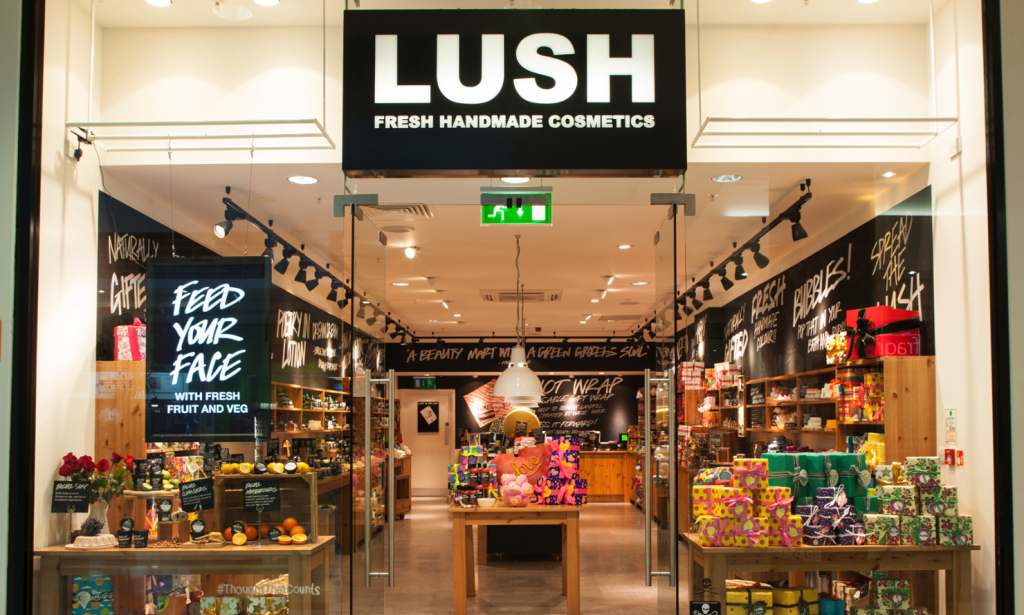
    A storefront of Lush, which sells skin and hair care products as well as perfumes and bath bombs. The signage is black with white text, the interior is made entirely from wood, and the displays are filled with colorfully wrapped soaps and boxes.
    Inside this store is a 20-something waiting to sell you soap with a CIA-level intensity

    I’m currently job-hunting, and I’m really hoping to not find myself in retail again, even though that’s where my professional skill-set is. With that in mind, I want to use this post to do the opposite of selling you something. Let’s deinfluence.

    Deinfluencing is a reaction to overconsumption. It’s a reaction against “hauls”, unboxing videos, sponsored content, and ads in general. It’s why I always link to the designers whose patterns I use, but never the yarn. I want to give people credit, but I’m not trying to sell you anything. And I’m extremely aware of how expensive yarn can be, because I have spent too much of my own money on it over the years.

    One of the hardest things to explain to non-knitters or crocheters is the amount of brand loyalty people have for certain yarn brands. One of the oldest jokes I would have to pretend to laugh at is that “buying yarn and using it are two separate hobbies.” People buy yarn not just just because they’re excited to use it, but just to have. I’m one of those people, and I’m trying not to be. But then there’s people who buy yarn from a company just because it’s rom that company. They collect yarn from premium brands like each skein is a Berkin. Yarn, in this subculture, has become a status symbol.

    It brings to mind a time I visited a yarn shop in my city, which has been closed for a long time. The location was on the edge of a trendy neighborhood with lots of walking traffic, boutiques and bistros. Across the street from the shop was a housing project. I got talking to the owner about her selection, and she let me know that despite many potential customers from that project wishing they could shop there, they simply couldn’t afford the brands she carried. Instead of listening to them, the owner told me she just couldn’t imagine stocking acrylic. Again, this store is no longer in business, probably because the owner was catering to imaginary big spenders instead of her very real neighbors and their needs.

    The glamorization of name brands, aspiration to buy, the flooding of new products into the market are not unique to the fiber world, but it is as pervasive here as it is anywhere. So here are my alternative, low- or no-cost alternatives that I have personally used.

    Indie dyers and LYSs

    Supporting small independent businesses is wonderful, I’m not arguing that. But again, not everyone can afford the selection at these places. For an alternative, sustainable option, I suggest the growing number of consignment craft stores. SCRAP USA is a nonprofit with multiple locations, for instance, but there are plenty of smaller 501(c)(3)s with the same model. Jess Crafts compiled an extremely thorough list of over 60 locations on her site.

    Notions

    Here are some of the re-used alternatives to new tools that I’ve personally used. They might not be as fancy, or have all the bells and whistles, but they work just as well. You might already have them in your house.

    Project Bags

    • My regular purse
    • Reusable shopping totes
    • Zip-lock plastic bags – if you ever shop online for clothes, chances are you’ve gotten a ton of these.
    • Bedding packaging – new bedsets often come in clear, plastic bags, and they often come with handles!

    Stitch Markers and progress markers

    • Paperclips (classic option)
    • Safety pins (progress marker)
    • Can tabs – I drink a lot of seltzer and boy have these come in handy when I’ve inevitably lost all my stitch markers to my couch cushions.
    • Yarn scraps – just tie off a tiny loop in a contrasting color.

    Stitch Holders

    • Any scrap yarn, string, or thread you have hanging around.

    Pattern Stands

    • A clipboard and a post-it note so you can keep track of what row you’re on.
    • Your computer – I don’t own a printer and very rarely use physical copies of patterns. I usually just scroll so my row is right at the top of the screen. Obviously a computer is expensive, but since I have one for other purposes anyway, it’s what works for me.

    Blocking Boards

    • Interlocking playmats for kids – they may not be printed with a grid of lines 1″ part, but they do the job and are usually the same size (and a lot cheaper than the ones sold by knitting brands).
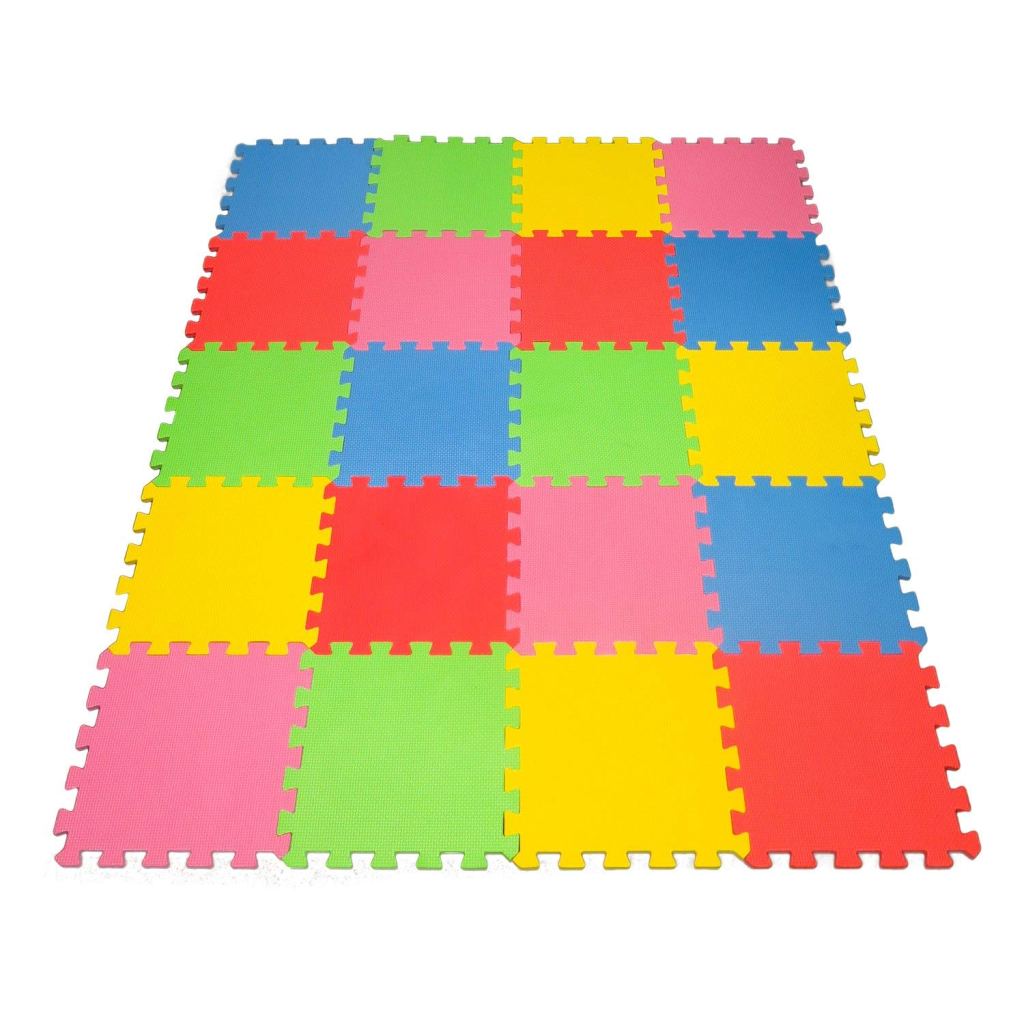
    A play mat consisting of 20 foam tiles lies on a white background. The tiles are red, blue, yellow, pink, and green.

    Stitch Stoppers

    • Save your wine corks and stick ’em on!
    • Poster putty

    There’s nothing wrong with buying notions or yarn that you know you’re going to use. As my own stash shows, I’m not one to judge. I love my needle gauge earrings, I have a strong preference for steel needles, and my swift/ball winder combo is pretty sweet. But the fanciness or aesthetics of yarn or notions will not make anyone a better crafter than they are, and that’s the most important thing to remember. And as I look at my own spending habits (especially in my time of voluntary unemployment), I think twice before pressing “checkout”.

    While I’m here, maybe I can influence you about something else.

    This past week Donald Trump made an unconstitutional decision to bomb Iran, threatening millions of innocent people with death and war. If you’ve read this far, I beg you to contact your representatives and ask them to oppose all further military action toward Iran and to stop arms sales to Israel, who instigated this conflict by attacking Iran. We also need to pressure our reps to impeach Trump. Again.

    Our government has been hanging the vague threat of Iran’s development of nuclear weapons for decades, and there’s never been evidence of it. Even if Iran did have nuclear warheads, so does the US, and we’re the only country who has every used one in war. Does that mean it’s justified to invade our country?

    It’s the same excuse we used to invade Iraq in 2002. After hundreds of thousands of Iraqi casualties and over 4,000 American servicepeople killed, we cannot fall for this lie again. I was 9 years old when 9/11 happened. Over the last 24 years, the consolidation of power under the executive office has been allowed to grow and grow, eroding our checks and balances system. Bush, Obama, Trump, and Biden are all guilty of using this power to bomb 8 countries between 2001-2025. I don’t care about governments, but I care about people, and peace should be nonpartisan.

    Find your representatives in the House and Senate here. While you’re there, you may also be interested in asking them to oppose putting 250 million acres of public lands up for sale to private corporations.
  • Craft, Art, and Gender

    What does my knitting have to do with my gender? More than I’d like. Less than you’d think.

    I sometimes wonder what people assume about me when I knit in public. I wonder, and worry, if it’s assumed that I’m invested in the sort of traditional femininity that knitting seems to represent. I’ve discussed this a little in a previous post – do these so-called “alpha” manosphere assholes see knitting as a sign of the kind of woman they believe we should all be.

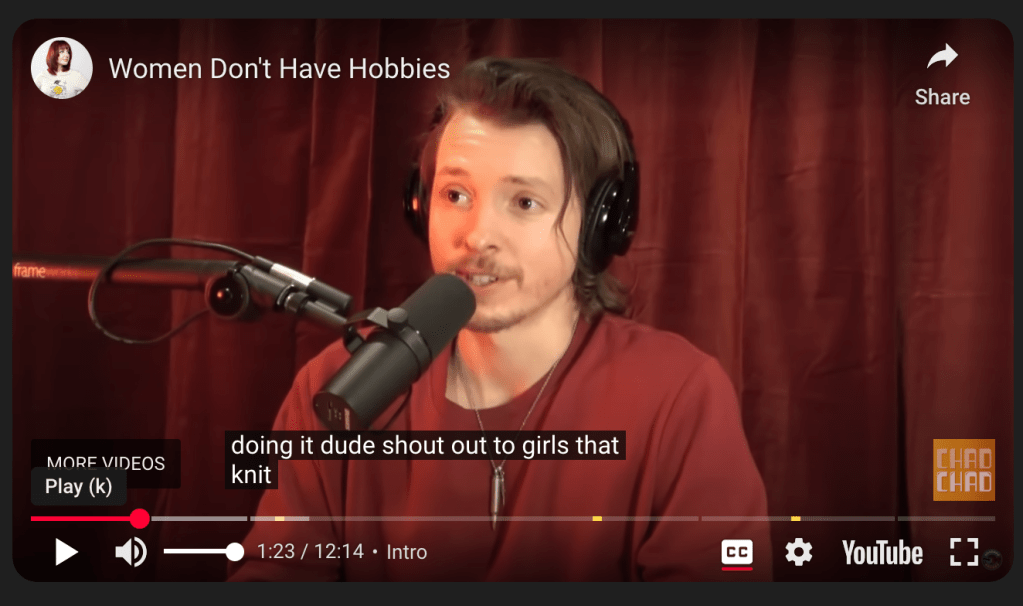
    A screen shot of a Youtube video. The frame is of a man in a red shirt against a red curtain background talking into a podcast microphone. The closed caption reads "dude, shout out to girls that knit"
    A clip from a manosphere Youtube channel where two men wonder if women actually have hobbies, and decide that knitting is an acceptable hobby for a woman to have because it’s “nurturing” and feminine. Don’t worry, I didn’t go to their actual YT channel to get this screenshot because I would never give them the views to poison my algorithm. Thanks to Chad Chad for taking that one for the team.

    I don’t knit because I’m a woman. I don’t knit in a feminine way. I also don’t knit in a feminist, reclaiming-the-power-of-the-craft way. I knit and crochet because I like it (and probably because I’m stimming, but that’s another blog post). I look at pretty much anything I do and wonder how much of it has to do with me being a woman.

    I feel best about myself when I feel feminine, but I recently realized that what I have been conditioned to understand as feminine is also what I have been conditioned to understand as beautiful. And chat, I do not feel beautiful. I also don’t feel nurturing, or supportive, or emotionally intelligent. I’m not motherly. I’ve never found traditional fulfillment in these traits or any power.

    So when we think of knitting and crochet, or any fiber craft, as a feminine activity, I question if my aversion to that is personal or if there really is a larger societal misattribution happening.

    Earlier this month I read an article in Art News about the burgeoning presence of fiber in the arts scene this year. “Fiber Art Has Officially Taken Over New York’s Museums and Galleries” by Alex Greenberger covers multiple exhibits, features, and retrospectives of fiber as painting and sculpture, at commercial galleries and museums like the MOMA.

    Almost all the artists mentioned and profiled in the article, as might be expected, are women. Greenberger credits the phenomenon of fiber-centered exhibits to a cultural correction of misogynist exclusion:

    Why so much fiber all of a sudden? The simple answer has to do with the changing face of recent art history. Weavings, embroideries, and the like have long been awarded an asterisk in the canon—if they’ve been accepted into the canon at all. Typically, art in those mediums has been classed separately as craft in the West or denigrated as “women’s work.” Thanks to the work of dedicated scholars, curators, and critics, fiber art has finally come in for reassessment.

    I wrote briefly in my post about chromatic politics about the shoehorning of women artists in the Bauhaus school to textile-based art forms. And how while fiber arts and decorative arts are often relegated to the superficial, their influence on the so-called “fine arts” is hard to ignore, like that of the mostly-female weavers of the Aymara on the aesthetics of architect Freddie Mamani.

    I don’t disagree with Greenberger’s theory of the gender pendulum swinging back in the direction of equity, and that the fiber art rage has been part of that. The way that the binary genders – men and women – have been separated and tiered has a lot to do with the way “art” and “craft” has been separated and tiered, which has given men a lot of fame and status and women a lot of obscurity. But I can’t help but wonder (!) what a gender utopia, a world where misogyny and queerphobia don’t exist, looks like.

    I have a list of evolving, circular desires for gender and art – a gender ouroboros maybe.

    • I want to see women included in “fine art” – painting, sculpture, architecture, etc. because women are capable of doing whatever they pursue.
    • I love seeing “craft” and the women artists who practice it included in the genres of fine art, because craft requires the same level of technique and intellect that the traditional “fine arts” require. It’s important to me that the disciplines and materials we associate with fine art gets expanded in order to perforate the gender separation that’s been engineered in the art world.
    • I don’t want to see fiber “craft” forever associated with women because not that all fiber artists are women and not all women are naturally fiber artists, and to believe so is gender essentialist in a way that gives me hives.
    • To call craft “women’s work” at all is colonial. Craft exists across the globe, in virtually every culture, and not all cultures divide labor along the same gender lines. For instance, textile crafters in West Africa were often men (Osborne, 2024), but during the trans-Atlantic slave trade, the white slave-owning class demanded that enslaved women perform it because it was more in line with the white/European division of labor by gender (Golden, 2023).
    • Not everyone lived by a gender binary like Christian Europeans did. Numerous cultures around the world recognize more than two genders, and the various nonbinary genders in those cultures also fulfilled traditional roles. Nonbinary people have also existed in binary gender cultures forever without being recognized. To only be talking about the elevation of women’s art erases the many trans nonbinary identities that are currently under attack, even by people claiming to be feminist*.
    • Even as objects previously tiered as “craft” are elevated to “art”, and artists working with materials often thought of as “craft supplies” instead of “artist materials”, are being curated for the fine arts scenes, will women and nonbinary artists be fairly represented alongside male artists without their gender or cultural background novelized alongside the medium?

    *If your brand of feminism aligns with Republican/right-wing politics or if you find that Nazis are agreeing with you, then you’re not a fucking feminist.

    To the last point, Greenberger makes a poignant criticism of the Woven Histories exhibit at the MOMA:

    The exhibition is unclear about the ties that bind many of its artists: what, for example, links an abstract painting from the ’70s by Jack Whitten and a raffia net from the ’60s by Ed Rossbach?…The exhibition also stumbles when presenting artists awaiting canonization such as Yvonne Koolmatrie, a Ngarrindjeri weaver who makes sinuous sculptures from sedge, a type of grass. These works are…lumped together with baskets by Indigenous artists, an awkward, reductive gesture that makes them feel like an afterthought.

    Here, Koolmatrie’s artistry is hitched to that of other indigenous artists with, as Greenberger suggests, no real curation as to why. Is it enough to say that “we all weave”, or does this decontextualize the places and cultures these individual artists come from? The importance of cultural specificity to art and craft cannot be overstated, and it is frequently missing from a lot of discourse about art and gender that I’ve seen and read. Race and gender are linked in systems of oppression, so they have to be discussed together in cultural criticism. After all, the Western/European art institutions that have displayed stolen precolonial indigenous art have historically not challenged the binary thinking of gender by acknowledging nonbinary artists.

    I grew up near the Baltimore Museum of Art, and even as a child I could understand the way most of the exhibits were organized. These rooms, the impressionists. Over here, the impressive collection of Matisses. In this stark white and angular wing, the contemporary exhibit. And over here… “African Art.” All the art the museum had from across the continent, from across centuries, in cramped glass display cases instead of mounted on walls or installed like the European and American paintings and sculptures. Looking back on it now, this exhibit was distinctly anthropological, archeological, in nature. These were not meant to be considered cerebrally like the Monets and Warhols. I wasn’t meant to think about the objects’ makers as individuals. It was just a room full of things with a single tenuous connection between them: the 11.7 million square mile continent of origin.

    Decades later, the BMA has gone through a total overhaul. That vague exhibit no longer exists. The new curators have gone full force into featuring living artists whose works they can fully contextualize. They’ve sold a number of extremely famous works (to the rage of many white patrons) to fund the acquisition of art by Black, indigenous, and queer artists. Last year, they installed “Walk a Mile in My Dreams” an exhibit dedicated to the work of Joyce J. Scott, a Baltimore artist who works in a plethora of different mediums and techniques, including fiber, weaving, and crochet. Scott’s work explores race, sexuality, violence, and natural destruction, and she’s as influenced by the cultures and artistic techniques of the many places she’s traveled as she is by her own family’s long history of making.

    I haven’t visited the Woven Histories exhibit myself, so I can’t speak personally to the level of explanation provided by the curator as to the connection between the different works, but it sounds like more specific context is needed to draw these connections. Maybe it takes an artist-specific installation, like “Walk a Mile in My Dreams”, to fully do justice to any artist.

    I have been thinking about my relationship to my gender for my entire life, and Greenberger’s article gave me a great vehicle to talk about it in relationship to the fiber crafts that have become such a big part of my day-to-day life (and my livelihood, at one point). This hobby, once necessary labor in a preindustrial age, taken for granted as “women’s work”; this women’s work that my own 94-year-old meat-and-potatoes mans’ man Navy veteran grandfather was taught as a boy; this women’s work that I have seen loved by cis men, gay and straight; this women’s work that I have seen relished by trans and non-binary people at fiber festivals.

    Even though us cis women are overrepresented in fiber arts, they don’t belong to us, and that makes me feel free. It’s not enough that I should feel empowered by the things that make me “feminine” – I want a femininity that demands nothing of me. The gender utopia I hope for is a decolonized one, a non-binary one. One where every singular person is recognized for their skills and artistry no matter their identity, without it having to reflect on anyone else.

  • Frederick Fiber Festival: A day of sidequests

    New-to-me dyers, a hyper-specific color mission, and the importance of showing up in the rain

    I had been wanting to go to the Frederick Fiber Festival for years and never had a chance because until recently, I had always been working on Saturdays. Tough, especially because FFF happens twice a year – twice as many chances for me to get my ass there!

    During my tenure at the yarn company, we typically went to the big events, like Rhinebeck, Stitches (before it imploded), and VKL (before the thought of unloading a truck in the middle of Times Square became enough to give one hives). I developed a preference for the farm-ier, more outdoorsy events, where in addition to indie dyers and designer appearances, there were also farmers auctioning sheep and herding dog demonstrations. FFF isn’t quite large enough for the complete county fair vibe (I’ll get my fill of that when I make another small roadtrip to Maryland Sheep & Wool next weekend), but it introduced me to a number of vendors I hadn’t had the pleasure of shopping with before.

    Before I went absolutely apeshit at every shiny new booth, I had to remind myself that I had a mission. I’ve been wanting to make an Artus Shawl ever since it came out, and I have a very specific color scheme in mind that revolves around luna moth green. My partner, who loves solving problems, was with me, so I asked him to keep an eye out for a similar shade. I was fully expecting not to find it that day, but I happened to find it at Cape May Fibers. I held up a skein of mohair and said “Look for this, but not fuzzy”; I put the skein back down but my partner had the good sense to take a picture of the label to get the colorway, and wouldn’t you know it, the color was called “Luna Moth”. So while I couldn’t get the weight I needed at the festival, I placed an order in sport weight that night.

    I also made a stop at Yarn Hero’s booth, another source for color-shifting fractal-spun yarn. What I really appreciated here was that in addition to their beautiful standard skeins, Yarn Hero had flawed skeins, mill ends, and test runs for sale, sold by the gram. Not only is it a more affordable option for festival-goers, but I find this also speaks to the sustainability of the company. It’s good to see businesses not hiding away skeins that are short or have slubs just because they can’t sell them full-price. And it’s a rare opportunity for people like me who aren’t picky about a little mill knot here and there, or for folks who don’t want to buy more yarn than they actually need for a project.

    This is another perk of going to festivals like these: you get to see products that often don’t make it to the business’ websites. Plus you get to actually meet the people who run the companies, see the colorways in person, and feel the yarns. This is especially important for companies that don’t have a retail space, and rely on trade shows and trunk shows to directly sell. These events are usually the biggest money-makers, and will often keep an indie dyer in business for months.

    Which is why it’s so crucial, if you’re able, to brave the rain if the forecast calls for it. It never quite stormed on Saturday, but we had a clap of thunder and the rain was off and on, like someone was turned on the spigot every ten minutes or so while the clouds blew through. Almost all of FFF’s booths, minus a few trucks and food vendors, were indoors and sheltered, but there was still a strong gust that blew through one of the buildings and threatened some stands. In those moments, everyone comes together to brace against the poles and pick up flying shawl samples.

    At many festivals, however, booth spaces are in outdoor tents more exposed to the elements and mud, and some unluckily-placed vendor gets the short end of the stick when the weather turns sour. Rain or shine, these events are planned well in advance and can’t be canceled.

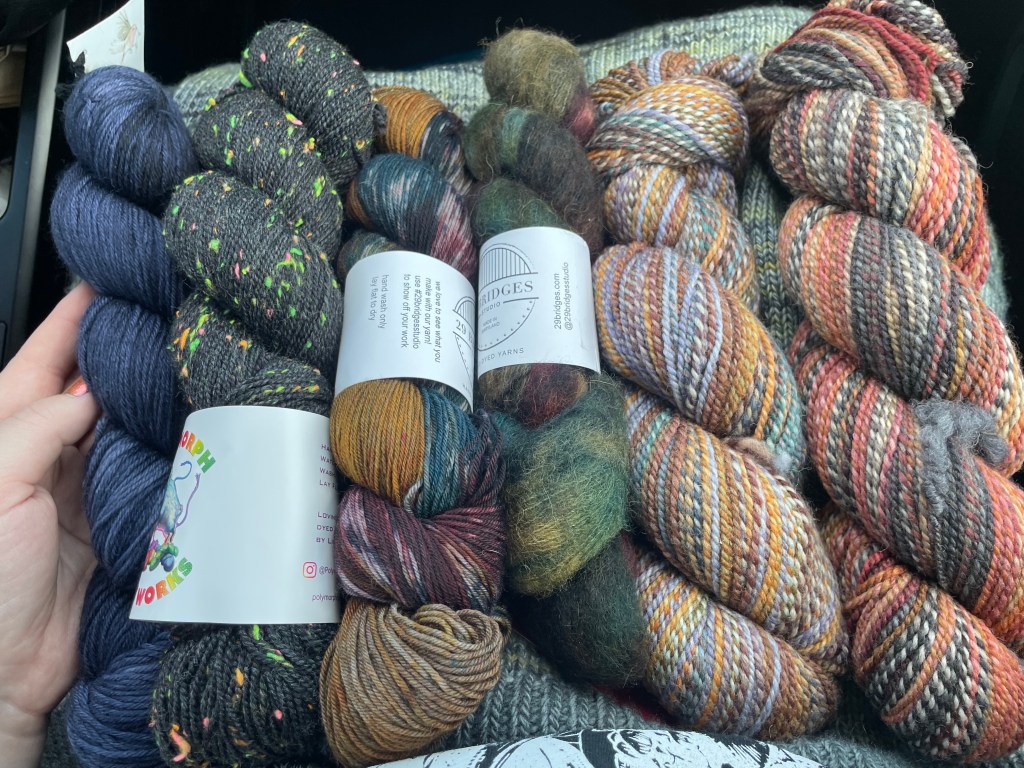
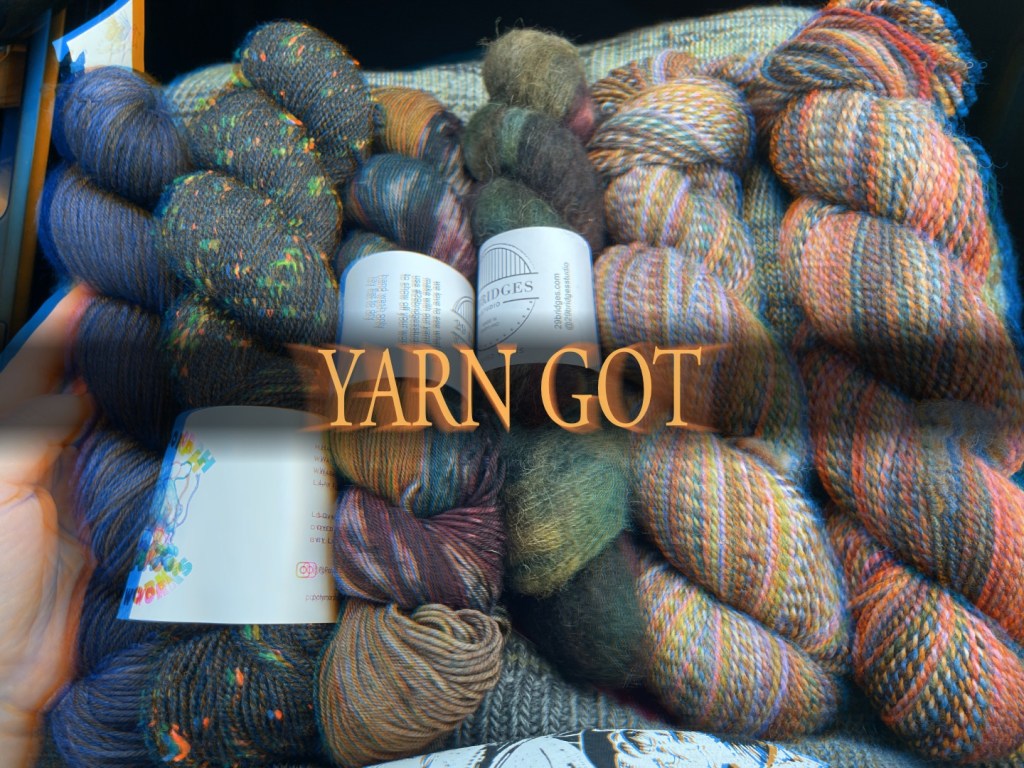
    Eventually the sun came out, and we called it a day at the Frederick Fairgrounds with my new skeins. The yarn I got from Polymorph Dye Works is especially fun, black with neon neps – it reminds me (in the best way) of 90s arcade carpet.

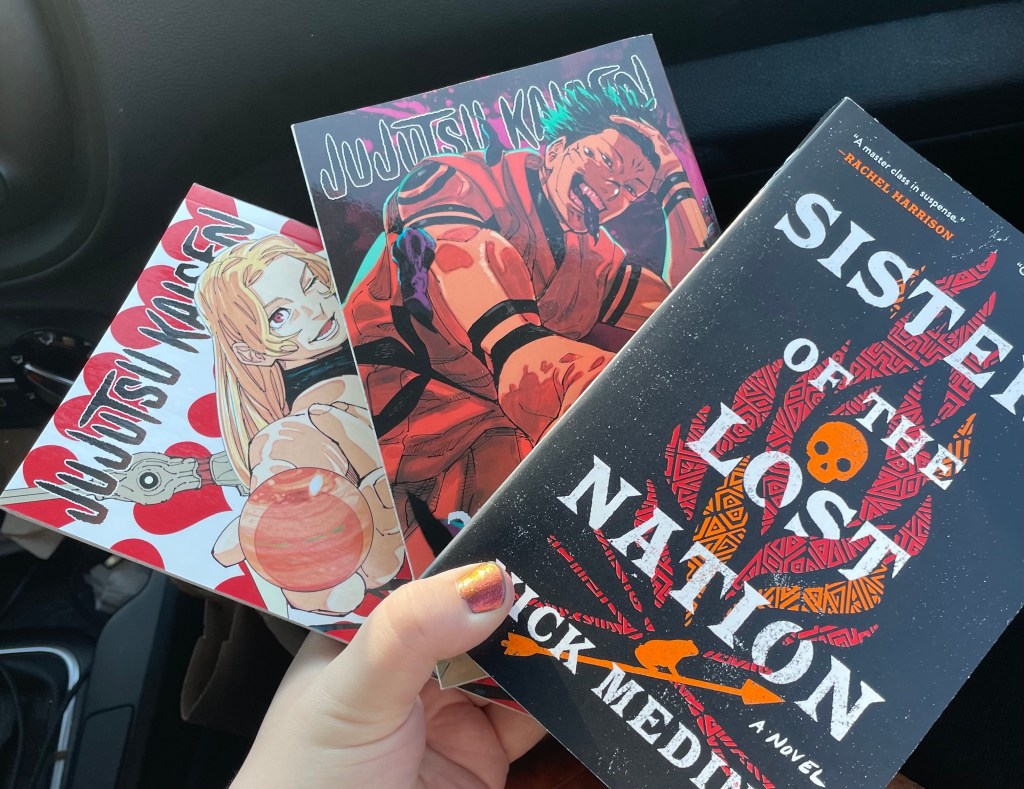
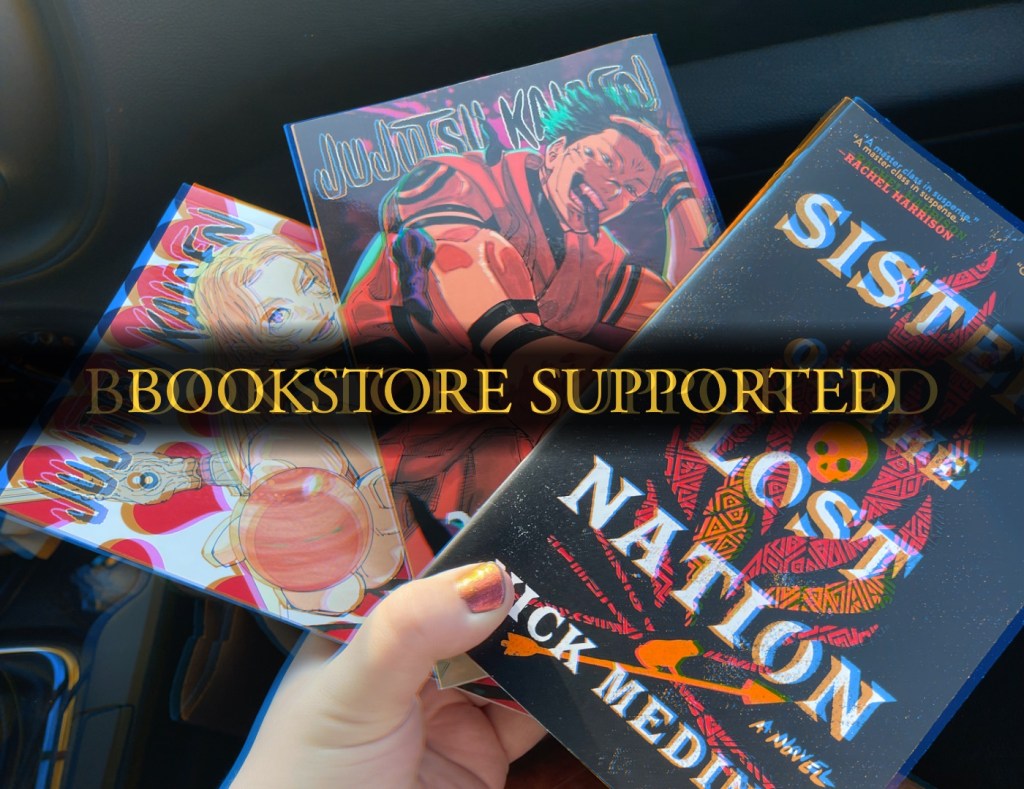
    But Frederick is a beautiful little city, so our day didn’t end just yet. My partner is a massive coffee-lover, and we made a stop at Gravel & Grind, a cafe and bike repair shop that sells great drinks and independently roasted beans. It was also Indie Bookstore Day, so while we drank our coffees we looked up the nearest bookshop to support. That turned out to be Curious Iguana on Market Street, downtown Frederick’s main drag of boutique storefronts and restaurants. I picked up volumes 23 and 25 of Jujutsu Kaisen, which were missing from my collection, as well as Sisters of the Lost Nation by Nick Medina; I had read Indian Burial Ground and I’m looking forward to reading his first novel.

    Our last stop of the day was Gwenie’s, a Filipino bakery with a couple locations in the MD/DC metro area. We were introduced to Gwenie’s by a friend of ours, and they requested a slice of ube cheesecake if we were going to be in the area. We got there within an hour of their closing time, when everything is 30% off, so we left with an armful of of mamons and sylvanas.

    An ube mamon and ube custard cake, you guessed it, styled like a Dark Souls achievement.

    Driving home from a lovely day out, I think the highlight of my Frederick visit was running into a regular customer from my former job and exchanging excited greetings. At least now they know I didn’t just fall off the face of the planet when I quit. Closure!

    *I’ve never played a Souls game, Sekiro, Bloodbourne, Elden Ring, or even a Souls-like. I just think the title cards are funny.

  • FO Friday: Granny squares at the sludge metal show

    FO Friday: Granny squares at the sludge metal show

    I love granny squares. Despite their fixed shape, I think they’re pretty versatile. You can stop at any point and make them whatever size you want, and they have a delicious kind of pixelated appeal. And of course they don’t have to be squares, which just opens their potential even more. They can be arranged and built upon, like legos or tessellation blocks, into endless configurations.

    It probably won’t surpise you to learn that these were my fuckin jam as a kid

    And the granny stitch is really having a moment, particularly among the young folks. The younger-than-me folks, they in their teens and 20s. There’s an interesting phenomenon about the way Gen Z finds and consumes knitting and crochet patterns versus those of us in older generations, who have been using Ravelry, books, and magazines. They create and consume on video – Youtube tutorials and shorter-form Tiktok clips. These designs are more custom, fitted to a single body, often experimental and artistic. They’re tied to one of many microtrends and “vibes”. A lot of them are sexy! And when they do go viral, it’s often because the technique is so simple it hardly requires the effort of a written pattern – it’s better to show than tell, get views instead of individual pattern sales, or just make the item to sell.

    Jack Black and Jason Momoa wear granny-stitch hexagon cardigans while promoting the Minecraft movie. The sweaters were made by Tosha Marie @treatyoselfcrochet, and there are many tutorials on Youtube on how to make your own. I’m thinking of making a couple for my niece and nephew for Christmas this year.

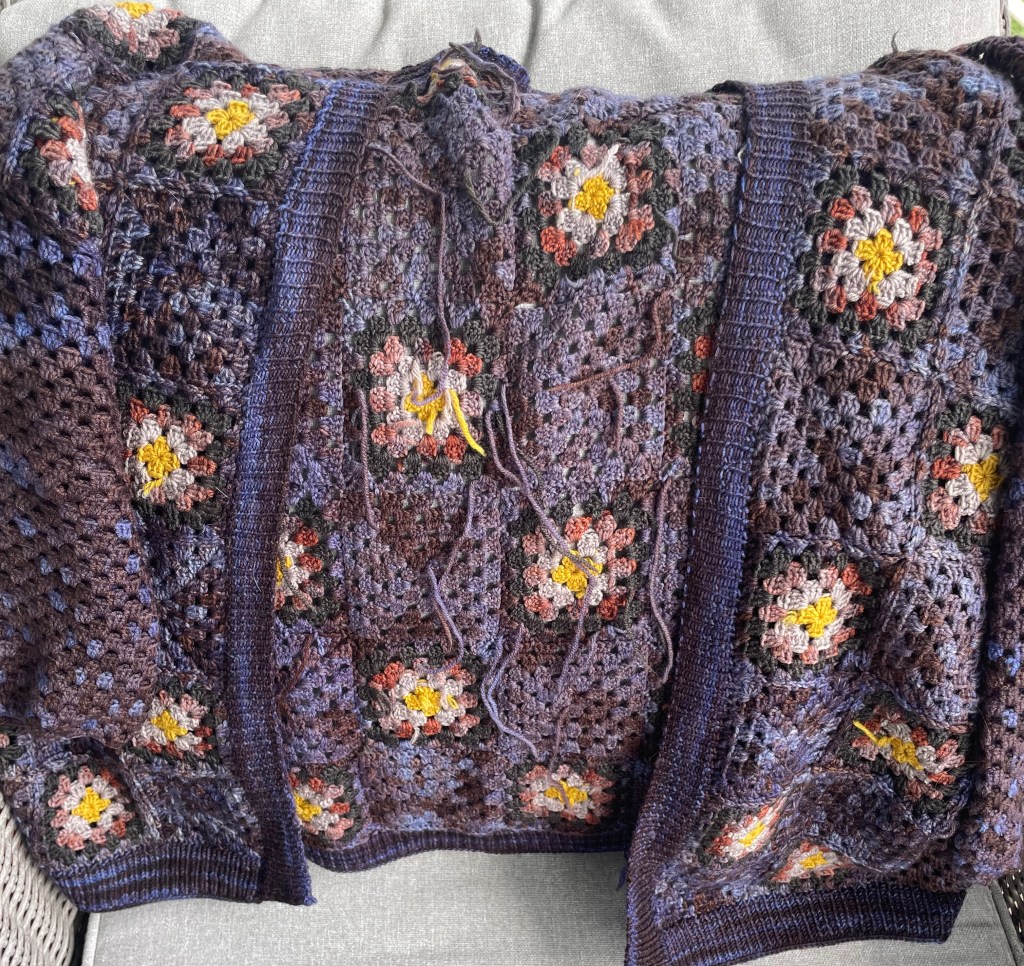
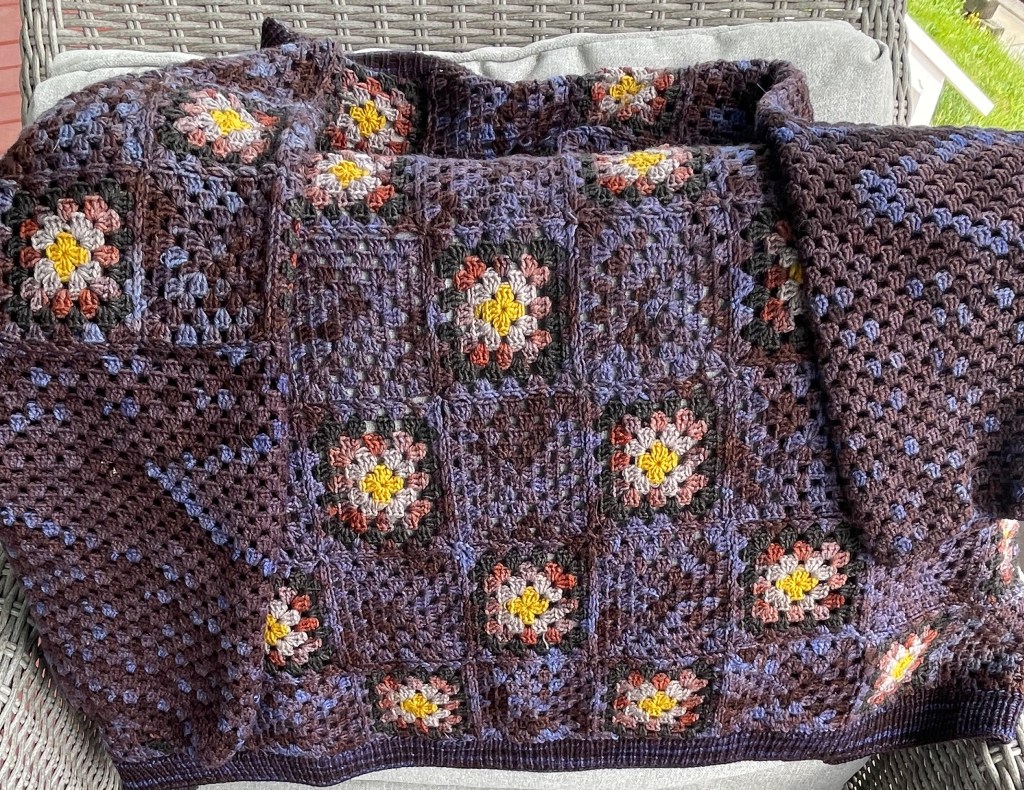
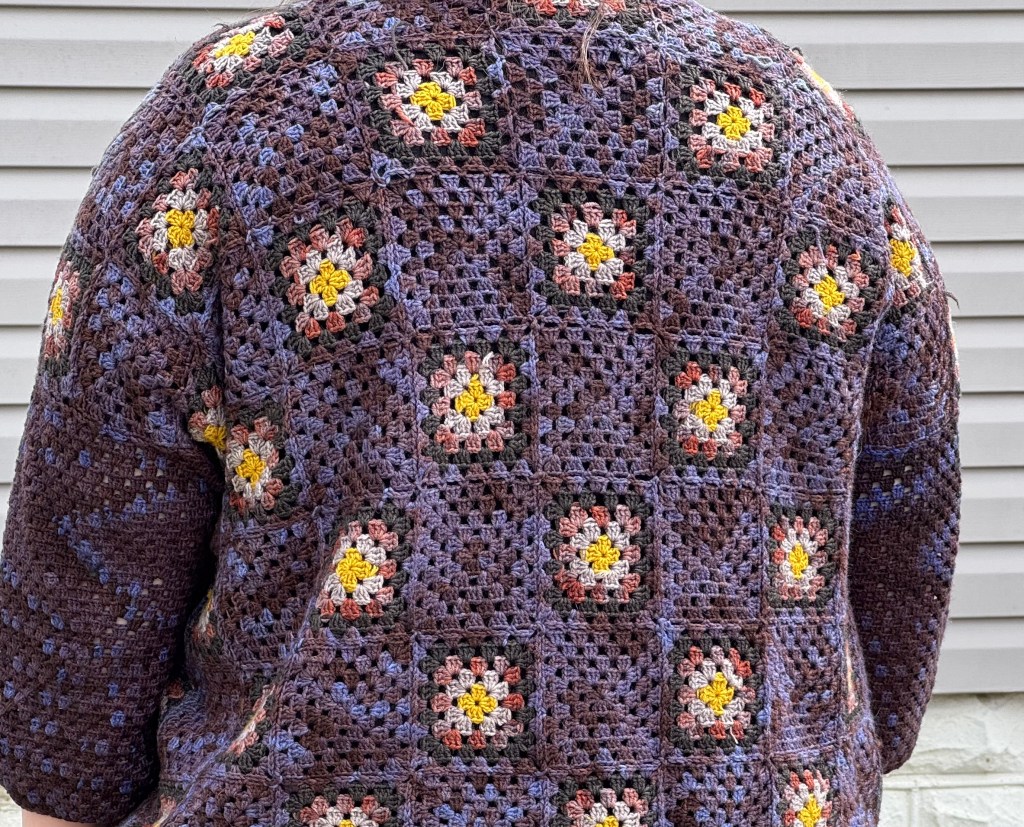
    Granny stitch – so hot right now. Last year I couldn’t resist jumping aboard, so I pulled together some odd partials of sock yarn from Neighborhood Fiber Co. to create my own granny square cardigan.

    This project was improvised and only made with my own body in mind, but I did take much inspiration from Amy Christoffer’s Ariana Cardigan. I just kept making squares and attaching them as I went until I felt I had enough to reasonably cover my back and shoulders. It was a great travel project – I remember I was working on this quite a bit during the 2023 holidays and driving to see family, and it’s nice not to need a pattern pulled up on my phone or printed out.

    Once all the squares were assembled, I draped the two front panels over my shoulders and marked enough room for arm holes, then seamed up the sides. Then I just did simple granny stitch sleeves in the round, decreasing every ten rounds or so until they got to 3/4 length. While I had just enough of my contrast colors, I did not luck out with the main color, and had to get two more skeins to complete the project. No regrets, I love this color (Petworth).

    I wore my granny square cardigan out this week when I went to see Faetooth during their first east coast tour. Faetooth is a three-piece from LA who describes their ethereal, shoegazey metal as “fairy doom”, and when I saw they were coming to my city I jumped on a ticket (good thing too, the show was sold out). They were touring with Sunrot, who I hadn’t heard of before, but were an absolute pleasure. Sunrot especially has incredible stage presence and messaging; they had free fentanyl testing strips, narcan, and condoms available for the crowd, and brought an expert on harm reduction on stage to talk about community care. When it looked like a fight might break out in the crowd, Sunrot’s singer stopped the set to make sure everything was cool and that no one was about to get hurt. And both they and Faetooth delivered messages of love for trans and non-binary people and solidarity for Palestine. There’s been many metal musicians who’ve gained notoriety for acts of violence and depravity to shock the “normies”; but there are as many metal musicians who point out that violence and depravity are in fact very mainstream, especially when perpetrated by our governments. The message of this show was that taking care of one another is the radical act.

    I knew I wanted to wear something handmade to this show because DIY is a big part of metal and punk music, and well, this is how I DIY. In addition to enjoying the music, I enjoyed the crowd and the hand-stitched patches on their battle jackets, their hand-painted and dyed clothes, their repurposed and mended fabrics. There is an interesting event horizon here, where sustainability for aesthetics and sustainability for economic necessity meet and it’s unclear which came first. Either way, it’s craft, and craft/art/music says “If it does not exist, make it.”

    Yarn

    Neighborhood Fiber Co. Studio Sock, colors (Center of the granny squares outward) Oliver, Federal Hill, Cedarcroft, Upton, Petworth)

  • Introductions

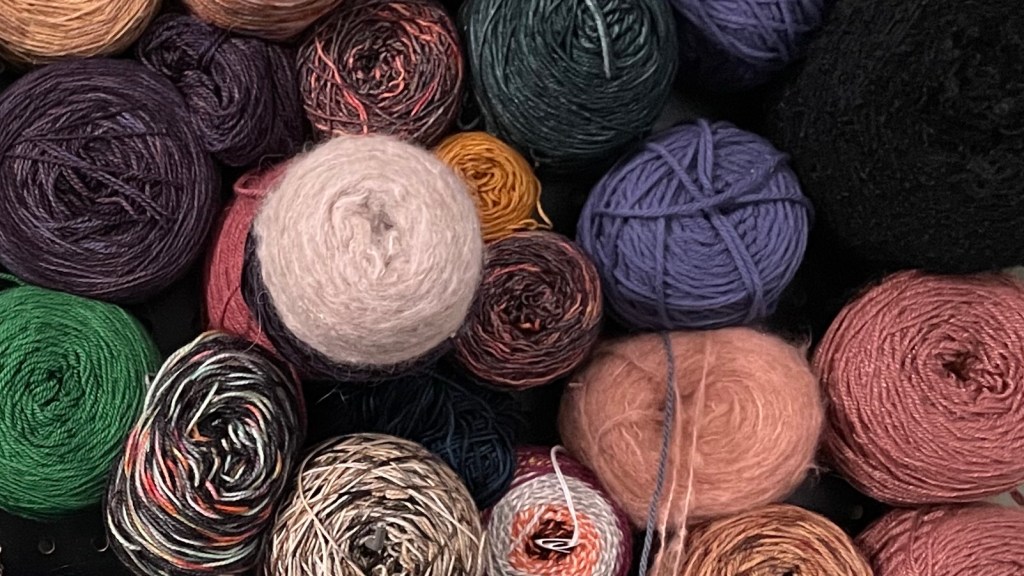
    A menagerie of caked yarn in different colors and textures

    Smitty is knitting

    Online I go by Smitty, a nickname I sort of borrowed from my dad. My pronouns are she/her but I wouldn’t be mad at they/them.

    When I was talking to my friends about starting a blog and they inevitably asked “about what?” I said knitting and crochet, because of all the things I know, it’s what I know the most about. Or at least what I have the most opinions about.

    What makes me ready to write about knitting? Well, I’ve been knitting and crocheting for over a decade (I learned in college when a very good friend taught me). I had always been a crafty and artistic kid; I loved drawing and painting, and making anything that came in a kit, especially if it involved lots of tiny pieces like beads. But when I learned yarn crafts, it felt like the thing my hands had always wanted to do.

    I also worked in the yarn industry for about six years, and ended up living off my hobby when I found a job at a small fiber business. As I became more ingrained there, I ended up seeing more of the yarn industry at large – its trends (of which there are many), and its dramas (of which there are more). I got to travel to fiber festivals and retreats, meet designers, and touch all the different kind of sheep I could. But when you work for a small business, you end up wearing many different hats. Over those years I acquired a lot of varied skills, but not a lot of professional focus. And after a certain point, I maxed out my upward mobility at the company. There were other, more personal reasons I decided to leave, but mostly I wanted to be more proactive with my career. I also wanted to do more with the thing I studied through college and grad school: writing.

    What can you expect me to write about? Knitting and crochet, sure, but every topic is more than what it is. I actually started drafting several other posts before I started this introduction, the post that should naturally come first. Those first drafts are proving fairly meandering, and full of tangents. Full of “well, I can’t talk about [topic] without talking about [political event] or [cultural philosophy] or [historical context]”. I, and a lot of other people I believe, end up discussing a lot of things when they talk about one thing.

    I know – it’s knitting and crochet; it’s not that deep. Sometimes it won’t be. I expect to pepper short posts about current projects, yarns I’m enjoying, and techniques I’m learning with longer, more meandering thoughts about aesthetics and craft at large. I’m interested in who knits and why, what is being knit and in what colors, how does it intersect with fashion, art, or culture? I will rarely “stick to knitting”. This blog will constantly overlap with my politics and other worldly interests. I’m far from a critical theorist, but this blog will be a way for me to exercise a critical muscle, using my favorite hobby as a dumbbell.

    I’ll get to that (I hope – I’m trying to get better at finishing my thoughts). For now, here are some other fun facts about me:

    • I love playing table-top roleplaying games like D&D. My current Pathfinder character is a gnome thaumaturge named Sandy Trousers. I am a huge Dimension 20 and Naddpod fan.
    • I have a crystal collection, but just because I like cool rocks.
    • I watched too much Animal Planet and read too many issues of Zookids as a child, so now I’m full of useless animal facts.
    • I was born without wisdom teeth.
    • I’m in my 30s, but I had shingles when I was 21, so spiritually that makes me 83.

    I can be found on Bluesky and Instagram as @smittyisknitting, so feel free to follow me there!