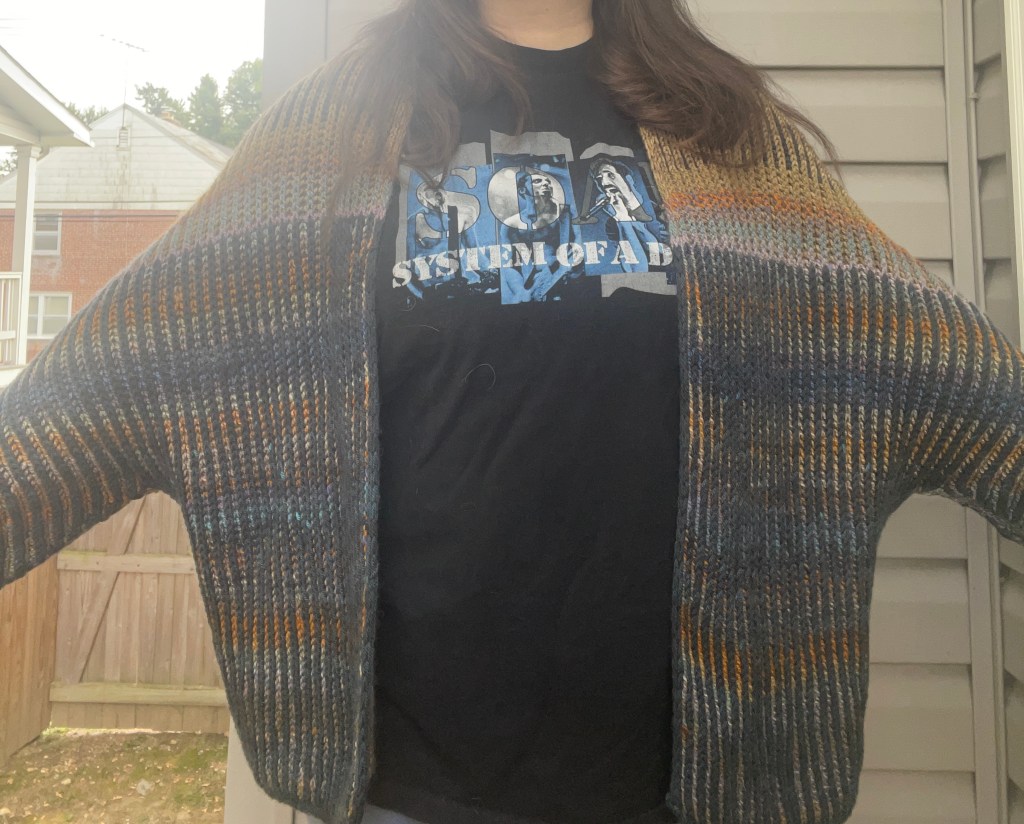
I’m really on a cardigan kick! The ones that I’ve made in the past have become too small for me, with the exception of my Felix Cardigan, which is an excellent staple piece that pretty much goes with anything. But lately I’ve been wanting showstoppers and statement-makers, especially when they can eat up as much of my stash as possible. A two-color brioche design like the Oliveros is ideal for this.
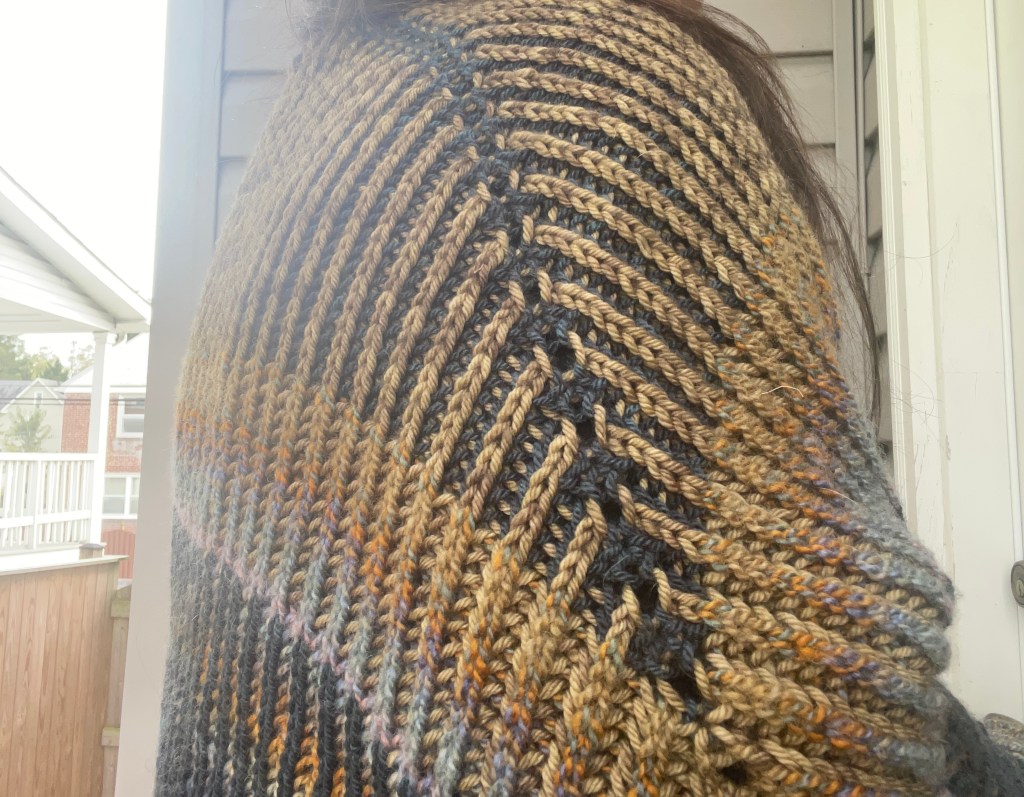
Brioche is an intimidating technique to learn, and fairly time-intensive (you basically work every row/round twice), but it creates one of the most relaxed fabrics in knitting. Cleo Malone, the designer, embraces that with a construction mostly unfettered by anything that constricts the stitches too much. No picking-up of stitches, no seaming. While well-designed, there’s very little structure. The whole sweater grows like organic matter from a central point at the back of the neck and over the shoulders, stretching with the body to let those flashes of contrast color shine through.
Of course, the relaxed nature of this pattern means it will grow significantly during blocking, which is what happened to me. The sleeves are actually quite a few inches past my wrist (and my fingertips). That’s okay with me, though, I’ll just cuff the sleeves. But if you want something more to your measurements, block with caution.
There’s a distinct cloak-iness to this pattern, so I decided to go full fantasy with the color choices. Blue and gold has always reminded me of magic and wizards, so from my stash I chose a deep navy/teal mystery yarn that I had left over from a sweater I made for my dad, “Willow” from Yarn Nouveau (an antique gold shade), and “Tectonic” from Feederbrook Farm, a prismatic marl with gold, blue, orange, and periwinkle. I have a whole Pinterest board of wizardy visuals, and I’m a sucker for the celestial aesthetic.
What I’m listening to
The wizardly inspiration isn’t surprising when I’ve been hosing down episodes of “The Wizard, the Witch, and the Wild One” from Worlds Beyond Number, a D&D actual play podcast with some giants of the TTRPG world: Aabria Iyengar, Lou Wilson, Erika Ishii, and Brennan Lee Mulligan. Iyengar plays the Wizard Sky (Suvi to her friends – the naming conventions of wizards is a whole thing in this universe), a magical prodigy balancing her duty to the institution that raised her with the outsider perspectives of her close companions: Ame, a rural-dwelling witch whose power comes from communion with nature and spirits (Ishii); and Eursulon, a spirit who has become stranded in the mortal plane where he is at risk of persecution (Wilson).
Iyengar and Mulligan, the dungeon master who runs this campaign, have created a very different vision of wizards than I’m used to. In table-top games, wizards can cast powerful spells and learn many different kinds of magic, but are known for being “squishy”, or easy to physically harm. The image of an old bearded sage in a tall brimmed hat persists.
Not here. Suvi is a young Black woman with a hot boyfriend and a caffeine addiction. Her adoptive mother figure is a sword-wielding valkyrie of a mage. The Citadel where they live is both an academic and military headquarters. There are spells that become people – a personified mage hand cantrip works as a baker and makes Suvi’s favorite sandwich. Wizards can donate their unused spell slots to other wizards who might need them more. They can imbue physical objects, including weapons, with spells. In “WWWO”, what is possible when magic can reshape reality is truly and thoroughly explored. Why couldn’t a wizard be anything, really?
It’s actually a little terrifying. I’m not very far into the campaign, but I’m waiting for the shoe – the shoe being that the Imperium and the Citadel are unsustainably powerful and, for all their wonder, must be dismantled before it embroils the world in unending war – drops. Highly recommend.
I’ve talked about my appreciation for Junction Fiber Mill on here before, and specifically their colorway “Constellation”. I picked up a sweater quantity with no plan during the Maryland Sheep & Wool Festival in 2024, but when I returned to their booth last weekend I was proud to show them what I had made with it: Andrea Gaughan’s Junco Sweater.
I was first turned onto Andrea Gaughan from knitwear designer Ellen Coy of Knithow, who is a knit-fit expert and part of a network of designers committed to size and shape-inclusivity. While I was going through Andrea’s portfolio, Junco’s diamond mosaic motif popped out to me immediately. Particularly because the sample in her pattern photos was in black and white natural wool, I was reminded of harlequins.
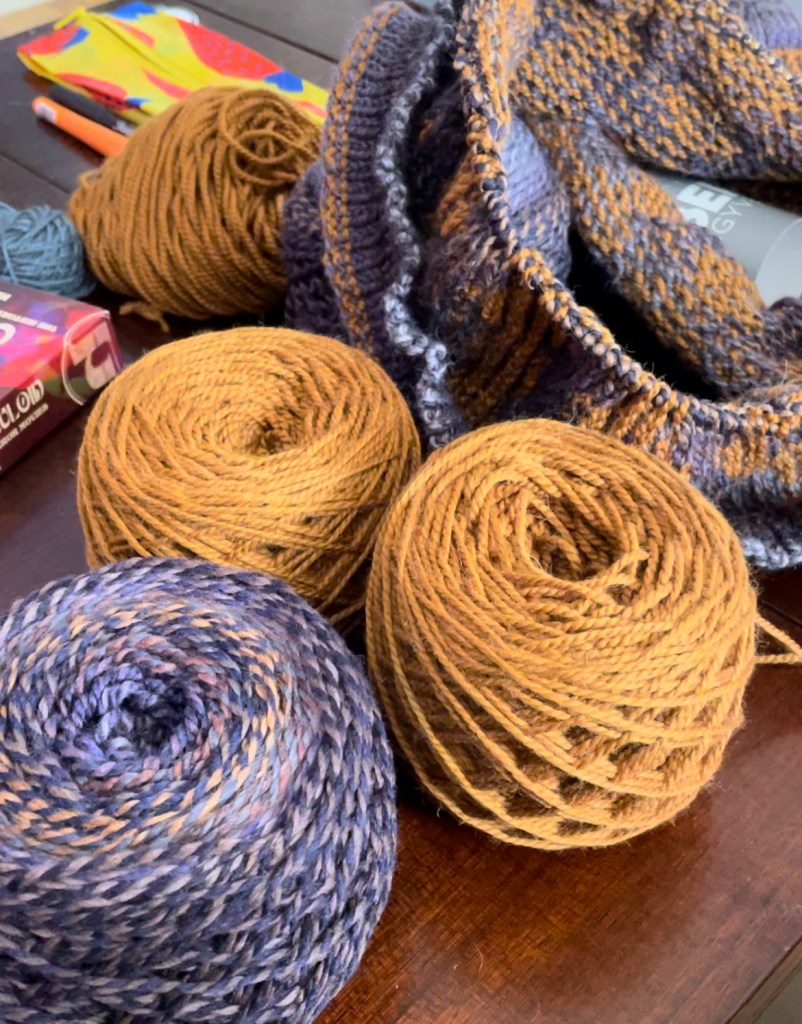
As striking as the monochrome was, I knew my DK-weight from Junction Fiber was perfect for this project. While mostly purple and gray, “Constellation” has some splashes of ochre and orange, so I wanted to find a rich, warm earth tone to pair with it. I found that at Rhinebeck later in the year from Fiber MacGyver, who was a new vendor at the 2024 festival; their color “Roasted Pecan” was a great complement.
Some wound up cakes of “Constellation” and “Roasted Pecan” sit next to my work-in-progress on Junco
I also adore mosaic knitting; while I want to improve my skill at stranded colorwork, it’s just so nice (and gentler on my knuckles) to only be managing one yarn at a time. Mosaic knitting shows off fractal-spun yarns like Making Tracks so well, and there’s a pixelated, 8-bit charm to the motifs this style creates; I appreciate the juxtaposition between my digital association with mosaic knitting and the millenia-old tile art that it’s named for.
For this project I sized up because I wanted this sweater to be roomy. As I have a 48″ bust circumference, this meant a big investment in the amount of yarn I was using and the time it would take. I also knew I wanted to add length to the body so the sweater would at least hit my hips. This bottom-up design uses an tubular long-tail cast-on for the hem and sleeves, and unfortunately my tension for this part was kind of loose, resulting in a flared silhouette. Instead of redoing it all, I sewed some elastic thread into the wrong side of the hem and sleeve cuffs, which both neatened up my ribbing and provided a stretchy edge, so I can it wear down at my hips or tuck it up under itself at my waist for a cropped look.
I’ve knit bottom-up patterns before, but this was the first raglan I knit bottom-up instead of top-down. At first I wondered what the benefit was, but I have to say it was nice getting the sleeves done before the yoke. It really felt like I was approaching a finish line when I was casting off the collar, with the rounds getting shorter and shorter as I went.
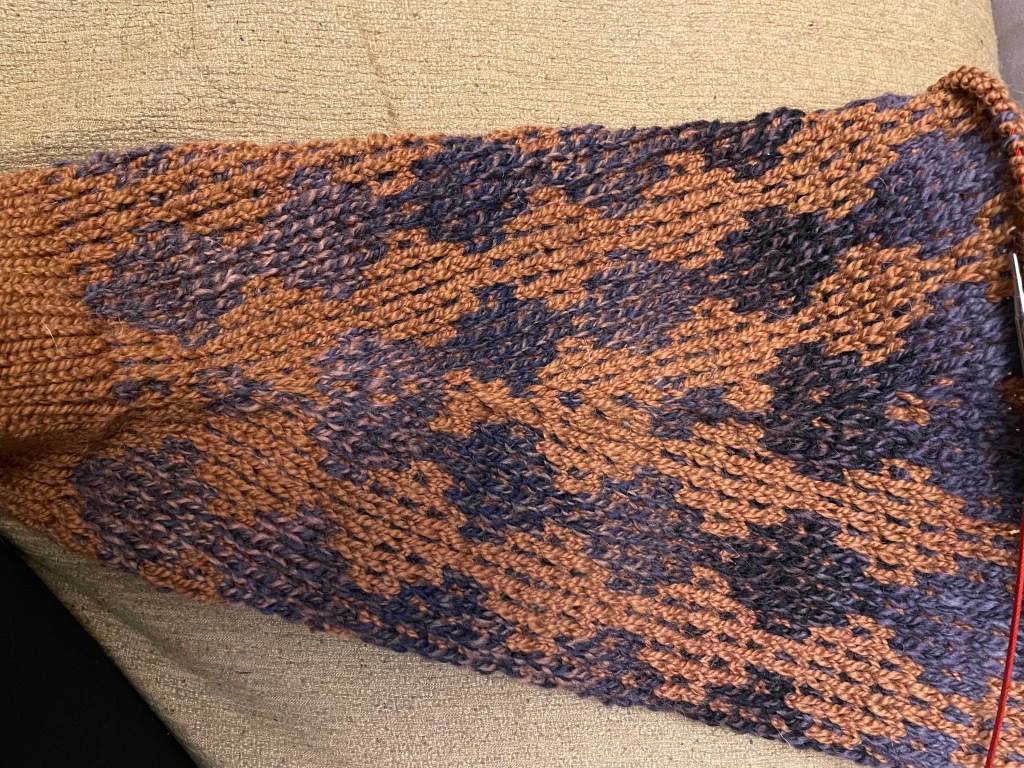
A close-up of the sleeve in progress. I think the increases look particularly cool.
From cast-on to blocking, Junco took me about 6 weeks to finish. The way the motif creeps from the increases of the sleeves and disappears again into the raglan decreases in the shoulders is psychedelically eye-catching, as is the shifting of colors in the yarn. I really couldn’t be happier, and I think it’s one of the projects I’m most proud of.
Apologies for the awkward/poorly-lit photos. My partner usually photographs my modeled pics and he’s out of town, so I had to take selfies.
Yarn
Junction Fiber Mill, Making Tracks in “Constellation” (MC); I used the leftover yarn in my Bookkeeper Cardigan
Fiber MacGyver, Merino Alpaca in “Roasted Pecan” (CC)
Mods
Added 3 repetitions of the chart to the body
Sewed elastic thread into the hem and sleeve cuffs for fit and stretch
Did a flat collar instead of a folded collar
What I’m Watching
*CW: I discuss medical procedural shows in this section, and they deal with plotlines involving overdose and addiction, suicide, gun violence, and transphobia.
I binged The Pitt in a day and loved it. The performances from the entire ensemble were outstanding, and I’m not surprised Noah Lyle is getting Emmy buzz. Because the season takes place over the course of a single ER shift, there’s an equally compelling supporting cast of patients and visitors who enter the ER, leave, move to other hospital wings, or tragically pass.
Once I finished the season I caught the bug for medical procedural. My family used to watch House every week while it was airing so in addition to the exciting tension of a medical mystery, this genre is also pretty nostaligiac for me. So I started ER, which also stars Noah Wyle, de-aged from traumatized ER chief to wide-eyed intern.
Watching the two shows back-to-back is an interesting way to compare the cultural attitudes and anxieties of today versus 30 years ago. In ER‘s first season, the writers include with gang-related gun violence perpetuated by teenagers and younger, patients with AIDs and HIV, and crack cocaine addiction. The Pitt handles a mass shooting, the fallout of Covid-19 and the collective trauma of healthcare workers, and accidental opioid overdose. ER has a recurring beat cop who flirts with one of the nurses and endearingly rushes a dog he accidentally hit with his cruiser to the OR, adopting the saved dog afterward; in The Pitt, a positive relationship with police is never guaranteed – some are helpful, some are patients, some are active obstacles to the doctors’ jobs. The Pitt portrays anti-maskers and anti-vaxxers with no patience for their nonsense, and explores a vignette of an aunt trying to secure an abortion for her niece before being interrupted by the pro-life mother; we watch the doctors perforate contemporary abortion restrictions and try to honor the pregnant patient’s choice to terminate while contending with the guardianship of her mom.
One of the hardest ER storylines to watch was that of a transgender woman being treated for injuries following a car crash, which is later revealed to be a suicide attempt. As soon as Rena’s doctors learn she is trans, they treat her with obvious contempt: nurses jokingly use slurs, and Carter, Lyle’s character, refuses to even speak to her if not necessary. Not one character on the medical staff ever challenges these attitudes, or treats Rena with dignity.
Rena speaks about her life experience as a trans person, describing the treatment she now faces from her doctors, but in the end she is written as a lurid interest story and not as a person. The character is played by a cis male actor, a miscasting problem that persists today – it privileges cis actors for roles when trans actors are already marginalized, and reinforces the idea that trans women are just men in women’s clothing. None of the doctors are shown to be even compassionate, let alone understanding, to her physical or mental health. At the end of episode, Rena completes suicide. Instead of coping with the fact that his mistreatment exacerbated Rena’s dysphoria, Carter is comforted by his supervisor and told that it was a simple oversight that they didn’t flag her ideation earlier. Then they go have Thanksgiving dinner together.
I understand that this episode is 30 years old and I’m watching it with a very different perspective on sex and gender. Apparently there are other instances of transphobic writing still to come. I also know that this kind of horrible treatment is commonly experienced by trans people in real life. But this is TV, and it’s not reality, it’s not real people making real decisions. It’s writers making the conscious choice to convey something to the viewer, and in this instance, it’s that trans people are inherently tragic, doomed, and unworthy of time and attention.
The Pitt also features a patient who is trans. Tasha, played by Eva Everett Irving, comes to the ER for a deep cut in her arm. She’s misgendered when her deadname is called to be seen, and corrects the ward clerk before going to get stitches from Dr. McKay and intern Javadi. As they clean and stitch her wound, they ask Tasha medically necessary questions, but also make small talk about her job as a high-end sommelier (Tasha’s cut is from a broken decanter). It’s cordial, relaxed, and friendly. At the end of the treatment, Javadi corrects Tasha’s medical record to reflect her name and gender so she won’t be deadnamed at future appointments, and apologizes for the error. Tasha thanks her for this, and Dr. MacKay praises Javadi’s attention to detail and empathy.
Here, the writers want to show a trans woman who is successful and content while representing how medical settings can be fraught settings for trans people. Tasha’s medical record outed her, which can be very dangerous if she was treated by a transphobic doctor – it was fixed. There was deadnaming – Tasha didn’t stand for it. Speaking of the writers, this episode was written by Noah Lyle. I don’t know if he included this patient interaction because of ER‘s track record of trans representation, but it was good to see the 180 turn in an episode that was already very personal for him.
I love granny squares. Despite their fixed shape, I think they’re pretty versatile. You can stop at any point and make them whatever size you want, and they have a delicious kind of pixelated appeal. And of course they don’t have to be squares, which just opens their potential even more. They can be arranged and built upon, like legos or tessellation blocks, into endless configurations.
It probably won’t surpise you to learn that these were my fuckin jam as a kid
And the granny stitch is really having a moment, particularly among the young folks. The younger-than-me folks, they in their teens and 20s. There’s an interesting phenomenon about the way Gen Z finds and consumes knitting and crochet patterns versus those of us in older generations, who have been using Ravelry, books, and magazines. They create and consume on video – Youtube tutorials and shorter-form Tiktok clips. These designs are more custom, fitted to a single body, often experimental and artistic. They’re tied to one of many microtrends and “vibes”. A lot of them are sexy! And when they do go viral, it’s often because the technique is so simple it hardly requires the effort of a written pattern – it’s better to show than tell, get views instead of individual pattern sales, or just make the item to sell.
Jack Black and Jason Momoa wear granny-stitch hexagon cardigans while promoting the Minecraft movie. The sweaters were made by Tosha Marie @treatyoselfcrochet, and there are many tutorials on Youtube on how to make your own. I’m thinking of making a couple for my niece and nephew for Christmas this year.
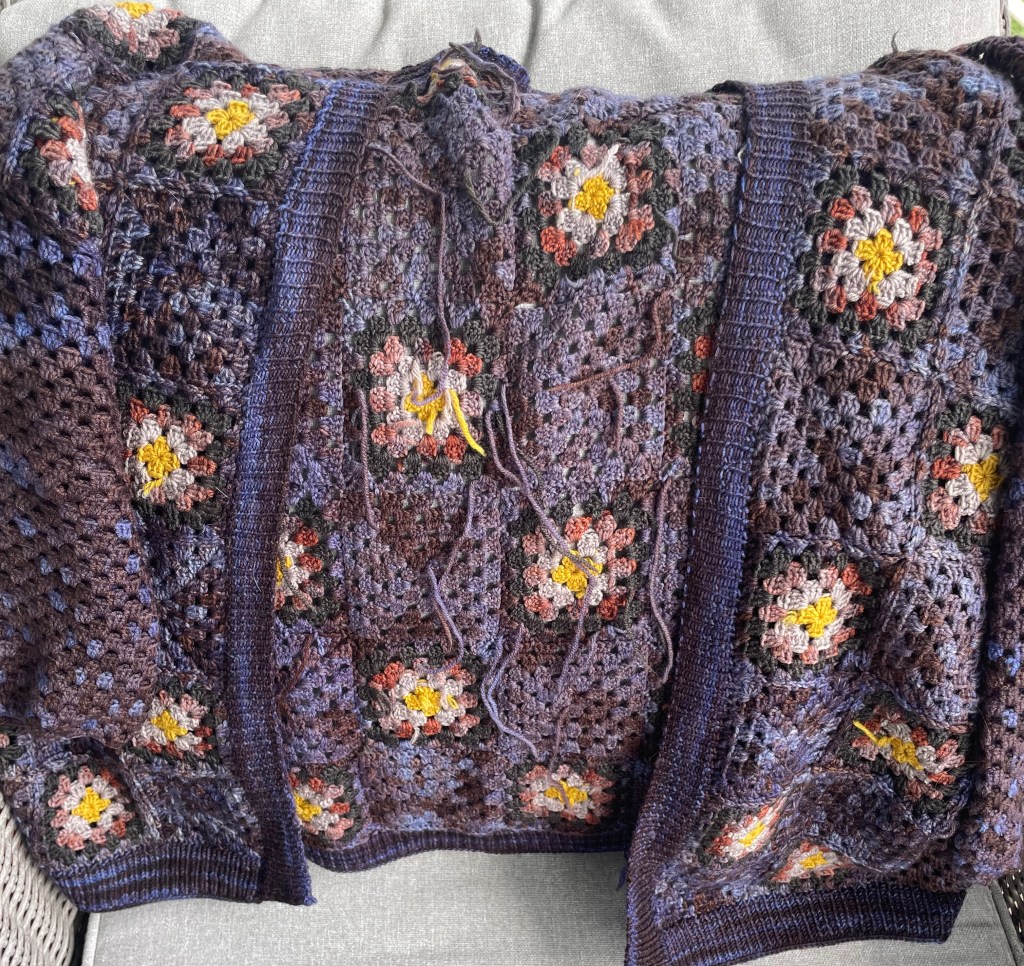
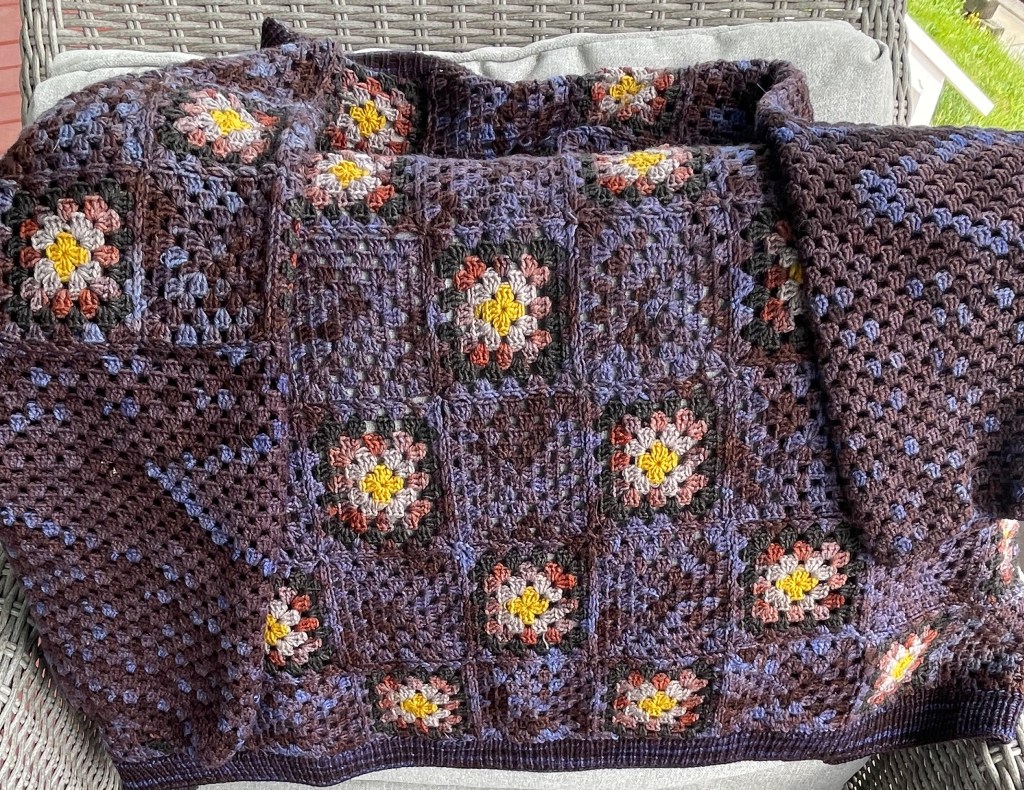
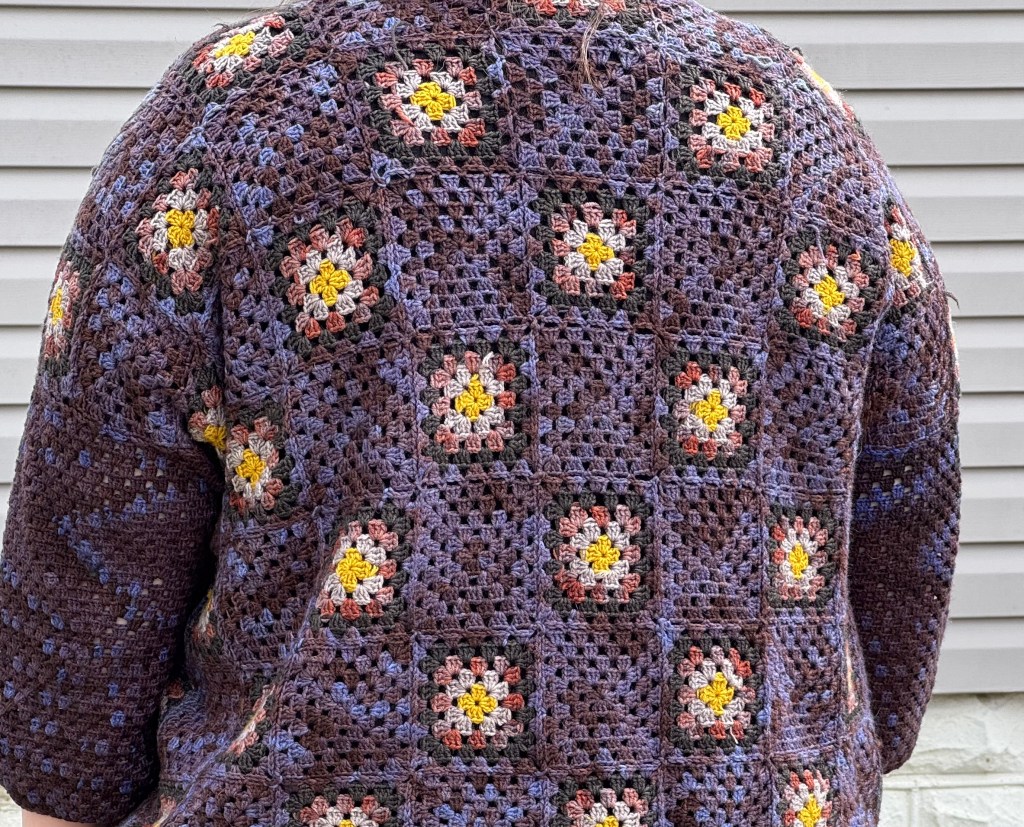
Granny stitch – so hot right now. Last year I couldn’t resist jumping aboard, so I pulled together some odd partials of sock yarn from Neighborhood Fiber Co. to create my own granny square cardigan.
My granny square cardigan unmodeled showing all the ends I never wove in
This project was improvised and only made with my own body in mind, but I did take much inspiration from Amy Christoffer’s Ariana Cardigan. I just kept making squares and attaching them as I went until I felt I had enough to reasonably cover my back and shoulders. It was a great travel project – I remember I was working on this quite a bit during the 2023 holidays and driving to see family, and it’s nice not to need a pattern pulled up on my phone or printed out.
Once all the squares were assembled, I draped the two front panels over my shoulders and marked enough room for arm holes, then seamed up the sides. Then I just did simple granny stitch sleeves in the round, decreasing every ten rounds or so until they got to 3/4 length. While I had just enough of my contrast colors, I did not luck out with the main color, and had to get two more skeins to complete the project. No regrets, I love this color (Petworth).
I wore my granny square cardigan out this week when I went to see Faetooth during their first east coast tour. Faetooth is a three-piece from LA who describes their ethereal, shoegazey metal as “fairy doom”, and when I saw they were coming to my city I jumped on a ticket (good thing too, the show was sold out). They were touring with Sunrot, who I hadn’t heard of before, but were an absolute pleasure. Sunrot especially has incredible stage presence and messaging; they had free fentanyl testing strips, narcan, and condoms available for the crowd, and brought an expert on harm reduction on stage to talk about community care. When it looked like a fight might break out in the crowd, Sunrot’s singer stopped the set to make sure everything was cool and that no one was about to get hurt. And both they and Faetooth delivered messages of love for trans and non-binary people and solidarity for Palestine. There’s been many metal musicians who’ve gained notoriety for acts of violence and depravity to shock the “normies”; but there are as many metal musicians who point out that violence and depravity are in fact very mainstream, especially when perpetrated by our governments. The message of this show was that taking care of one another is the radical act.
I knew I wanted to wear something handmade to this show because DIY is a big part of metal and punk music, and well, this is how I DIY. In addition to enjoying the music, I enjoyed the crowd and the hand-stitched patches on their battle jackets, their hand-painted and dyed clothes, their repurposed and mended fabrics. There is an interesting event horizon here, where sustainability for aesthetics and sustainability for economic necessity meet and it’s unclear which came first. Either way, it’s craft, and craft/art/music says “If it does not exist, make it.”
My granny square cardigan, modeled and still showing some of the ends I never wove in
Yarn
Neighborhood Fiber Co. Studio Sock, colors (Center of the granny squares outward) Oliver, Federal Hill, Cedarcroft, Upton, Petworth)
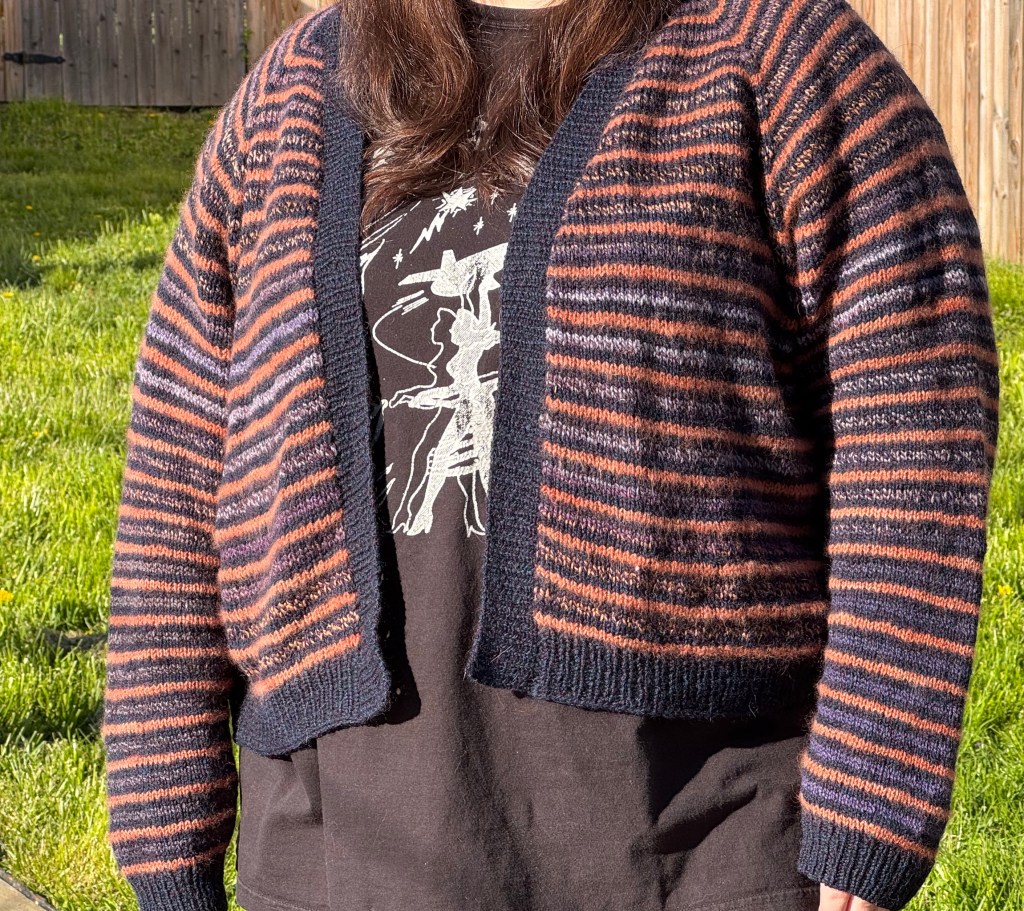
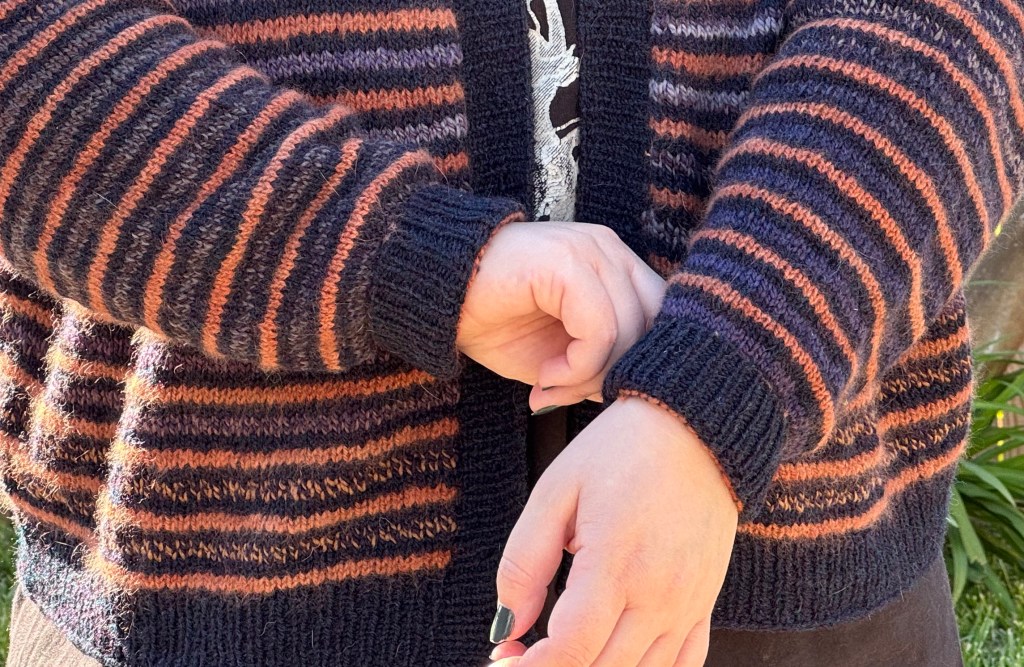
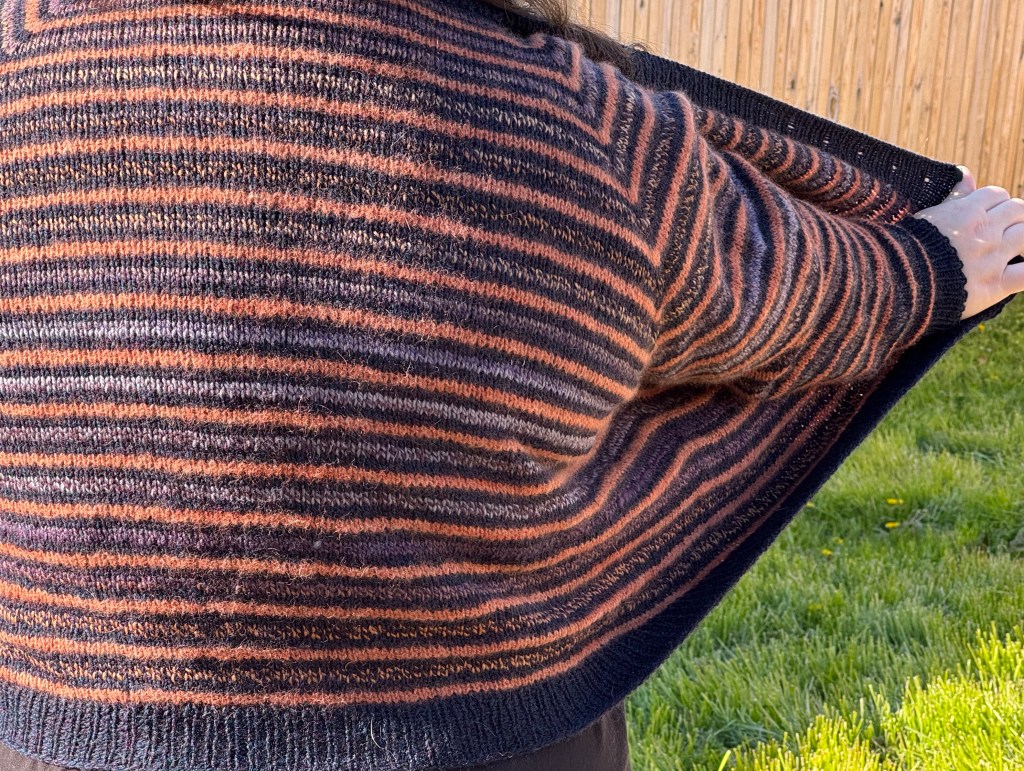
Stripes are probably the most efficient way to use up as many odd skeins in my stash as possible. And I had been itching for a cardigan because so many of my sweater projects recently have been pullovers. Enter Taylor Owen’s Bookkeeper.
Raglan, top-down, and stockinette, the Bookkeeper Cardigan makes use of thin stripes and a corrugated hem/button-band to funkify a chill layering piece. It has a pretty low armpit, creating a wider fit that is gently snatched with some subtle waist shaping. This cardigan is very relaxed, and the waist decreases could always be skipped if you prefer a more rectangular torso.
However, because this was a stashbusting project, I skipped the corrugated ribbing because I was afraid I would only have enough of one of my contrast colors for the body. I ended up not even having even that much, and needing to order an additional skein anyway, so joke’s on me. Shoulda just gone for it (sigh).
I will say I don’t mind having most of an extra skein of Junction Fiber Mill’s Making Tracks around though. I love this yarn, and Peg and Amanda are gems. I’ve been enjoying their drops of pop-inspired colors. I first used Making Tracks in my Junco sweater; I’ll probably share that in another FO Friday post soon since I’ve been meaning to take modeled photos of it.
Mods
No corrugated ribbing, just straight 1×1 on the button bands and hems
Different frequency of decreases on the sleeves for desperate yarn conservation (🧶🐓)
Sleeves are shorter because i have t-rex arms.
Yarn
Kelbourne Woolens Scout, “Navy Heather” (MC)
Junction Fiber Mill Making Tracks, “Constellation” (CC1)
Mystery sport weight, terra cotta orange (CC2)
What I’m listening to
The other day my good friend asked if I had an “anarchy playlist”, because they’re building one of their own and were looking for inspiration. I just happened to have something for them, which I’ll link below. I’m excited to hear theirs when they’re finished with it.
I also took a deep dive looking for new metal to listen to, but metal is a genre unfortunately plagued by fascist and nazi sympathizers. Luckily, the Anti-fascist Black Metal Network is here to help boost bands and labels that have progressive politics.
I’m not telling anyone to listen to metal with me, I’m aware that it’s not everyone’s cup of tea, but it’s not just these fringe subcultures that have a nazi problem. Obviously it’s the entire American government, which is disappearing people, both documented and undocumented, and sending them to concentration camps. This is not hyperbole. That prison in El Salvador is a concentration camp, and the government wants to send whoever they want there.
With that, I’ll leave you with my playlist, and this: trans women are women, immigrants are your neighbors, release Kilmar Abrego Garcia and Merwil Gutiérrez and anyone imprisoned in CECOT, and no one is illegal on stolen land.





 Smitty is Knitting