Tag: knitting

  • Comedia dell’arte. Comedia dell’yarn-te?

    Comedia dell’arte. Comedia dell’yarn-te?

    Down to clown in Venice

    I began indulging my love for harlequin motifs with my Junco Sweater, but at the end of last month, I got to visit the harlequin homeland: Italy!

    My partner, who is a freelance assistant camera operator, worked on Cover-Up, a documentary about journalist Seymour Hersh and directed by Laura Poitras and Mark Obenhaus. He was invited to attend its premiere at the Venice Film Festival, and I got to go with!

    This event was wild. Most of the time, I felt like I had snuck into the back door of a party I hadn’t been invited to. My partner noticed Mads Mikkelsen and was tempted to tell him how much he enjoyed his work in Death Stranding. I accidentally caught Tilda Swinton on camera trying to film an art installation. Willem Dafoe was hanging out in the hotel bar. I drank Negronis while watching people I can only assume were European royalty pass by in evening gowns. Guards walked around wearing military berets and machine guns. I was nervous to make sudden moves.

    The level of wealth was strange to me. It was strange to witness in person. It was especially strange considering that Cover-Up is about a guy who blew the top off multiple war crimes committed by American’s military, namely, the My Lai massacre during the US invasion of Vietnam, and the torture at Abu Ghraib prison during the invasion of Iraq. Hersh is a truly remarkable person who pursues the truth regardless of what people think, and what enemies he makes. He’s been accused of spreading conspiracy theories. He was the subject of angry, worried phone calls between Nixon and Kissinger. He’s on the left in this photo from Reuters.
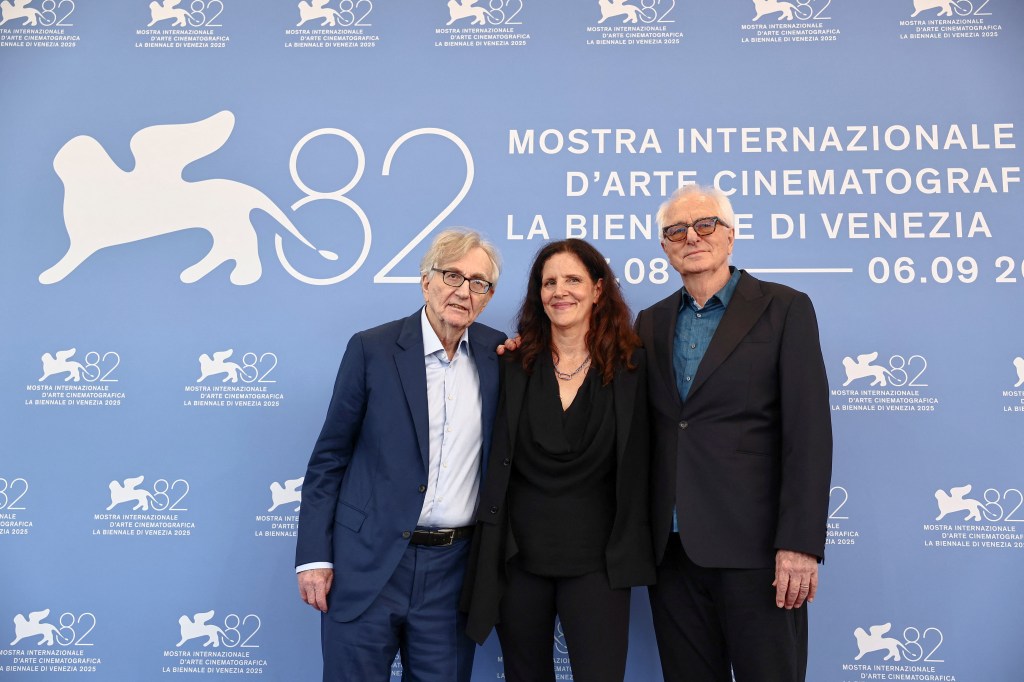
    Director Laura Poitras, director Mark Obenhaus and journalist and political writer Seymour Hersh pose during a photocall for the movie “Cover Up” out of competition, at the 82nd Venice International Film Festival, Venice, Italy, August 29, 2025. REUTERS/Yara Nardi

    The same day Cover-Up premiered, so did After the Hunt, a new Luca Guadagnino movie starring Julia Roberts and Ayo Edebiri. We passed the red carpet during their entrance but couldn’t see over the wall of photographers. But I do wish I had seen Roberts’s dress with my own eyes:
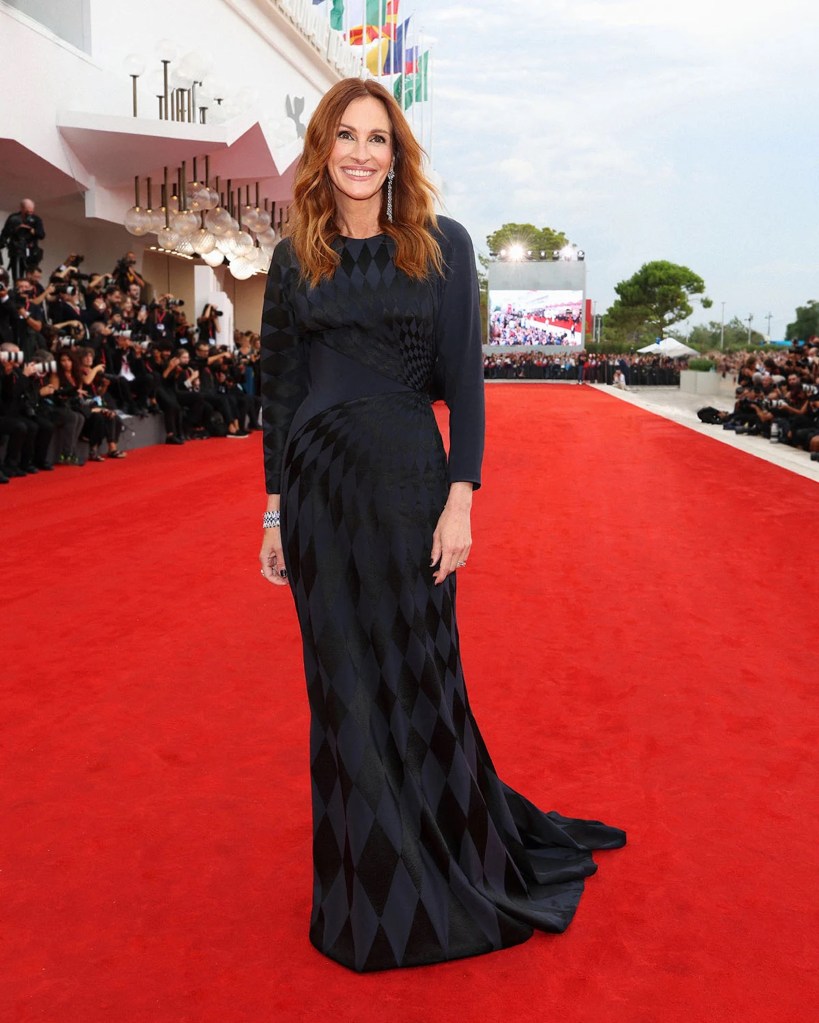
    Julia Roberts stands amiling on a red carpet. She is wearing a black gown with a low-contrast pattern of diamonds.

    Roberts wore Atelier Versace, a long blue-black gown with a low-contrast pattern of diamonds cascading down the skirt and rising up the shoulders. I thought this was a fashionable nod to the history of comedia dell’arte and Harlequin in its country of origin.

    In commedia dell’arte theater, Harlequin is a stock character, a servant and a trickster with two masters, undermining the authority of both. Which is also why Harley Quinn of DC comics makes such a good anti-hero: sometimes allied with the abusive Joker and sometimes Batman, she flips between her penchant for chaos and her moral agency.

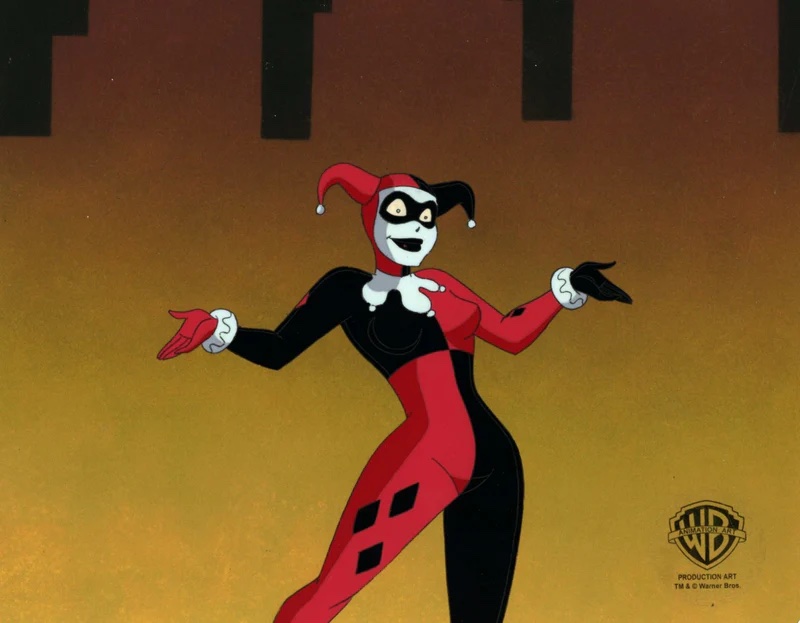
    Harlequin’s costume patterns range from diamonds to patchwork triangles, often colorful and bright, but sometimes black and red. And in Venice, those motifs manifest in Carnevale masks. As a former Catholic, I still feel drawn to the gilded imagery of Catholic religious ritual, and the way it has adapted (or appropriated, in many cases) pagan traditions. It’s catnip to a heathen like me.
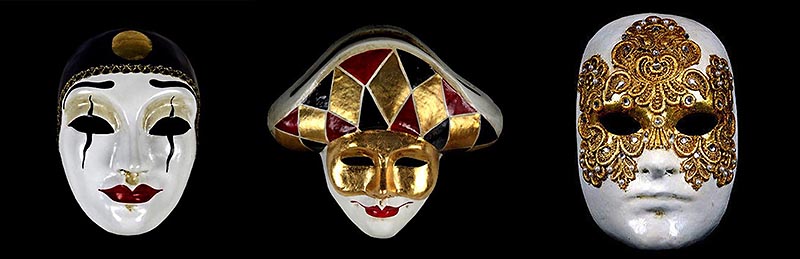
    A trio of Carnevale masks. On the left is a white mask with red lips and wavy lines crossing vertically over the eyes, and a black cap shape over the forehead. In the middle, a mask with red lips and a gold mask over the eyes - this figure wears a crescent-shaped headpiece with gold, black, and red diamonds. On the left, a mask that is completely white except for a large golden filigree covering the foreheard, eyes, nose bridge, and cheeks.

    I also got to visit the Peggy Guggenheim collection, where they happened to have a temporary exhibit featuring the work of Helena Maria Vieira da Silva, a Portuguese abstract painter who mapped space using grids of colorful squares. I was really taken by this exhibit and Vieira da Silva’s style, and I think it’s no coincidence that she also worked in tapestry and stained glass – the way those forms naturally lead toward geometry, pixelation, and abstraction probably had an influence on her painting style, the signature use of a grid to create depth and find form in her depictions of movement, cityscapes, and interiors.
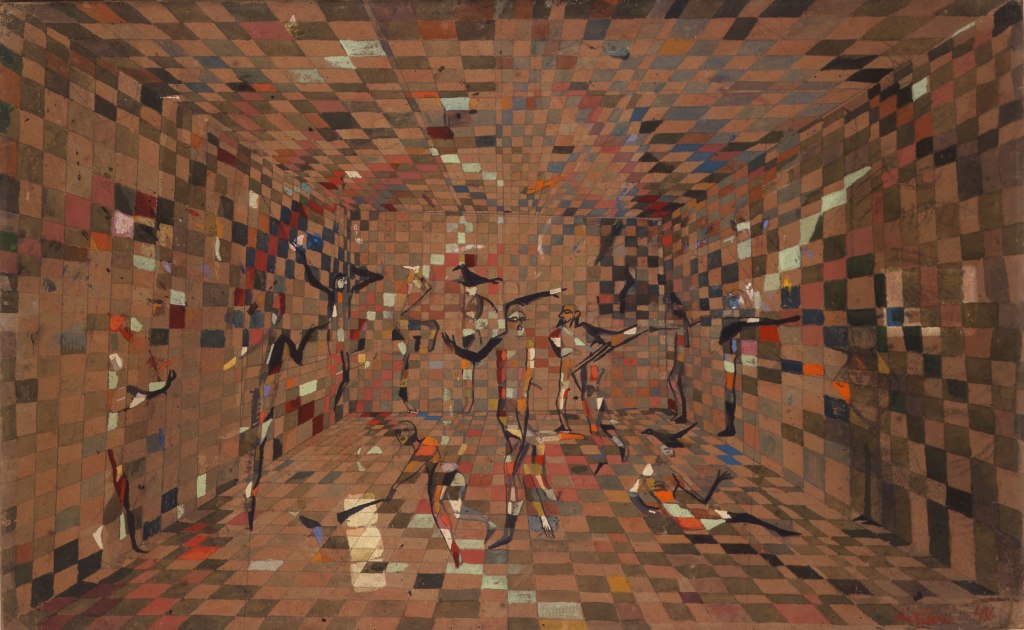
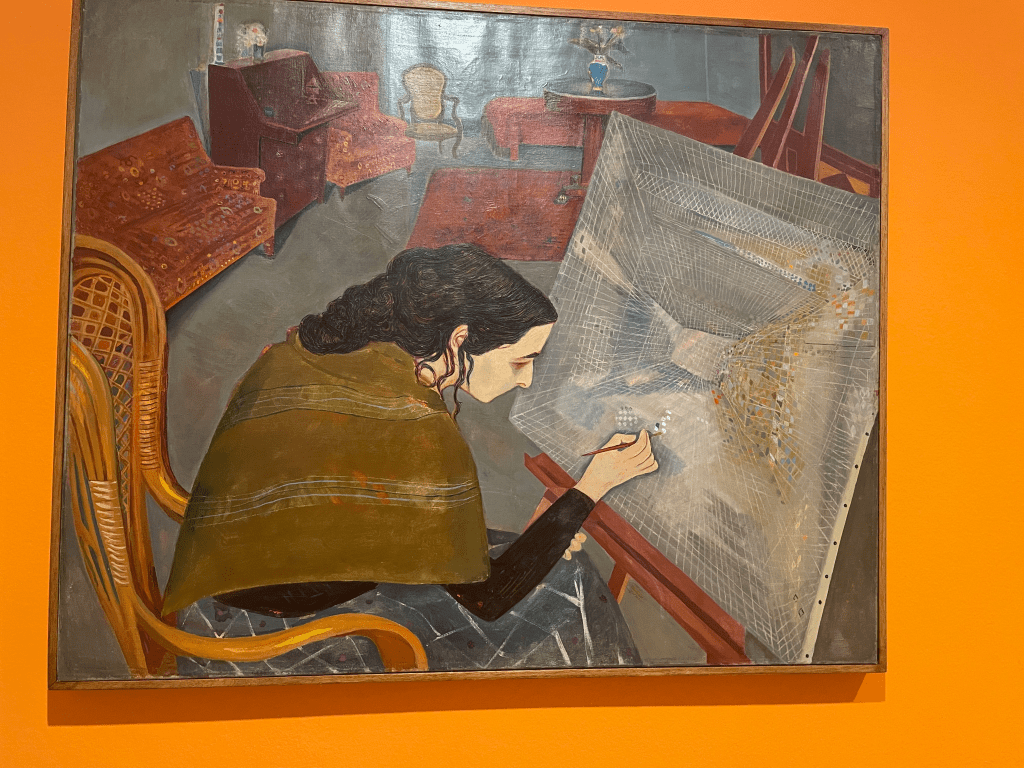
    Now that I’m back from Venice, I’ve been looking for ways to translate that interest in diamond motifs into knitwear. Through my searches on Ravelry, I came across this project by user SilasM.

    That was it, that was exactly what I wanted to make. The pattern is Harlequin Pullover by Anne Mieke Louwerens, an artist who has worked in textiles and knitwear design, painting, graphic design, and ceramics.

    But I had a small roadblock. I couldn’t find this pattern online anywhere, because it was originally published in the fall/winter 1988 issue of Vogue Knitting.
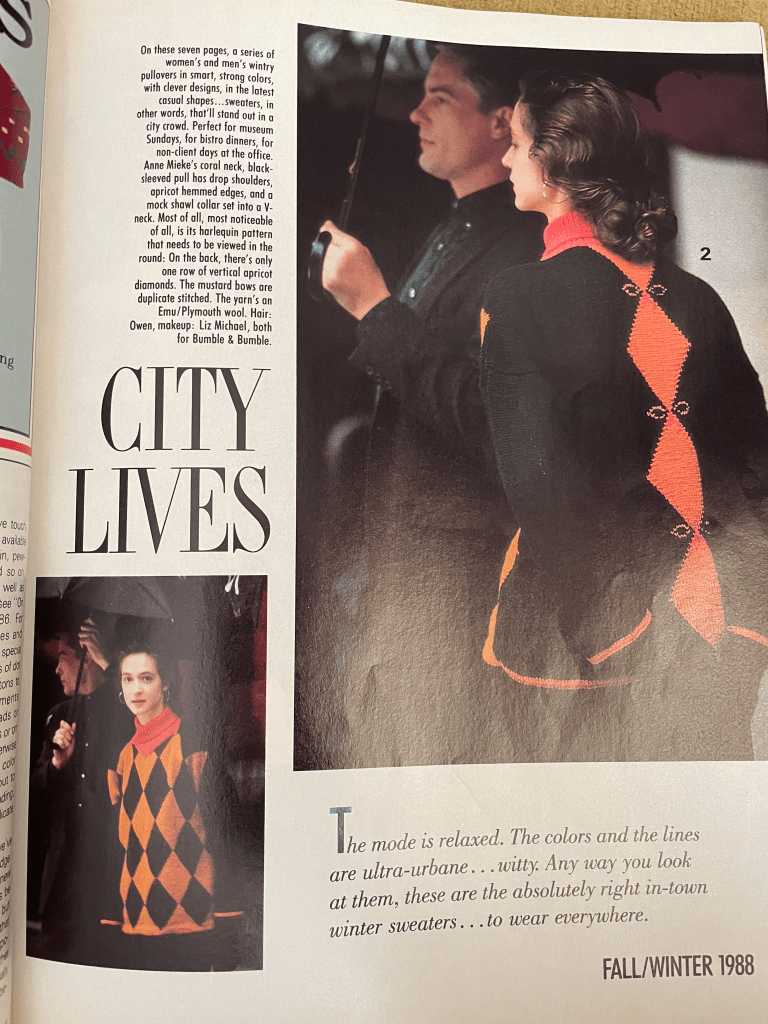
    A page from the issue of Vogue Knitting where the Harlequin sweater is modeled. Int he main photo, the model is acing away from the camera and a single line of orange diamonds on a black background is shown on the back. There are duplicate stitch bows adorning the tops of the diamonds. In the inset image on the bottom left, the models faces the front, showing the grid of orange and black diamonds and a coral cowl neck. In both photos, the model is standing next to a man in a suit, holding an umbrella. The model is a white woman with brown hair, wearing gold hoop earrings.
    The Harlequin sweater modeled in the Vogue Issue.

    But that’s why God made eBay, right? Luckily I found a hard copy of the issue from a seller on the site, who kept this magazine miraculously preserved for the last 36 years.

    After looking at the pattern directions, I’m already planning a couple mods. To feel truly in the piebald spirit of Harlequin, I want to make all the contrast color diamonds different colors. I’m also planning to add some shoulder shaping, and sleeve decreases to preserve some yardage. I’m split on the cowl neck. I love how it looks, but I’m partial to lower necklines. It’s added by picking up the stitches around the neck after the rest of the sweater pieces are grafted together, so I won’t have to make a decision until much, much later.

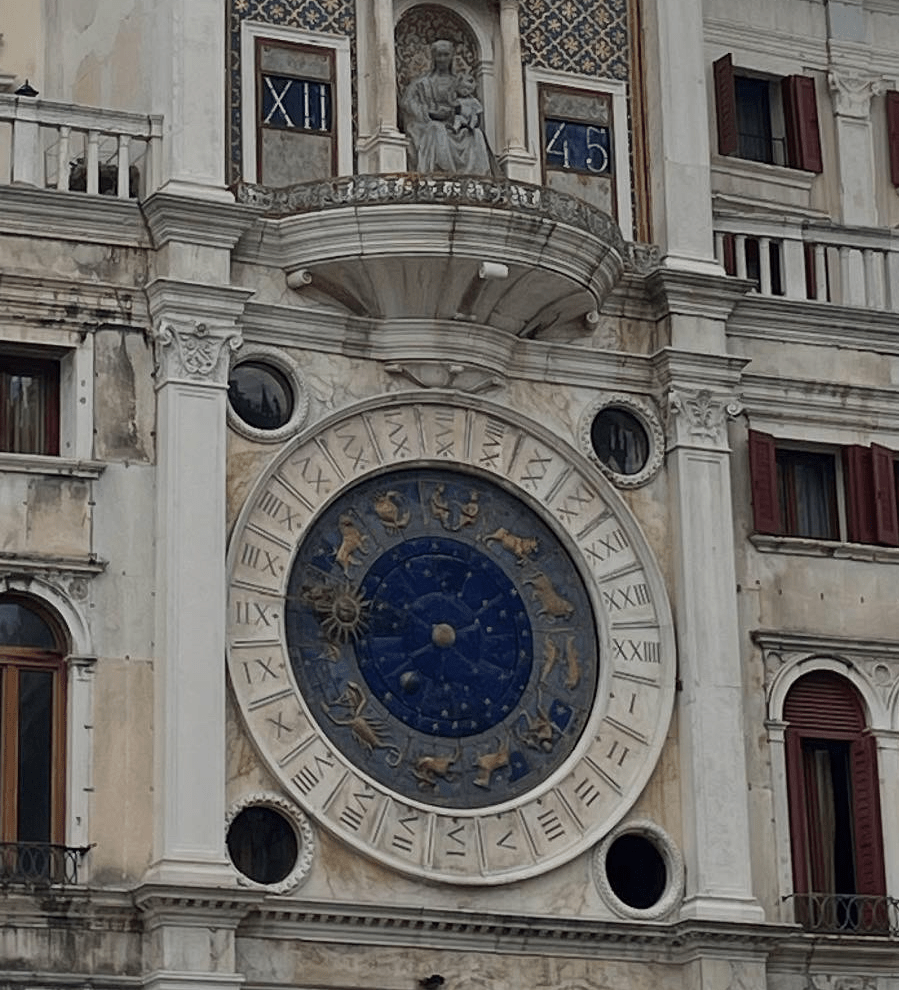
    The diamond motif wasn’t the only thing that caught my eye in Venice. Right now I’m also enamored with celestial imagery, which is all over the city (and other parts of Italy, according to my friend who has traveled more extensively there). So I was completely transfixed by the Torre dell’Orologio in San Marco Square, an astronomical clock tower depicting the 12 zodiac signs. It tells the time, and the positions of the moon, Mercury, Venus, Mars, Jupiter and Saturn, as well as the astrological position of the sun.
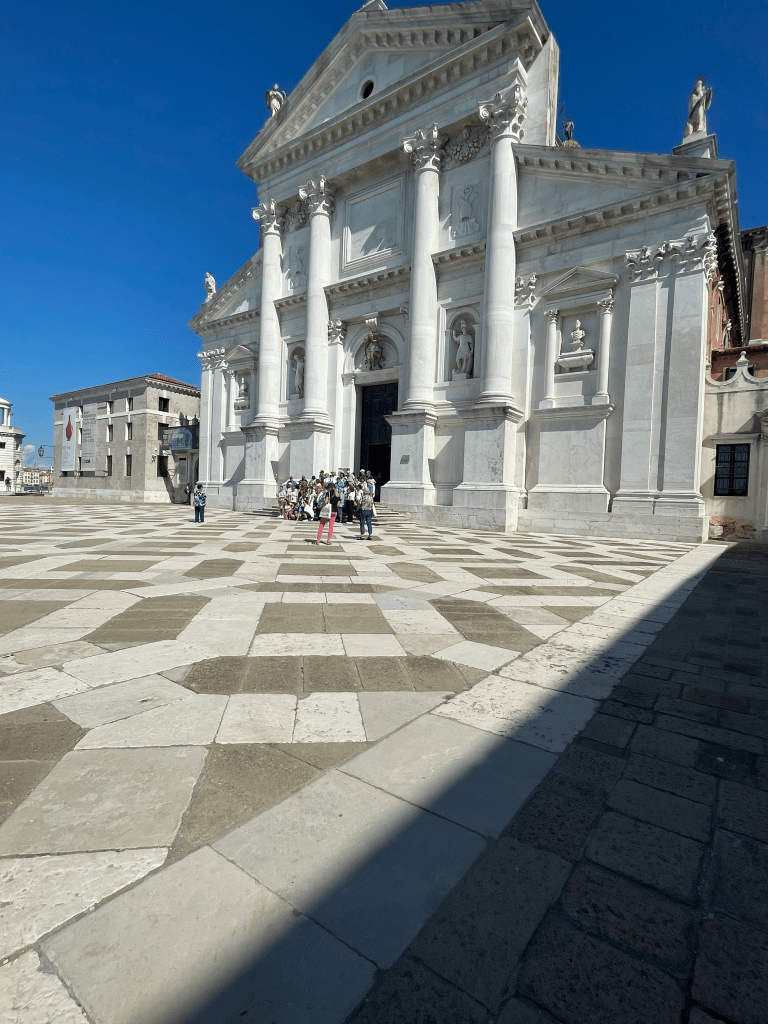
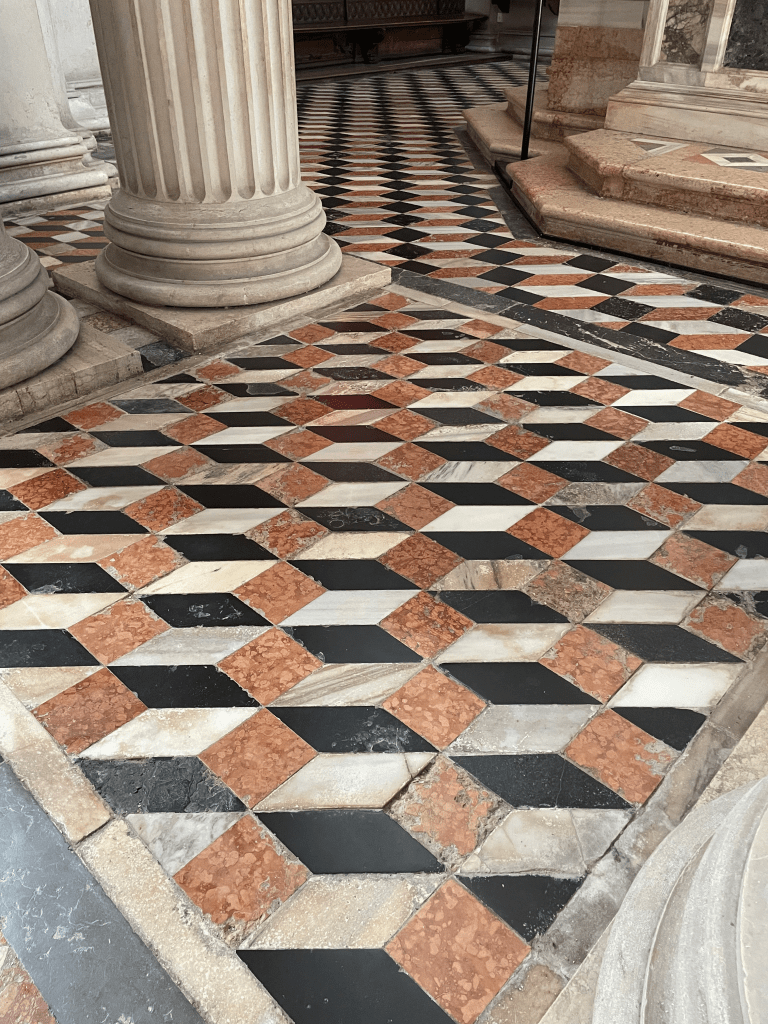
    I also found plenty of inspiration in the tile floors at San Giorgio, a church and monastery. The island, San Giorgio Maggiore, is also home to a photography gallery, which had an exhibit on Robert Mapplethorpe while we visited.
    In addition to Venice’s classic sights, we were invited by the Cover-Up production team to the Biennale Architetturra to see the installation “Calculating Empires” by Kate Crawford, a researcher who has been studying AI for the past decade, and artist Vladen Joler. I got to speak a little with Dr. Crawford, who was so extremely cool. The project is available to view online here.

    Also at the Biennale Architetturra was Necto, an installation made from knit fiber and LED lights. Read the full details here.
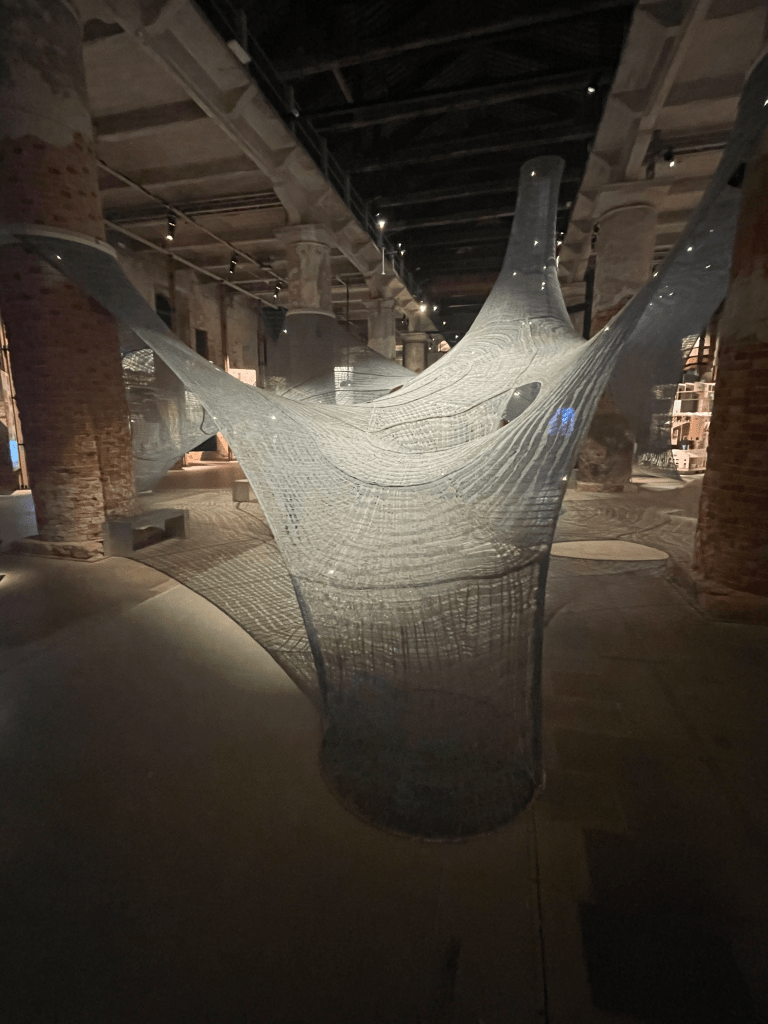
    A large knitted art piece is suspended on multiple brick columns in a large room, kind of like a giant spiderweb. Multiple lines of LED lights run through it, and dots of light can be seen throughout.
    This is what I was filming when Tilda Swinton’s tour group came through.

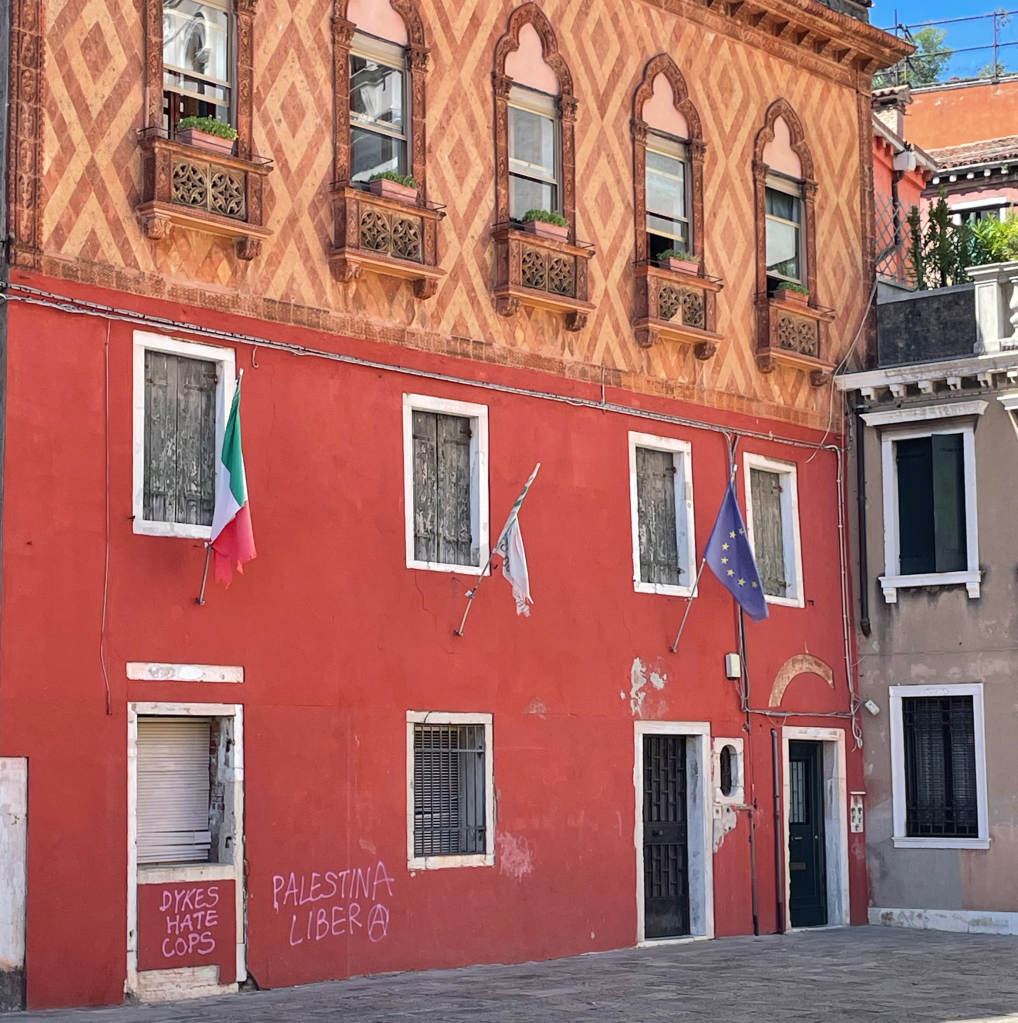
    And besides the “official” art, there were tons of murals and graffiti all around Venice. Much of it was anti-Amazon and anti-Bezos, since he had just completely shut down the city for his own wedding just a few months prior. Most of it was in support of a free Palestine and an end to the genocide in Gaza.

    And last, the two funniest images I took. On the left, a young man whose whole job is to carry a falcon around to scare pigeons away from this rooftop bar. On the right, a trio of suited, ear wire-wearing tough guy security guards at the Film Festival take a much-needed gelato break.

    There are worse gigs, probably.
  • FO Friday: The Oliveros Cardigan

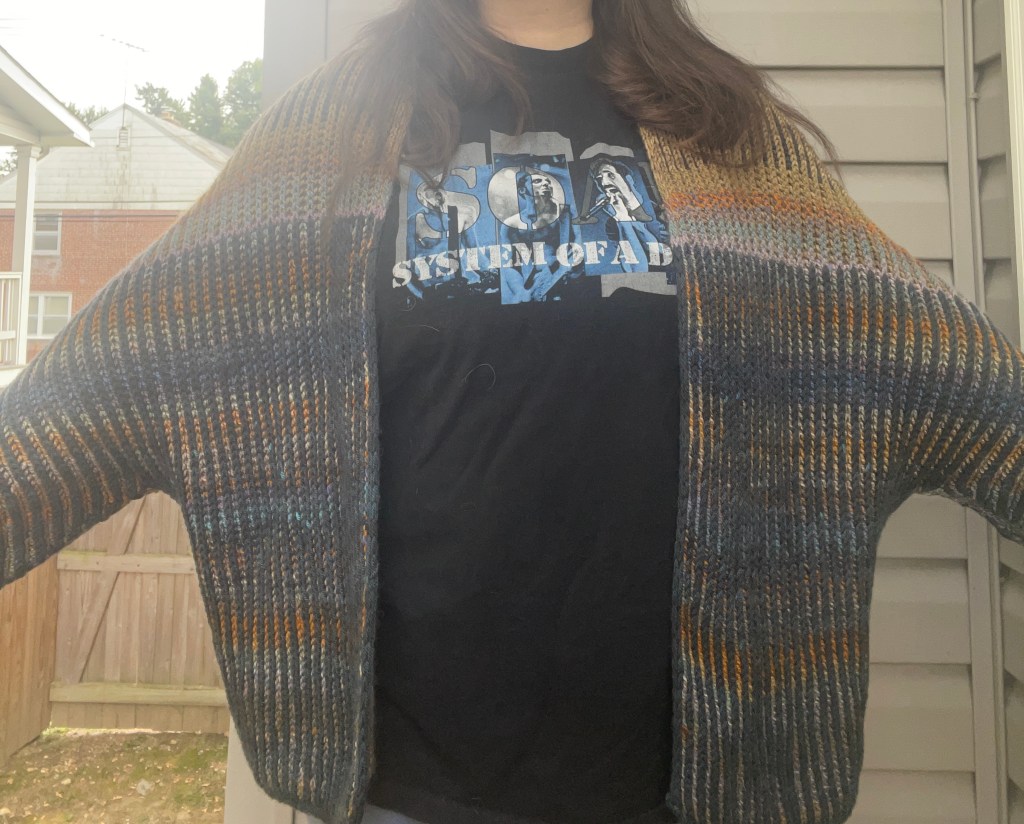
    I’m really on a cardigan kick! The ones that I’ve made in the past have become too small for me, with the exception of my Felix Cardigan, which is an excellent staple piece that pretty much goes with anything. But lately I’ve been wanting showstoppers and statement-makers, especially when they can eat up as much of my stash as possible. A two-color brioche design like the Oliveros is ideal for this.

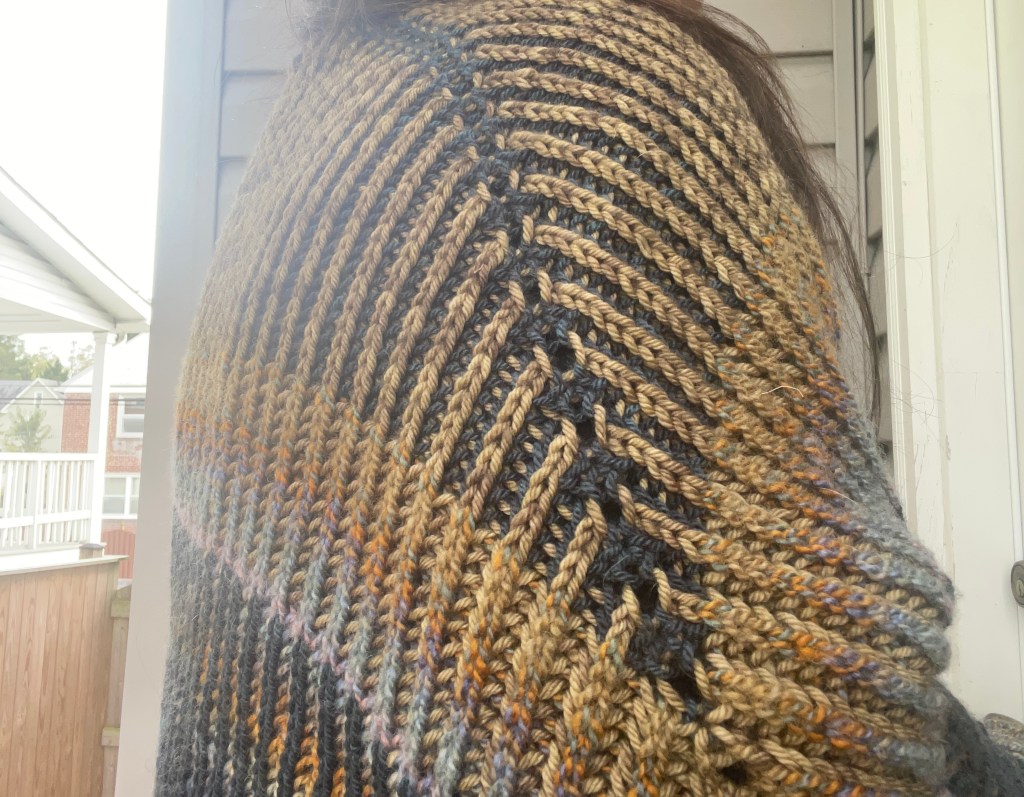
    Brioche is an intimidating technique to learn, and fairly time-intensive (you basically work every row/round twice), but it creates one of the most relaxed fabrics in knitting. Cleo Malone, the designer, embraces that with a construction mostly unfettered by anything that constricts the stitches too much. No picking-up of stitches, no seaming. While well-designed, there’s very little structure. The whole sweater grows like organic matter from a central point at the back of the neck and over the shoulders, stretching with the body to let those flashes of contrast color shine through.

    Of course, the relaxed nature of this pattern means it will grow significantly during blocking, which is what happened to me. The sleeves are actually quite a few inches past my wrist (and my fingertips). That’s okay with me, though, I’ll just cuff the sleeves. But if you want something more to your measurements, block with caution.

    There’s a distinct cloak-iness to this pattern, so I decided to go full fantasy with the color choices. Blue and gold has always reminded me of magic and wizards, so from my stash I chose a deep navy/teal mystery yarn that I had left over from a sweater I made for my dad, “Willow” from Yarn Nouveau (an antique gold shade), and “Tectonic” from Feederbrook Farm, a prismatic marl with gold, blue, orange, and periwinkle. I have a whole Pinterest board of wizardy visuals, and I’m a sucker for the celestial aesthetic.

    What I’m listening to

    The wizardly inspiration isn’t surprising when I’ve been hosing down episodes of “The Wizard, the Witch, and the Wild One” from Worlds Beyond Number, a D&D actual play podcast with some giants of the TTRPG world: Aabria Iyengar, Lou Wilson, Erika Ishii, and Brennan Lee Mulligan. Iyengar plays the Wizard Sky (Suvi to her friends – the naming conventions of wizards is a whole thing in this universe), a magical prodigy balancing her duty to the institution that raised her with the outsider perspectives of her close companions: Ame, a rural-dwelling witch whose power comes from communion with nature and spirits (Ishii); and Eursulon, a spirit who has become stranded in the mortal plane where he is at risk of persecution (Wilson).

    The title image for the Worlds Beyond Number podcast. on the right, the words "Worlds Beyond Number" appear on three lines in white font. On the left, the cast - Mulligan, Wilson, Iyengar, and Ishii - sit around a campfire telling and listening to a story. A line of tops of pine trees line the bottom of the image. The flames from the campfire spreads in a supernova-esque swirl around the rest of the banner, coalescing into a ball of light behind the "o" in "Beyond". Everything is on a deep teal, starry background.

    Iyengar and Mulligan, the dungeon master who runs this campaign, have created a very different vision of wizards than I’m used to. In table-top games, wizards can cast powerful spells and learn many different kinds of magic, but are known for being “squishy”, or easy to physically harm. The image of an old bearded sage in a tall brimmed hat persists.

    Not here. Suvi is a young Black woman with a hot boyfriend and a caffeine addiction. Her adoptive mother figure is a sword-wielding valkyrie of a mage. The Citadel where they live is both an academic and military headquarters. There are spells that become people – a personified mage hand cantrip works as a baker and makes Suvi’s favorite sandwich. Wizards can donate their unused spell slots to other wizards who might need them more. They can imbue physical objects, including weapons, with spells. In “WWWO”, what is possible when magic can reshape reality is truly and thoroughly explored. Why couldn’t a wizard be anything, really?

    It’s actually a little terrifying. I’m not very far into the campaign, but I’m waiting for the shoe – the shoe being that the Imperium and the Citadel are unsustainably powerful and, for all their wonder, must be dismantled before it embroils the world in unending war – drops. Highly recommend.

  • WIP Wednesday: Aquamarline

    WIP Wednesday: Aquamarline

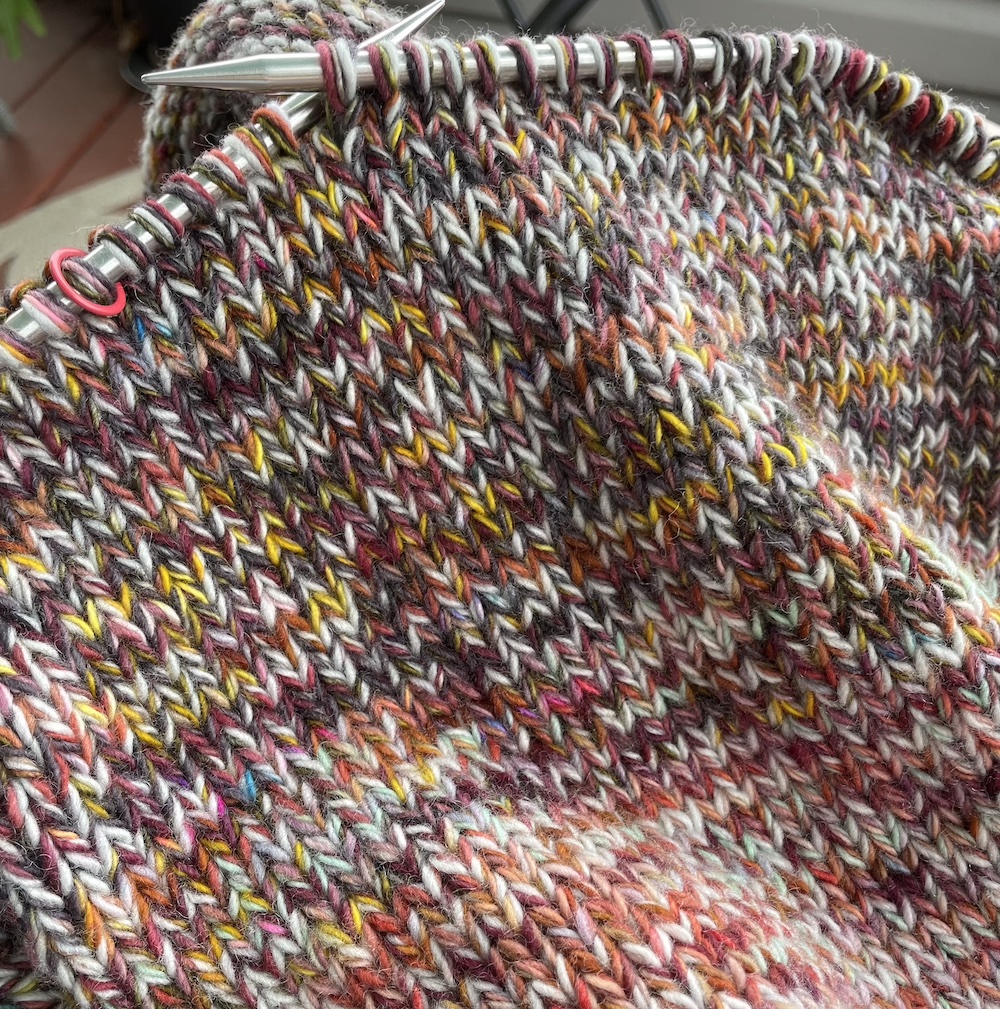
    Well, my quest to reduce my stash continues as I’ve begun AquaMarline by Park Williams. I recently finished two cardigans (I’ll cover those in a FO Friday post) and I was itching to start something new, mainly because I will be traveling soon and I wanted to have a project in-progress for the planes, trains, and automobiles.

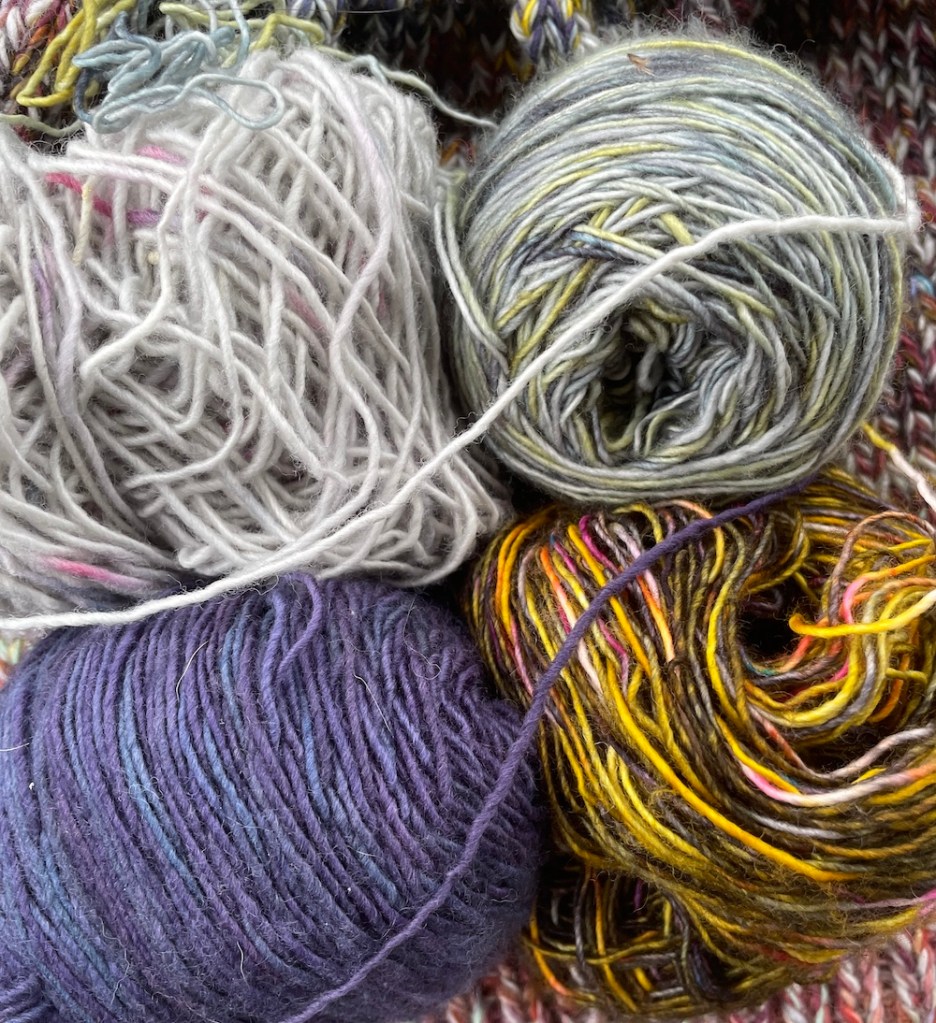
    Four balls of yarn. From clockwise bottom left: A deep blue and purple yarn, a silver yarn with pink speckles, a light green yarn speckled with yellow and dark blue gray, and a multicolor yarn with brigh yellow, hot pink, and blank.
    Four of the many colors that will comprise the sweater. Clockwise from bottom left: Hamilton, David Hess, and Block Party in Rustic Fingering from Neighborhood Fiber Co, and a Skinny Single from Hedgehog Fibres (lost the label so I’m not sure of the color name!)

    Is a bulky sweater knit primarily from four strands of single-ply fingering the most practical choice for a travel project? No, but I’ve been on a large project kick for a while, so I stuffed the project and all four yarn balls into my backpack and moved a pair of shoes into my partner’s luggage.

    I didn’t notice until I went to cast on that AquaMarline is a raglan knit from the bottom up. And it wasn’t until I was nearly done with the torso that I thought that might interrupt the marling gradient; I didn’t want the sleeves, knit separately and then attached to the body, to have a completely different color scheme and then have a noticeable border when they joined. So instead of starting the sleeves from the cuff, I started them from the other end. I did a crochet cast-on for the number of stitches needed for the widest part of the sleeve, and knit a couple of rounds in the same colors used in the torso. Then I attached the sleeves, and when I finish the body, I’ll return and knit the sleeves down to the cuffs. A crochet cast-on, like a provisional cast-on, will let me pick up live stitches when I’m ready.

    The torso of my Aquamarline with the beginnings of the sleeves attached.

    I think this pattern would offer much smoother color distribution if it was designed to be top-down rather than bottom-up, but as the design description says, this pattern is all about playing with color and experimenting. Maybe I’m just a little too much of a control freak to allow for some heavily randomized color schemes.

    Where I’m traveling

    I brought my Aquamarline with me on the Amtrak to Philadelphia, where I saw one of my very favorite bands at Citizen’s Bank Arena. Yes, after 20 years of trying to see them live, I finally saw My Chemical Romance in concert. Truly, truly a dream come true for me. In the days since I’ve been relishing the feeling of being 13 years old again listening to Three Cheers for Sweet Revenge. It’s such a deep nostalgia for not just a time in my life, but for the imagination my preteen self had and how this particular band helped me indulge it.

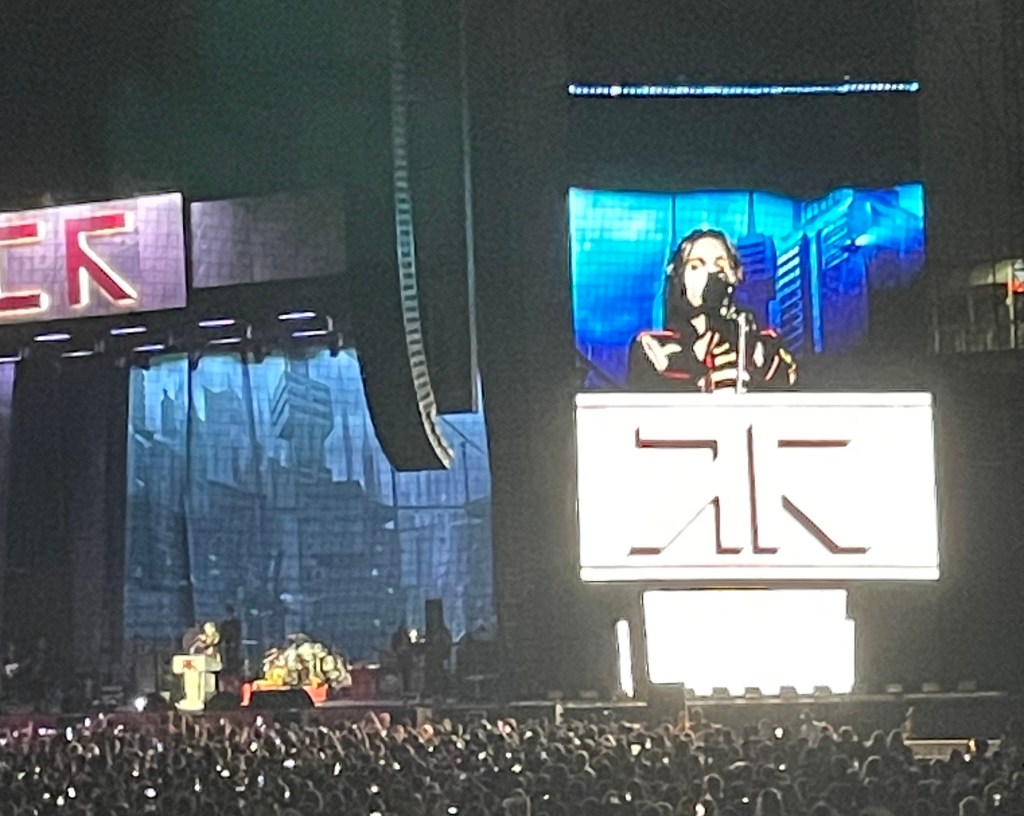
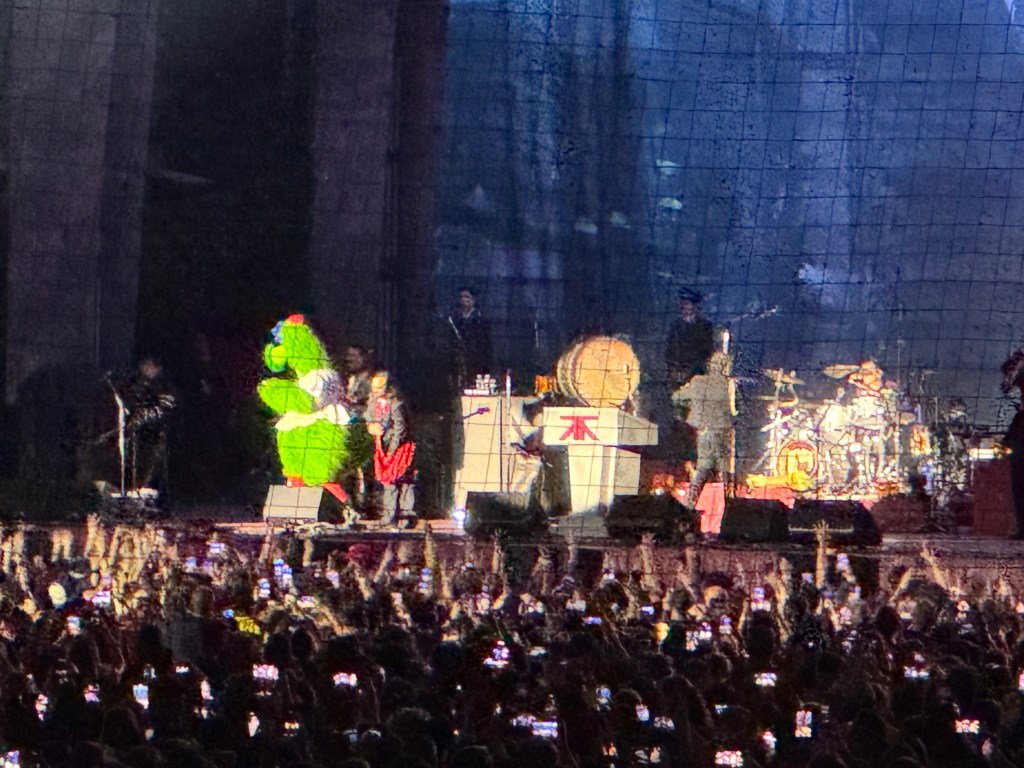
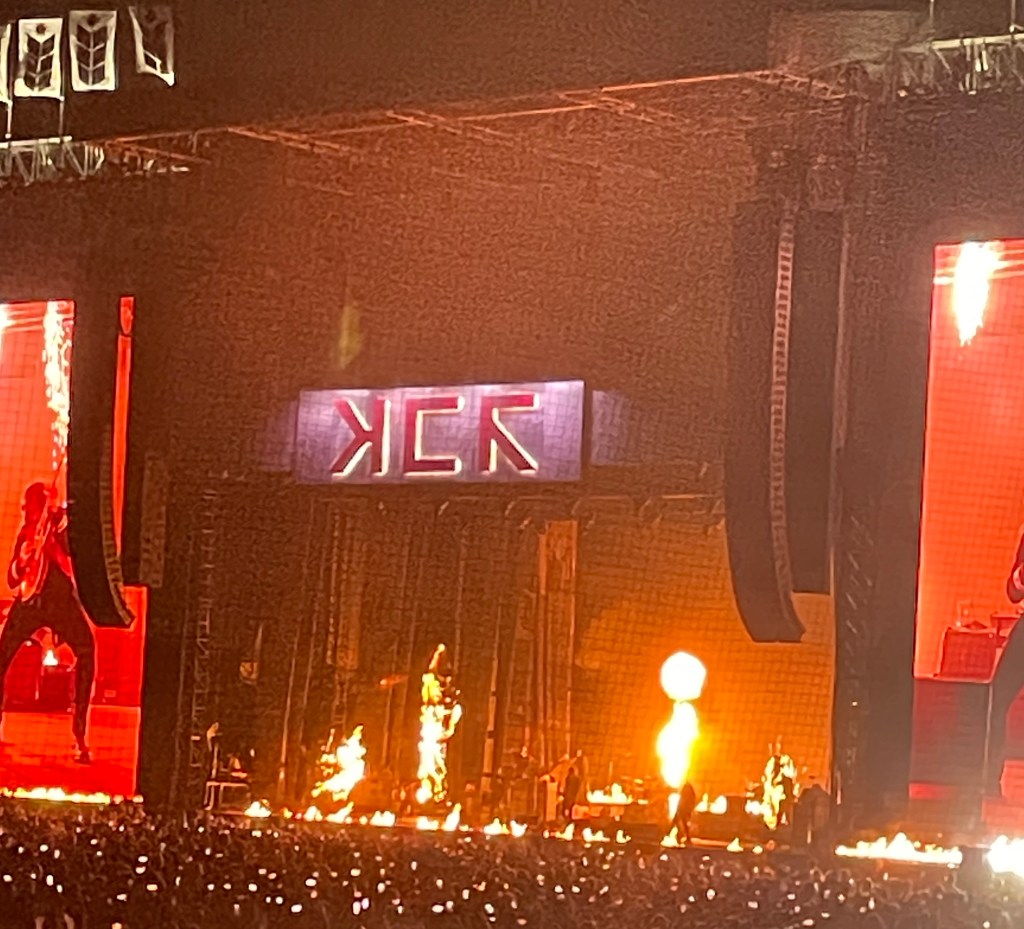
    This MCR tour is all about The Black Parade, which is the album that broke them into the mainstream. The first act of their performance, or pageant, really was the entirety of the album. The band dressed in their marching-band outfits and acted as the entertainment for a dictator of a fictional nation called Draag. During the set there was a firing squad, an appearance by the Philly Phanatic, Variety Puzzles, a launch of a nuclear warhead, a murder by a clown, a burlesque performance by the clown, and a suicide bombing by the clown. If MCR is good at anything, they are experts at theatrics.

    Their second set was very stripped back. After Gerard Way, the lead singer, had his throat slashed and the rest of the members were taken off the stage with bags on their heads by Draag’s secret police, they reappeared on a second stage in the middle of the crowd and played a selection from their other albums. I don’t think there was a single person in the audience who didn’t know the words to every song, in either set. Here’s my selection of bad photos – I wish I had more but my phone battery was at 20% by the time they took the stage.

    The Variety Puzzle bit was very exciting for me. I love Variety Puzzles.

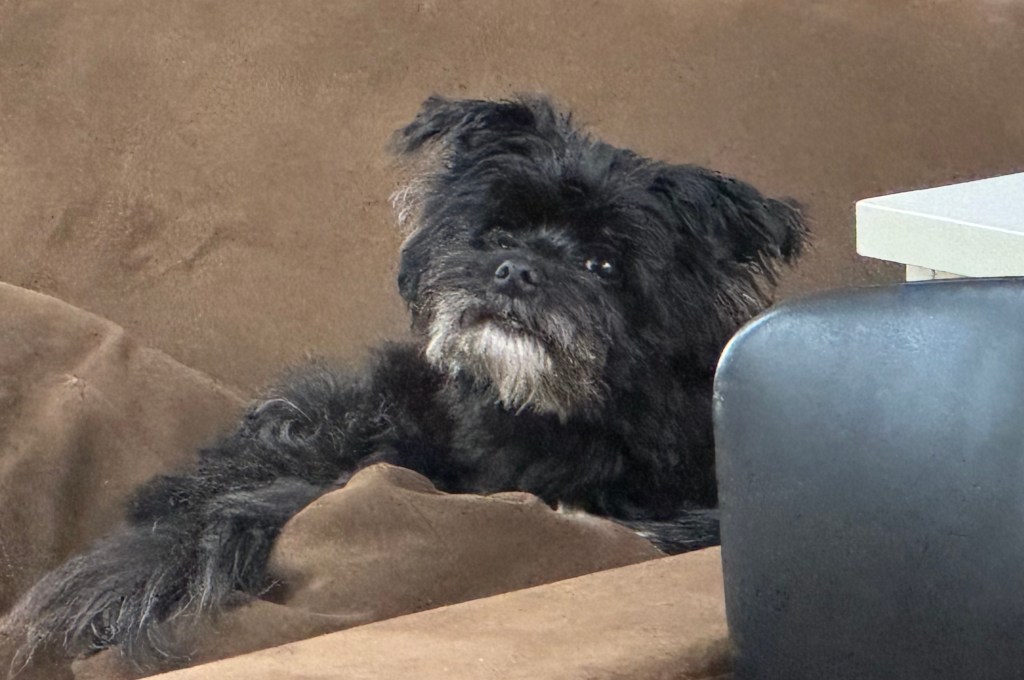
    The next day my partner and I spent the day wandering Philadelphia. After checking out of the hotel, we found a very high-quality cafe, Thank You Thank You, offering lots of different roasts that my partner has been wanting to try – he’s a huge coffee enthusiast – and had a couple of pourovers. Then i foudn the nearest yarn store, which was Yarnphoria just south of Center City. This is a lovely spot with cool, contemporary samples, displays of crocheted amigurumi, and the cutest little shop dog there ever was: Gertie.

    A small, long-haired black dog with gray on her chin lounges on a brown couch cushion.
    Gertie ❤

    When we walked in there were already some customers there who looked very much like they had also been to the concert the night before, so I felt very at home. The owner (or who I assume was the owner) was extremely welcoming and helpful, pointing out all the local brands they had available. I left with two skeins of Scout from Kelbourne Woolens, which is also a local Philadelphia business. At one point, Gertie got up from her couch, barked, and individually sniffed every person in the store. Definitely worth a visit if you’re ever in town. I would have loved to visit Wild Hand as well, but unfortunately we didn’t have time that day to travel to the Mt. Airy neighborhood from downtown.

    And in just under a week, I’ll be leaving town again for Venice! My partner, who works in the film industry as an AC (assistant camera), worked on the documentary Cover Up about the career of Seymour Hersh. The documentary is from Laura Poitras and Mark Obenhaus (Citizenfour), and it was accepted to premier at the Venice Film Festival. This documentary is probably my partner’s favorite of the work he’s done, as he’s an ardent follower of politics and history, so it was beyond exciting for him that he was invited to attend the premiere. And I’m even luckier that I get to join him!

  • De-influencing you (and me)

    De-influencing you (and me)

    A close up of circular knitting needles with live stitches on the cable. An aluminum can tab is being used as a stitch marker to mark the beginning of the round. The yarn in the foreground is beige and in the background is purple.

    One of the things that made me most uncomfortable about my yarn job was being a salesperson. Sometimes I would be in the middle of talking to a customer – maybe while I was recommending a yarn, or telling a stale joke – I would see myself from the outside and think: “God look how fake I’m being. They can totally tell I’m full of shit.”

    It got very uncomfortable when the items people were interested in buying were out of their price range, because a lot of times I’d agree that something was a little ridiculous to spend money on. Not necessarily the yarn, but notions. Of course, I could never say “yeah, I get it, $17 is a lot to spend on scissors and the pair in my junk drawer at home work just fine for cutting yarn.” Because both of us knew it’s my job to sell things, and that the customer was there to buy things, and at the end of the day I needed the business to make money in order to keep my job.

    I never got sleazy. I never lied about a product being able to do something it couldn’t, or promised that the experience of having it would make someone a better crafter. Once a pair of young sisters, somewhere between 14-18 year olds, came in because they wanted to make one of those mega jumbo blankets that are knit on, like, US 50 needles.

    A blanket knit from extremely thick white yarn spills out of a basket in a sunny room with a wooden floor. Beige-core at its finest.
    You know ’em from being every other pin on Pinterest for years.

    They were asking about using roving to make one of their own. I was completely honest. Roving would have fallen apart immediately, and would have been prohibitively expensive. It was one of the only times I said to someone that Michaels carried a yarn specifically manufactured for this trend and they’d be better off going there. And it’s not like I would have made a sale on roving anyway, because who’s going to shell out upwards of $500 on the amount of roving they’d need.

    I also think of my own experiences as a customer. It was hard for me to be an engaging salesperson because I HATE attracting the attention of a salesperson while I’m shopping. The affect of selling repels me, and I assume it’s just as uncomfortable for the salesperson to pretend to be my friend as it is for me. Which is why as much as I like Lush and its products, I dread shopping there.

    A storefront of Lush, which sells skin and hair care products as well as perfumes and bath bombs. The signage is black with white text, the interior is made entirely from wood, and the displays are filled with colorfully wrapped soaps and boxes.
    Inside this store is a 20-something waiting to sell you soap with a CIA-level intensity

    I’m currently job-hunting, and I’m really hoping to not find myself in retail again, even though that’s where my professional skill-set is. With that in mind, I want to use this post to do the opposite of selling you something. Let’s deinfluence.

    Deinfluencing is a reaction to overconsumption. It’s a reaction against “hauls”, unboxing videos, sponsored content, and ads in general. It’s why I always link to the designers whose patterns I use, but never the yarn. I want to give people credit, but I’m not trying to sell you anything. And I’m extremely aware of how expensive yarn can be, because I have spent too much of my own money on it over the years.

    One of the hardest things to explain to non-knitters or crocheters is the amount of brand loyalty people have for certain yarn brands. One of the oldest jokes I would have to pretend to laugh at is that “buying yarn and using it are two separate hobbies.” People buy yarn not just just because they’re excited to use it, but just to have. I’m one of those people, and I’m trying not to be. But then there’s people who buy yarn from a company just because it’s rom that company. They collect yarn from premium brands like each skein is a Berkin. Yarn, in this subculture, has become a status symbol.

    It brings to mind a time I visited a yarn shop in my city, which has been closed for a long time. The location was on the edge of a trendy neighborhood with lots of walking traffic, boutiques and bistros. Across the street from the shop was a housing project. I got talking to the owner about her selection, and she let me know that despite many potential customers from that project wishing they could shop there, they simply couldn’t afford the brands she carried. Instead of listening to them, the owner told me she just couldn’t imagine stocking acrylic. Again, this store is no longer in business, probably because the owner was catering to imaginary big spenders instead of her very real neighbors and their needs.

    The glamorization of name brands, aspiration to buy, the flooding of new products into the market are not unique to the fiber world, but it is as pervasive here as it is anywhere. So here are my alternative, low- or no-cost alternatives that I have personally used.

    Indie dyers and LYSs

    Supporting small independent businesses is wonderful, I’m not arguing that. But again, not everyone can afford the selection at these places. For an alternative, sustainable option, I suggest the growing number of consignment craft stores. SCRAP USA is a nonprofit with multiple locations, for instance, but there are plenty of smaller 501(c)(3)s with the same model. Jess Crafts compiled an extremely thorough list of over 60 locations on her site.

    Notions

    Here are some of the re-used alternatives to new tools that I’ve personally used. They might not be as fancy, or have all the bells and whistles, but they work just as well. You might already have them in your house.

    Project Bags

    • My regular purse
    • Reusable shopping totes
    • Zip-lock plastic bags – if you ever shop online for clothes, chances are you’ve gotten a ton of these.
    • Bedding packaging – new bedsets often come in clear, plastic bags, and they often come with handles!

    Stitch Markers and progress markers

    • Paperclips (classic option)
    • Safety pins (progress marker)
    • Can tabs – I drink a lot of seltzer and boy have these come in handy when I’ve inevitably lost all my stitch markers to my couch cushions.
    • Yarn scraps – just tie off a tiny loop in a contrasting color.

    Stitch Holders

    • Any scrap yarn, string, or thread you have hanging around.

    Pattern Stands

    • A clipboard and a post-it note so you can keep track of what row you’re on.
    • Your computer – I don’t own a printer and very rarely use physical copies of patterns. I usually just scroll so my row is right at the top of the screen. Obviously a computer is expensive, but since I have one for other purposes anyway, it’s what works for me.

    Blocking Boards

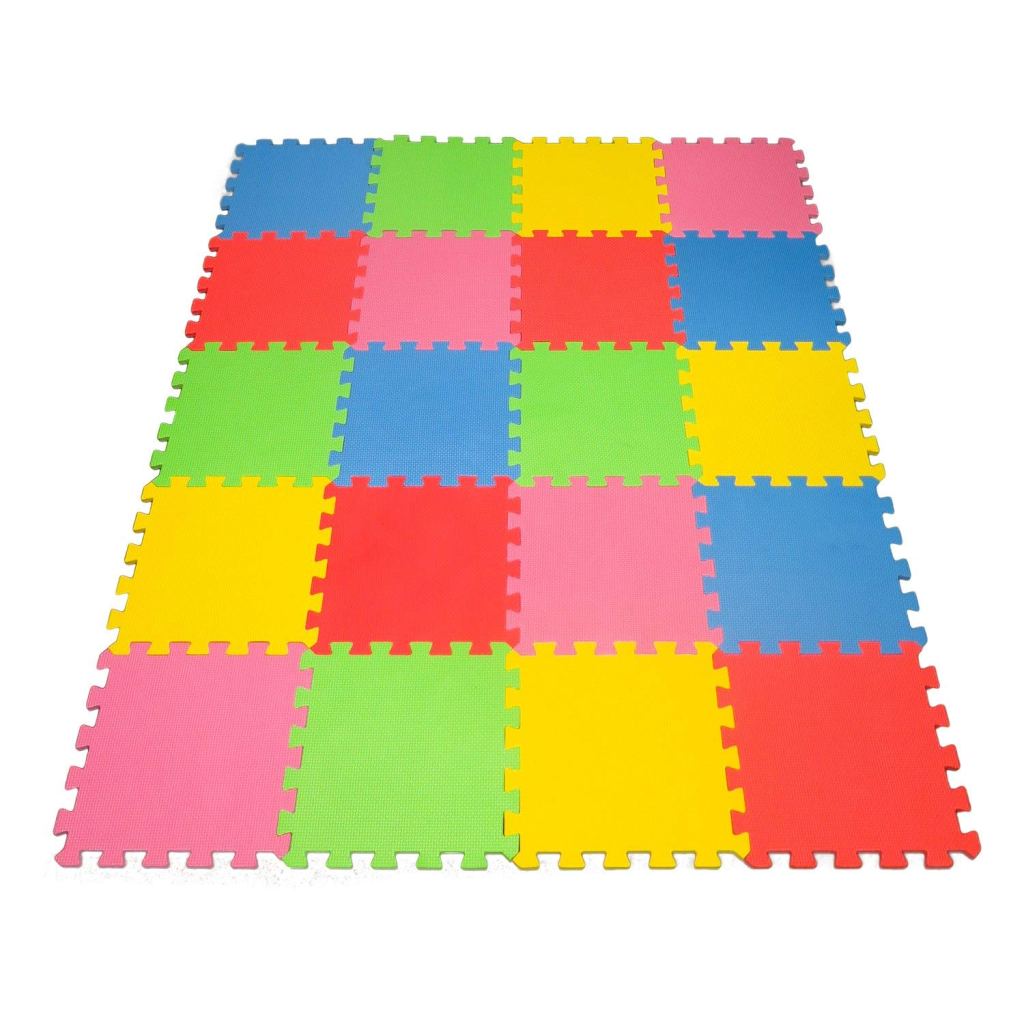
    • Interlocking playmats for kids – they may not be printed with a grid of lines 1″ part, but they do the job and are usually the same size (and a lot cheaper than the ones sold by knitting brands).
    A play mat consisting of 20 foam tiles lies on a white background. The tiles are red, blue, yellow, pink, and green.

    Stitch Stoppers

    • Save your wine corks and stick ’em on!
    • Poster putty

    There’s nothing wrong with buying notions or yarn that you know you’re going to use. As my own stash shows, I’m not one to judge. I love my needle gauge earrings, I have a strong preference for steel needles, and my swift/ball winder combo is pretty sweet. But the fanciness or aesthetics of yarn or notions will not make anyone a better crafter than they are, and that’s the most important thing to remember. And as I look at my own spending habits (especially in my time of voluntary unemployment), I think twice before pressing “checkout”.

    While I’m here, maybe I can influence you about something else.

    This past week Donald Trump made an unconstitutional decision to bomb Iran, threatening millions of innocent people with death and war. If you’ve read this far, I beg you to contact your representatives and ask them to oppose all further military action toward Iran and to stop arms sales to Israel, who instigated this conflict by attacking Iran. We also need to pressure our reps to impeach Trump. Again.

    Our government has been hanging the vague threat of Iran’s development of nuclear weapons for decades, and there’s never been evidence of it. Even if Iran did have nuclear warheads, so does the US, and we’re the only country who has every used one in war. Does that mean it’s justified to invade our country?

    It’s the same excuse we used to invade Iraq in 2002. After hundreds of thousands of Iraqi casualties and over 4,000 American servicepeople killed, we cannot fall for this lie again. I was 9 years old when 9/11 happened. Over the last 24 years, the consolidation of power under the executive office has been allowed to grow and grow, eroding our checks and balances system. Bush, Obama, Trump, and Biden are all guilty of using this power to bomb 8 countries between 2001-2025. I don’t care about governments, but I care about people, and peace should be nonpartisan.

    Find your representatives in the House and Senate here. While you’re there, you may also be interested in asking them to oppose putting 250 million acres of public lands up for sale to private corporations.

  • WIP Wednesday: The Artus Shawl

    WIP Wednesday: The Artus Shawl

    Freed from the queue!

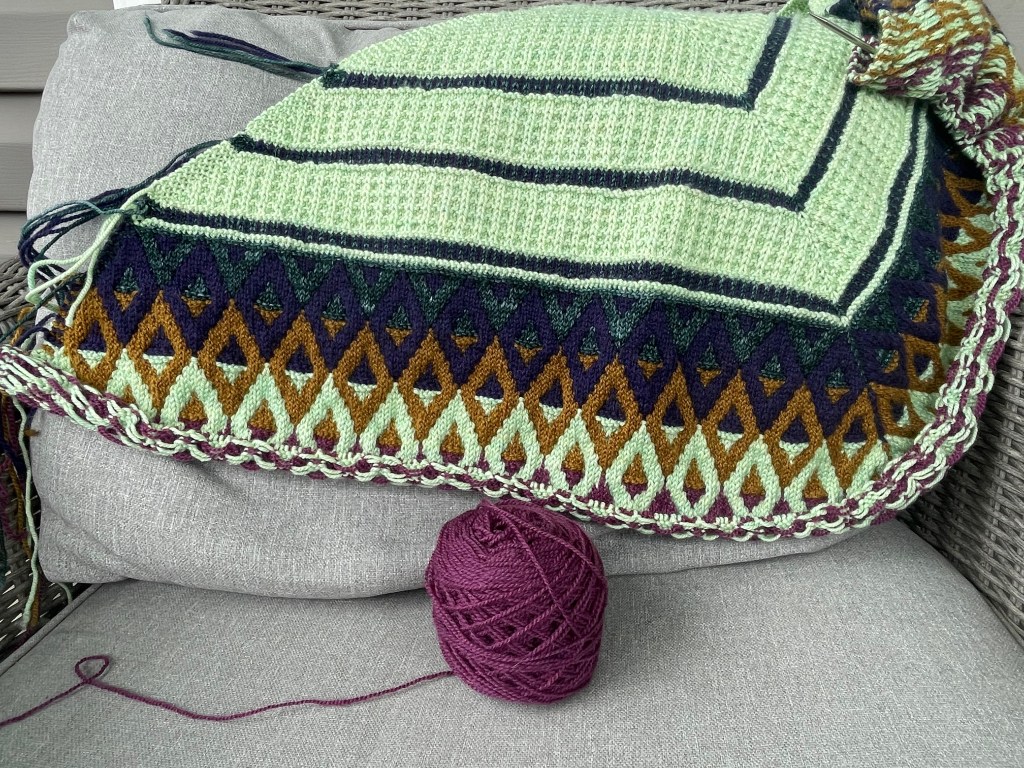
    This WIP Wednesday I’m happy to share a project I’ve been hoping to start for a loooooong time: the Artus Shawl by Natasja Hornby. What was stopping me? Well, despite the unforgiveable size of my stash, I could not pull together 5 different colors of sport-weight yarn.

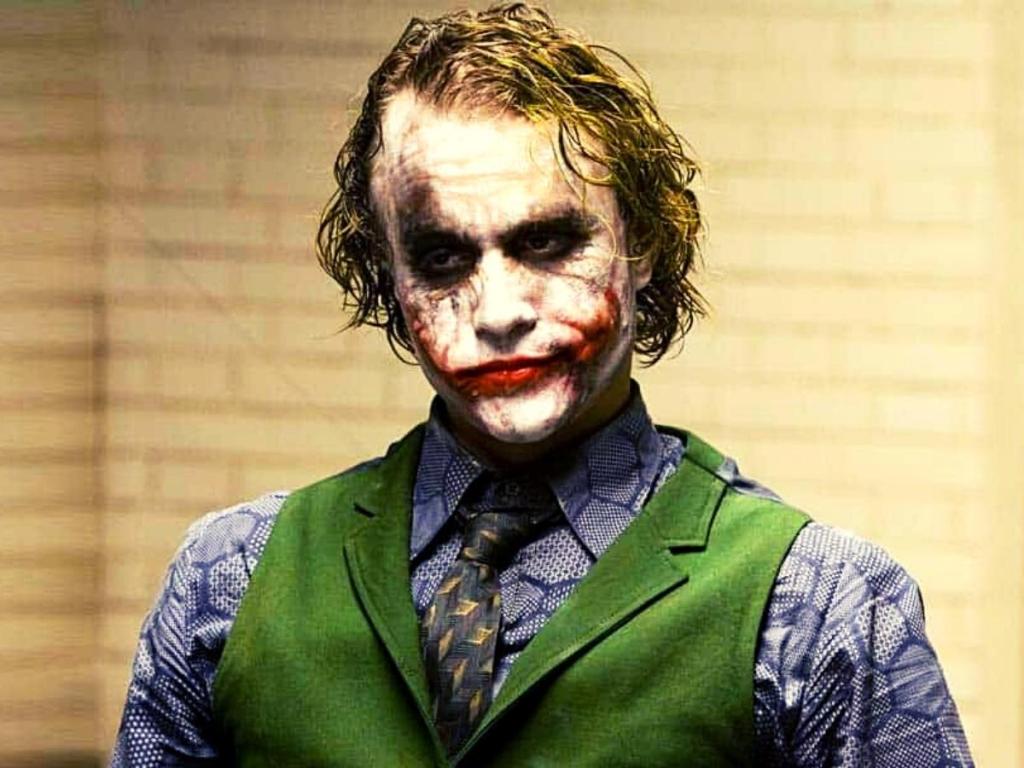
    I love the challenge of a wider color palette, which I consider to be 5 colors or more. I’ve been using Pinterest a lot lately and started a board just for aesthetic photos that contain intriguing color combos, and an interesting trend emerged: I’m really into purple and green right now. Not to be all Joker-y about it though.

    Heath Ledge in "The Dark Knight" in full makeup and costume as the Joker. He has greasy green-tinged blondish hair, white clown face paint, black grease paint around his eyes, and red grease paint on his lips and up his cheeks to make a smile. He's wearing a purple hexagon-print shirt and a green waistcoat.

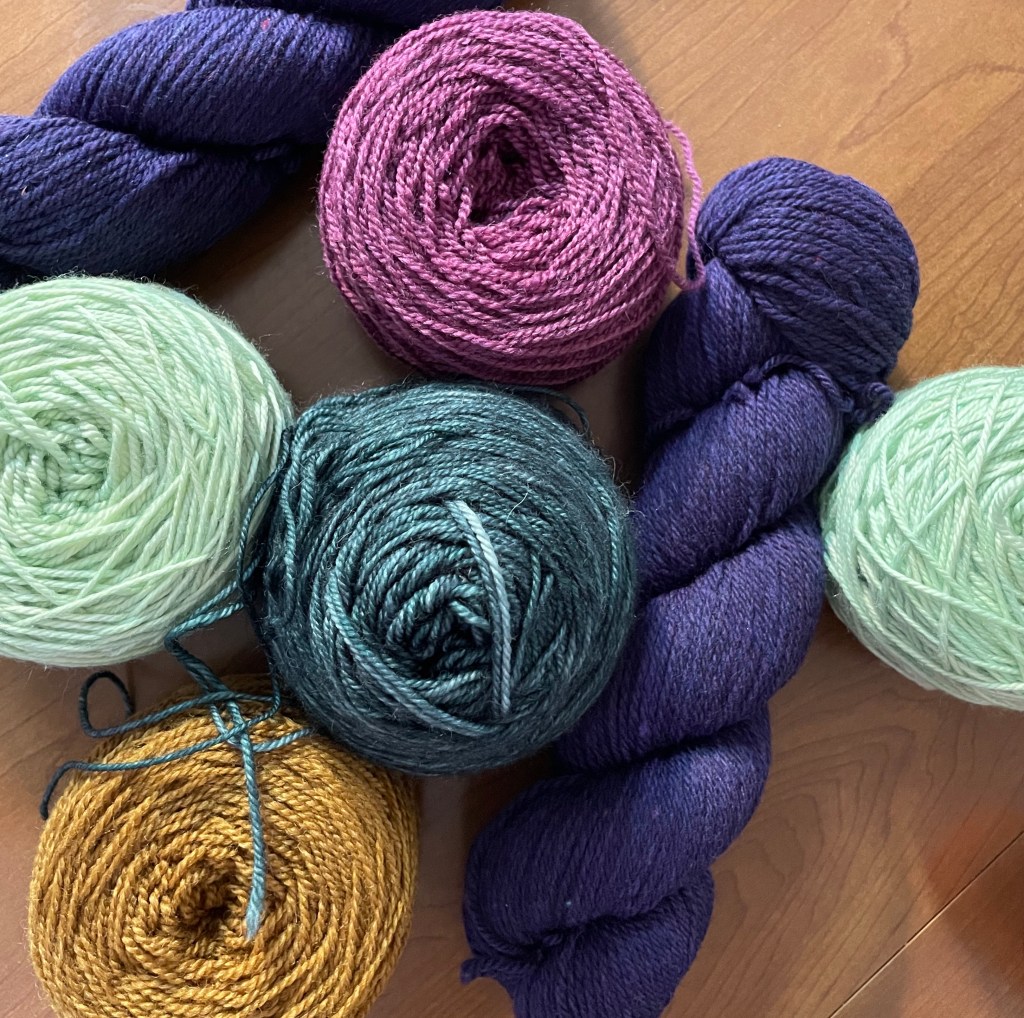
    Golds and oranges have also been popping out to me, and I like the contrast of earthy ochres in rock formations and tree bark and more mystical, mermaidy shades that appear in luna moths (and Cape May Fiber had a Luna Moth colorway!), seashells, and tilework. So when I attended the Frederick Fiber Festival and Maryland Sheep and Wool, I went with a mission to find some of these particular shades. I got nearly everything from these trips, and then rounded our my palette with a purchase from Brooklyn Tweed. BT has recently stopped producing their own yarn (but will still be publishing patterns), and they were running a clearance sale. Their beautiful inky blue-violet color “Tapestry”. was a perfect fit, and I ended up getting enough skeins for this shawl and a future sweater.

    The Artus palette: Tapestry (deep purple) in Imbue Sport by Brooklyn Tweed, Luna Moth (light green) in Merino Cashmere Silk Sport, Ochre (gold) and Aubergine in Making Tracks Lite by Junction Fiber Mill, and a mystery stash yarn in a deep blue-green.

    Now that I’ve cast on I’m locked the fuck in on this shawl. I’m extremely engaged. There are three small sections of stranded colorwork at the top of the pattern that I was kind of dreading (I’m not great at stranded, and even worse at it on the wrong side)n and Hornsby made these sections mercifully short – my finger joints thank her. I’m now in the mosaic sections, at the trim of the shawl, where I’m only handling one color of yarn at once. Because mosaic stitches tend to be more tense than stitches worked with no slips, there’s a risk that the long side of the shawl will bend downward instead of maintaining a triangle with straight, defined lines. To avoid this, I’m stretching the slipped stitches in the mosaic charts to the absolute maximum to.keep a similar gauge to the stitches in the waffle stitch section. And I think it’s working! I won’t be able to tell until it’s completely off the needles and blocked, but I’m feeling optimistic.

    Now that all five colors have been worked into the project, I’m excited to share a photo that really shows how the palette works.

    You know, now that I look at this diamond motif, it vaguely reminds me of someone…

    A still of Harley Quinn from Batman: The Animated Series. She's in her original character design, wearing a red and black jester unitard and cap with diamond print on the legs and arms. She is shrugging.
    Lol whoops

    What I’m Listening to

    I got to see one of my favorite bands last week, Amyl and the Sniffers. They’re an Australian punk/pub rock band whose latest album has a little bit of glam, although they haven’t lost a speck of their edge; their single “Jerkin’” is about as catchy and contemptuous as can be imagined. But among their harder, nastier songs like “GFY”, they have plenty of tracks that are deeply heartfelt and earnest, like “Knifey”, which is dedicated to victims of femicide, and “Big Dreams”, which offer words of encouragement to anyone struggling to figure out their life’s trajectory. That sincerity feels like a binding element of the band, judging by the ease of their on-stage banter with each other (which includes some great, groan-worthy dad jokes). Amyl and the Sniffers offers a truly electric live performance, and I can’t wait for their return to the US.

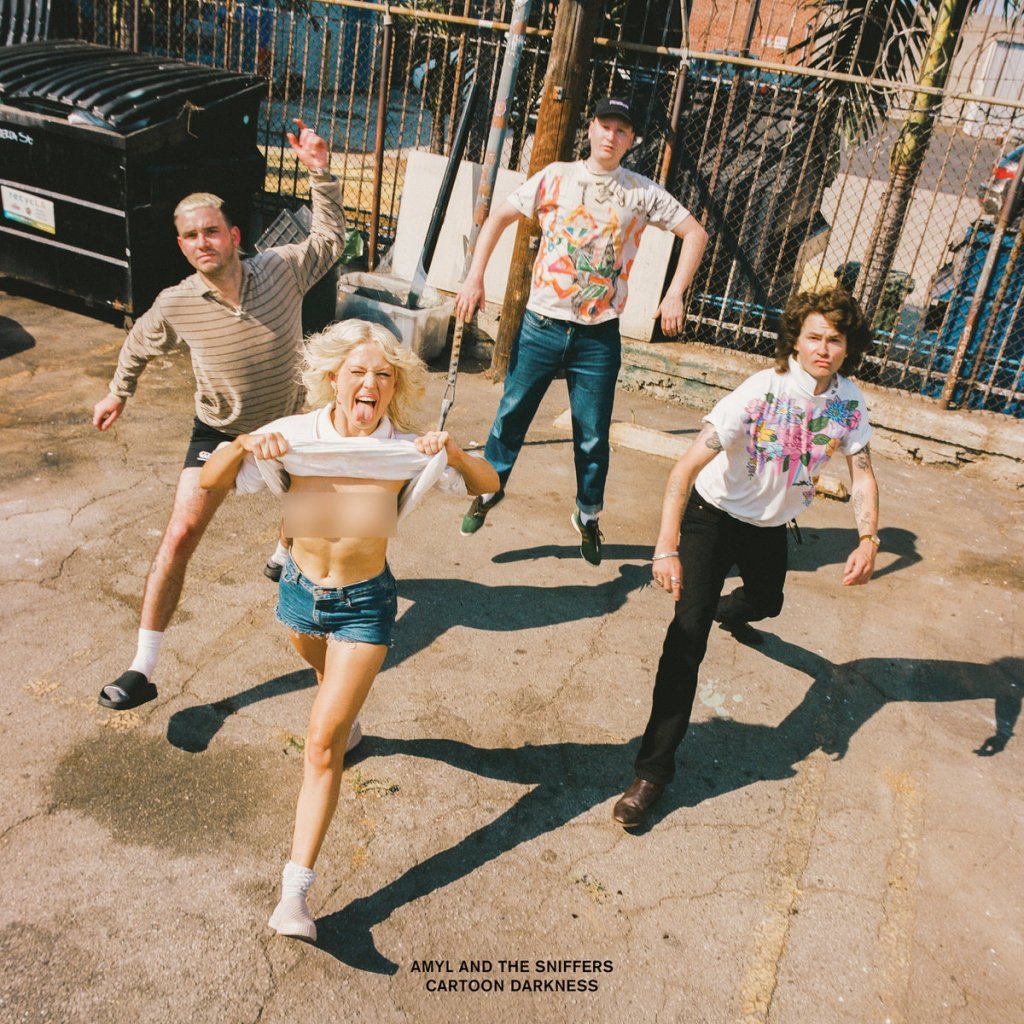
    The cover of Amyl and the Sniffers' newest album, Cartoon Darkness. Each of the four band members is mid-run or jump and looking up toward the camera. The photo was taken on a very bright sunny day. There is a dumpster and a chain-link fence in the background. Amy Taylor is in front; she is sticking out her tongue and lifting up her shirt; her bare chest is blurred out.
    The cover of Amyl and the Sniffers’ newest album, Cartoon Darkness

    Till next WIP Wednesday my dudes!

    A gif of a person with a mustache and shoulder-length hair, wearing swimming goggles and a Spiderman costume. In the first frame the caption reads "It is Wednesday, my dudes." In the second frame the person stands in a doorway and screams, the caption reading "AAAAAAAAAAAAAAAAA"
  • Craft, Art, and Gender

    What does my knitting have to do with my gender? More than I’d like. Less than you’d think.

    I sometimes wonder what people assume about me when I knit in public. I wonder, and worry, if it’s assumed that I’m invested in the sort of traditional femininity that knitting seems to represent. I’ve discussed this a little in a previous post – do these so-called “alpha” manosphere assholes see knitting as a sign of the kind of woman they believe we should all be.

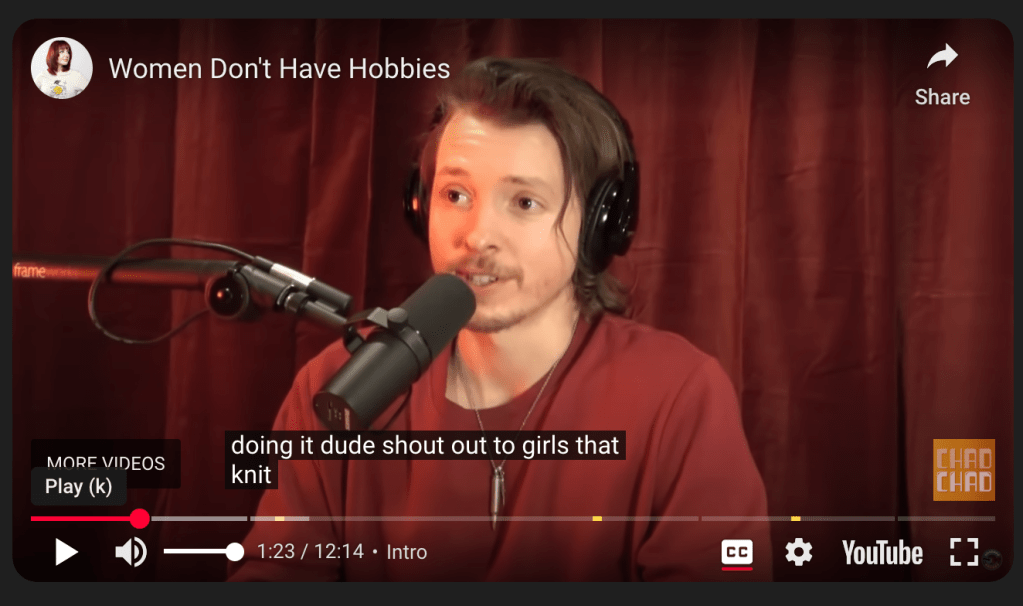
    A screen shot of a Youtube video. The frame is of a man in a red shirt against a red curtain background talking into a podcast microphone. The closed caption reads "dude, shout out to girls that knit"
    A clip from a manosphere Youtube channel where two men wonder if women actually have hobbies, and decide that knitting is an acceptable hobby for a woman to have because it’s “nurturing” and feminine. Don’t worry, I didn’t go to their actual YT channel to get this screenshot because I would never give them the views to poison my algorithm. Thanks to Chad Chad for taking that one for the team.

    I don’t knit because I’m a woman. I don’t knit in a feminine way. I also don’t knit in a feminist, reclaiming-the-power-of-the-craft way. I knit and crochet because I like it (and probably because I’m stimming, but that’s another blog post). I look at pretty much anything I do and wonder how much of it has to do with me being a woman.

    I feel best about myself when I feel feminine, but I recently realized that what I have been conditioned to understand as feminine is also what I have been conditioned to understand as beautiful. And chat, I do not feel beautiful. I also don’t feel nurturing, or supportive, or emotionally intelligent. I’m not motherly. I’ve never found traditional fulfillment in these traits or any power.
    So when we think of knitting and crochet, or any fiber craft, as a feminine activity, I question if my aversion to that is personal or if there really is a larger societal misattribution happening.

    Earlier this month I read an article in Art News about the burgeoning presence of fiber in the arts scene this year. “Fiber Art Has Officially Taken Over New York’s Museums and Galleries” by Alex Greenberger covers multiple exhibits, features, and retrospectives of fiber as painting and sculpture, at commercial galleries and museums like the MOMA.

    Almost all the artists mentioned and profiled in the article, as might be expected, are women. Greenberger credits the phenomenon of fiber-centered exhibits to a cultural correction of misogynist exclusion:

    Why so much fiber all of a sudden? The simple answer has to do with the changing face of recent art history. Weavings, embroideries, and the like have long been awarded an asterisk in the canon—if they’ve been accepted into the canon at all. Typically, art in those mediums has been classed separately as craft in the West or denigrated as “women’s work.” Thanks to the work of dedicated scholars, curators, and critics, fiber art has finally come in for reassessment.
    I wrote briefly in my post about chromatic politics about the shoehorning of women artists in the Bauhaus school to textile-based art forms. And how while fiber arts and decorative arts are often relegated to the superficial, their influence on the so-called “fine arts” is hard to ignore, like that of the mostly-female weavers of the Aymara on the aesthetics of architect Freddie Mamani.

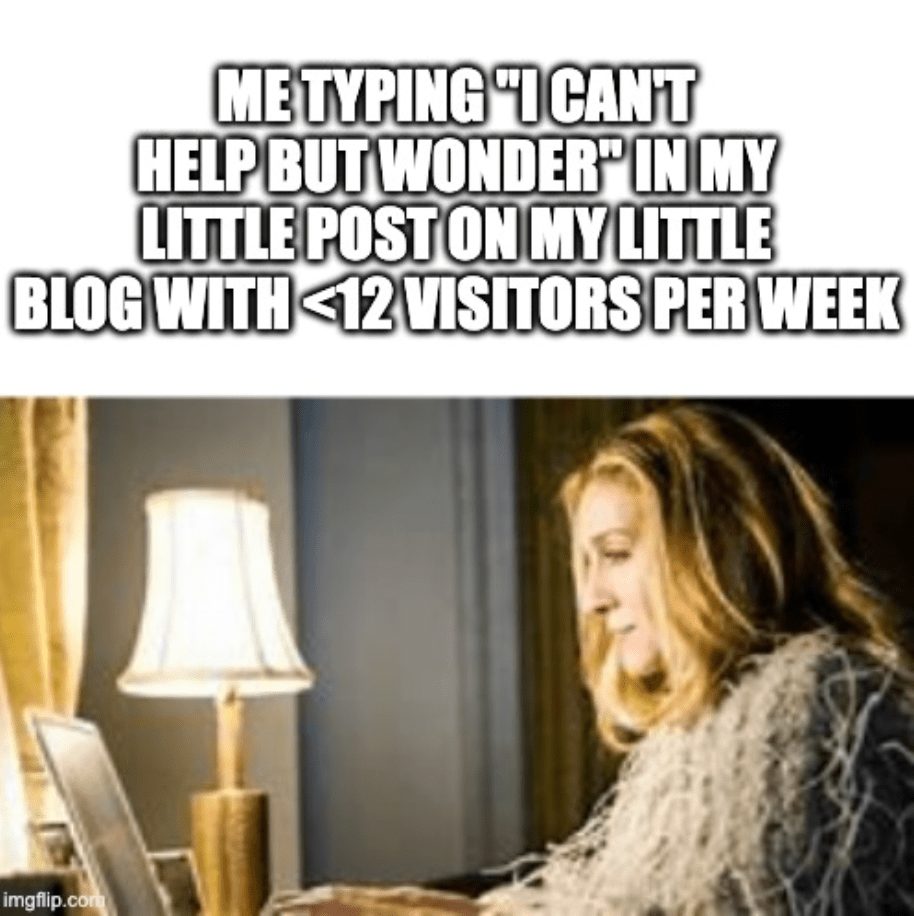
    I don’t disagree with Greenberger’s theory of the gender pendulum swinging back in the direction of equity, and that the fiber art rage has been part of that. The way that the binary genders – men and women – have been separated and tiered has a lot to do with the way “art” and “craft” has been separated and tiered, which has given men a lot of fame and status and women a lot of obscurity. But I can’t help but wonder (!) what a gender utopia, a world where misogyny and queerphobia don’t exist, looks like.

    I have a list of evolving, circular desires for gender and art – a gender ouroboros maybe.

    • I want to see women included in “fine art” – painting, sculpture, architecture, etc. because women are capable of doing whatever they pursue.
    • I love seeing “craft” and the women artists who practice it included in the genres of fine art, because craft requires the same level of technique and intellect that the traditional “fine arts” require. It’s important to me that the disciplines and materials we associate with fine art gets expanded in order to perforate the gender separation that’s been engineered in the art world.
    • I don’t want to see fiber “craft” forever associated with women because not that all fiber artists are women and not all women are naturally fiber artists, and to believe so is gender essentialist in a way that gives me hives.
    • To call craft “women’s work” at all is colonial. Craft exists across the globe, in virtually every culture, and not all cultures divide labor along the same gender lines. For instance, textile crafters in West Africa were often men (Osborne, 2024), but during the trans-Atlantic slave trade, the white slave-owning class demanded that enslaved women perform it because it was more in line with the white/European division of labor by gender (Golden, 2023).
    • Not everyone lived by a gender binary like Christian Europeans did. Numerous cultures around the world recognize more than two genders, and the various nonbinary genders in those cultures also fulfilled traditional roles. Nonbinary people have also existed in binary gender cultures forever without being recognized. To only be talking about the elevation of women’s art erases the many trans nonbinary identities that are currently under attack, even by people claiming to be feminist*.
    • Even as objects previously tiered as “craft” are elevated to “art”, and artists working with materials often thought of as “craft supplies” instead of “artist materials”, are being curated for the fine arts scenes, will women and nonbinary artists be fairly represented alongside male artists without their gender or cultural background novelized alongside the medium?

    *If your brand of feminism aligns with Republican/right-wing politics or if you find that Nazis are agreeing with you, then you’re not a fucking feminist.

    To the last point, Greenberger makes a poignant criticism of the Woven Histories exhibit at the MOMA:

    The exhibition is unclear about the ties that bind many of its artists: what, for example, links an abstract painting from the ’70s by Jack Whitten and a raffia net from the ’60s by Ed Rossbach?…The exhibition also stumbles when presenting artists awaiting canonization such as Yvonne Koolmatrie, a Ngarrindjeri weaver who makes sinuous sculptures from sedge, a type of grass. These works are…lumped together with baskets by Indigenous artists, an awkward, reductive gesture that makes them feel like an afterthought.

    Here, Koolmatrie’s artistry is hitched to that of other indigenous artists with, as Greenberger suggests, no real curation as to why. Is it enough to say that “we all weave”, or does this decontextualize the places and cultures these individual artists come from? The importance of cultural specificity to art and craft cannot be overstated, and it is frequently missing from a lot of discourse about art and gender that I’ve seen and read. Race and gender are linked in systems of oppression, so they have to be discussed together in cultural criticism. After all, the Western/European art institutions that have displayed stolen precolonial indigenous art have historically not challenged the binary thinking of gender by acknowledging nonbinary artists.

    I grew up near the Baltimore Museum of Art, and even as a child I could understand the way most of the exhibits were organized. These rooms, the impressionists. Over here, the impressive collection of Matisses. In this stark white and angular wing, the contemporary exhibit. And over here… “African Art.” All the art the museum had from across the continent, from across centuries, in cramped glass display cases instead of mounted on walls or installed like the European and American paintings and sculptures. Looking back on it now, this exhibit was distinctly anthropological, archeological, in nature. These were not meant to be considered cerebrally like the Monets and Warhols. I wasn’t meant to think about the objects’ makers as individuals. It was just a room full of things with a single tenuous connection between them: the 11.7 million square mile continent of origin.

    Decades later, the BMA has gone through a total overhaul. That vague exhibit no longer exists. The new curators have gone full force into featuring living artists whose works they can fully contextualize. They’ve sold a number of extremely famous works (to the rage of many white patrons) to fund the acquisition of art by Black, indigenous, and queer artists. Last year, they installed “Walk a Mile in My Dreams” an exhibit dedicated to the work of Joyce J. Scott, a Baltimore artist who works in a plethora of different mediums and techniques, including fiber, weaving, and crochet. Scott’s work explores race, sexuality, violence, and natural destruction, and she’s as influenced by the cultures and artistic techniques of the many places she’s traveled as she is by her own family’s long history of making.

    I haven’t visited the Woven Histories exhibit myself, so I can’t speak personally to the level of explanation provided by the curator as to the connection between the different works, but it sounds like more specific context is needed to draw these connections. Maybe it takes an artist-specific installation, like “Walk a Mile in My Dreams”, to fully do justice to any artist.

    I have been thinking about my relationship to my gender for my entire life, and Greenberger’s article gave me a great vehicle to talk about it in relationship to the fiber crafts that have become such a big part of my day-to-day life (and my livelihood, at one point). This hobby, once necessary labor in a preindustrial age, taken for granted as “women’s work”; this women’s work that my own 94-year-old meat-and-potatoes mans’ man Navy veteran grandfather was taught as a boy; this women’s work that I have seen loved by cis men, gay and straight; this women’s work that I have seen relished by trans and non-binary people at fiber festivals.

    Even though us cis women are overrepresented in fiber arts, they don’t belong to us, and that makes me feel free. It’s not enough that I should feel empowered by the things that make me “feminine” – I want a femininity that demands nothing of me. The gender utopia I hope for is a decolonized one, a non-binary one. One where every singular person is recognized for their skills and artistry no matter their identity, without it having to reflect on anyone else.

  • WIP Wednesday: Knitting the Pivoine Cardigan

    WIP Wednesday: Knitting the Pivoine Cardigan

    It’s WIP Wednesday and this week’s theme for #showmeyourknits is cardigans! Fortunately my wip this week is the Pivoine Cardigan by Audrey Borrego, a drop-shoulder cardi with lovely lace detailing at the bottom of the torso.

    Borrego recently stepped away from the knitwear design game a few months ago, and very generously made all her patterns free on Ravelry. When I checked Ravelry that day and saw that she was all over the first three pages of the Hot Right Now feed, I had the same thought as some other folks: “Holy shit, did something happen to her?” Nope! Just a voluntary change in life direction. Hero portfolio of 100+ patterns is an amazing gift from a very prolific designer, and I hope she’s having a wonderful time in the next chapter of her life.

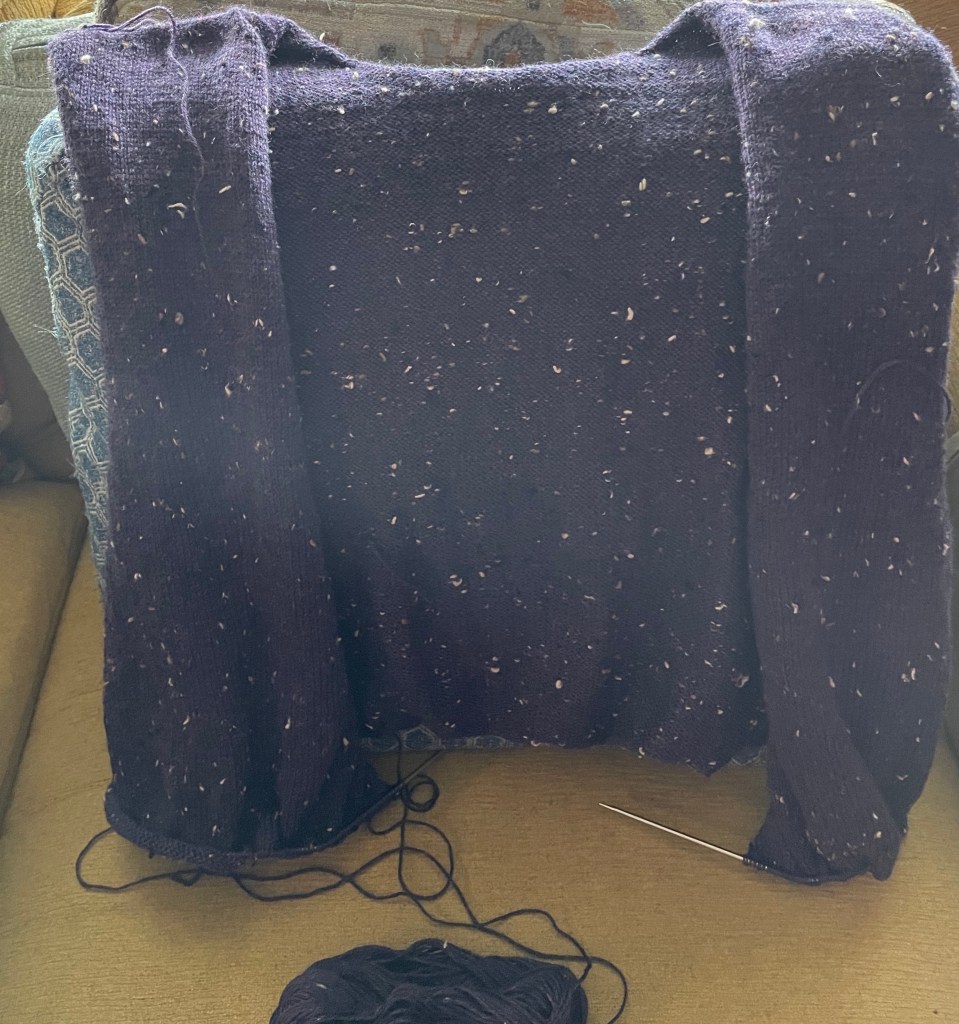
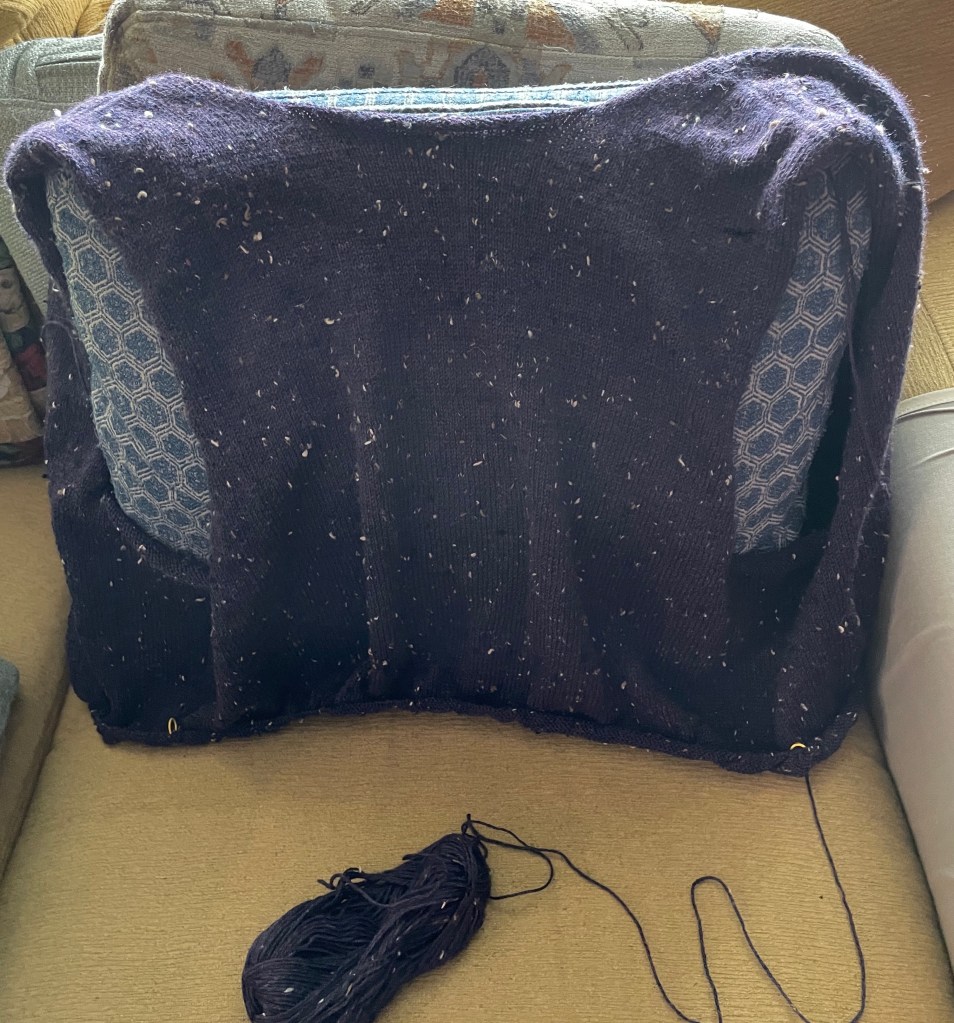
    I’m using Knit Picks Stroll Tweed, which I picked up a few years ago during a Halloween sale (they discounted all their black, orange, green, and purple yarn). The pattern calls for sport-weight, but considering the suggested needle size for the body is US 3, a fingering like this is working nicely as a substitute. I’m knitting size 7, and the depth of the armholes is perfect – I really like wearing big t-shirts, and there’s plenty of room for my tee sleeves to fit without weird bunching at the shoulders.

    I also plan to add significant length to the body so it covers my butt, and now that I’ve passed my natural waist I’m adding increases to accommodate my hips circumference. I’m adding increases at the same rate as the pattern calls for decreases in the sleeve, and I’ll just have to make sure I stop when my stitch count reaches the correct multiple for the lace pattern.

    There’s a possibility I’ll run out of the yarn before I get to the sleeves, but honestly, I’m hoping that will be the case. I have plenty of other fingering-weight skeins in my stash that need to be used, and I think contrast sleeves would be very striking for this project. The stash bust continues!

    And now, a lightly cuss-seasoned rant about generative AI

    While on Ravelry this week I came across a “design” whose picture was clearly generative AI and reported it. As far as I can tell, it’s been taken down. I figured Ravelry wouldn’t be AI-friendly (I was not the only person to report the page) but it would be great if the mods could make a policy statement about AI use, if only to encourage its users to take a broader critical stance against generative AI.

    Obviously AI in knitting patterns is a problem. If the “designer” can’t even produce a finished object from their own written pattern, they’re clearly a scammer and unable to write a pattern to begin with. There’s no reason to trust that the pattern will be any more real than the generated image they’re using to advertise. But generative AI is a much larger problem that has infiltrated pretty much everything we interact with on a daily basis. I believe it poses extremely bleak outcomes for creativity and critical thinking.

    Before I go off I want to point out that I’m not immune to the draw of AI and how it can be used. When I was studying creative writing, I wrote an experimental poem using the predictive text AI on my phone. I presented it to my workshop, completely transparent that I had used predictive text, because I was intrigued that the data my phone had stored about my typing history created a digital mirror of my personality. I called it “Runecasting with Predictive Text”. This was back in 2017, when generative AI was still producing eye-burning fractal nonsense images that could never be confused with a photograph or human-made artwork. Now I look back at that little experiment and shudder. I want to share my shame with you.

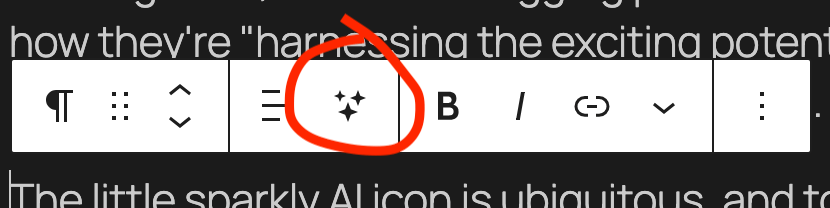
    Generative AI is way more refined now. It’s replacing human labor, especially creative jobs like writing, art, and design. It’s widely used in political campaigns to smear opponents and create propaganda. It’s even being used to write public policy that we’re all supposed to live under. NYC Mayoral Candidate and sexual predator Andrew Cuomo faced criticism for using ChatGPt to write parts of his campaign’s housing policy. And yet our social media networks, job hunting sites, even this blogging platform I use proudly advertise how they’re “harnessing the exciting potential of AI” or some such bullshit to appear cutting edge to its users. The little sparkly AI icon is menacingly ubiquitous.

    Left: WordPress invites me to generate an image with AI instead of using this screenshot. Right: The aforementioned sparkle icon.

    AI provides no new information to us. It plagiarizes artists and writers. It only reflects, and all it reflects is existing human thought, including our worst prejudices and bigotries; it just delivers them back to us faster. And if it’s used by elected officials that are too fucking smooth-brained and lazy to come up with new ideas or to think critically, then I don’t want to live here anymore. And we probably won’t live here for long anyway, because generative AI is pumping massive amounts of CO2 into the atmosphere and sucking up our water supply.

    Last, I want to address the argument that generative AI helps people be creative. Nothing could be less true. Artists love the process. They love practice. That’s why great masters’ sketches are valued by art collectors and museums, not just their finished works. That’s why there are so many musical compositions called “etudes” (studies). It’s why dancers and athletes and musicians and anyone who uses their body to do anything has to spend so much time conditioning their muscles and joints for performance. If you have an idea for an image and want it to exist, and you use AI to make it exist immediately, then that isn’t artistry – it’s spectatorship.

    There’s nothing wrong with being a spectator. But the ethical thing to do is hire an artist. Support artists and writers who are using their brains and bodies, who are making truly creative and critical decisions about art. Or do it yourself! Actually do it yourself. Accept that your first try at a creative endeavor might be messy, poorly executed, or embarrassing. No one needs to be perfect. We just need each other to try.

    If you’re newer to the concept of generative AI or just want some help spotting it, here are things I look out for.

    In images

    • Look at any letters, fingers, or (in the case of knitting and crochet patterns) stitches. AI has a harder time generating fine details like these; words will often be illegible, hands will have too many/too few fingers, and stitches will not make any physical sense.
    • The depth of focus is really shallow. Gen AI will often blur backgrounds and even the edges of a subject to reduce the amount of detail it has to create.
    • Everything is oddly smooth. If the image looks like it’s lacking texture and human figures look like they have silicone for skin, it might be AI.

    In videos – many of the above red flags apply

    • Multiple people seem to have the same face or look extremely similar.
    • People moving toward the “camera” do not appear to be getting any closer.
    • A person’s face is moving but their body is not, or the head and body are moving out of sync with each other.
    • A celebrity starts talking like they’re an SEO-optimized ad – they start talking using words like “viral”, “Hollywood”, “diet” in relation to a specific product. It’s likely a deepfake using actual footage of the celebrity with a generated voiceover. Obviously anybody could actually be saying these words, but if it’s in relation to a weight loss plan or beauty product, exercise caution.

    In writing

    • The author’s portrait appears AI-generated. Unfortunately publications are faking writers along with plagiarized writing.
    • The same ideas are repeated in re-worded phrases or sentences.
    • The sentence structure is repetitive.
    • There are a lot of words over-used by AI; this Reddit thread has a good compilation of examples.
    • The website or publisher has recently laid off large portions of its staff; it’s likely they’ll rely more on AI now that they’ve cut their human workforce.

    I think that’s all for this week. Until the next WIP Wednesday, my dudes, and watch out for that AI slop!

    A gif of a person with a mustache and shoulder-length hair, wearing swimming goggles and a Spiderman costume. In the first frame the caption reads "It is Wednesday, my dudes." In the second frame the person stands in a doorway and screams, the caption reading "AAAAAAAAAAAAAAAAA"
  • FO Friday: The Junco Sweater

    FO Friday: The Junco Sweater

    I’ve talked about my appreciation for Junction Fiber Mill on here before, and specifically their colorway “Constellation”. I picked up a sweater quantity with no plan during the Maryland Sheep & Wool Festival in 2024, but when I returned to their booth last weekend I was proud to show them what I had made with it: Andrea Gaughan’s Junco Sweater.

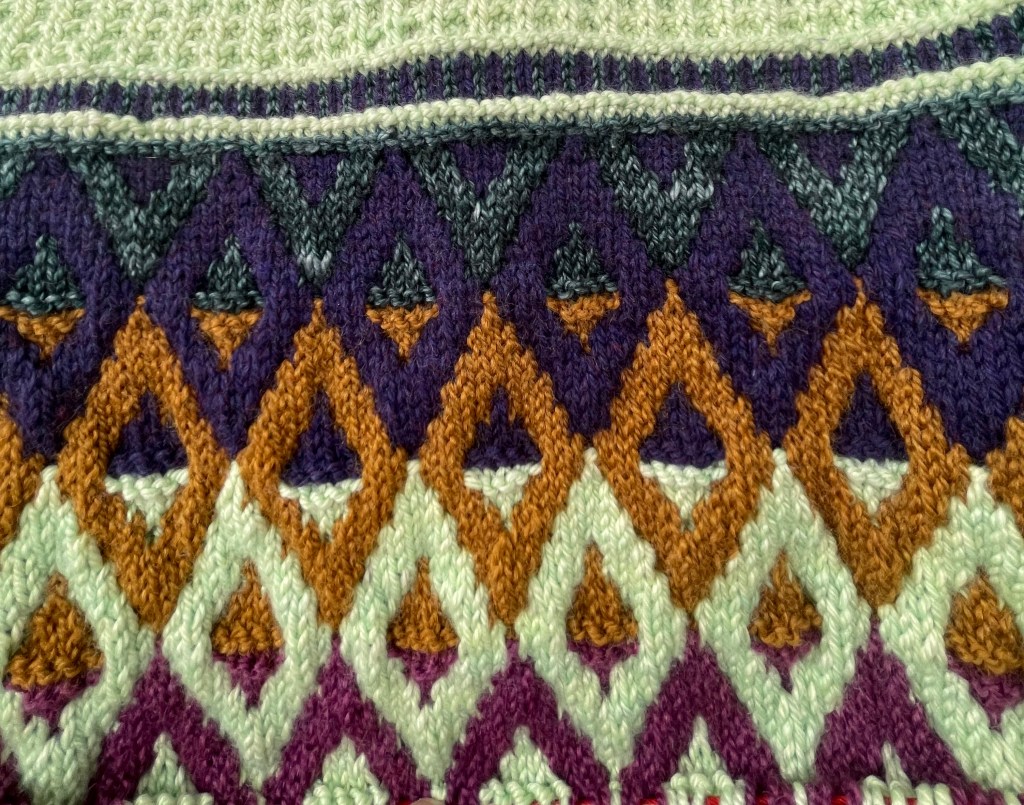
    I was first turned onto Andrea Gaughan from knitwear designer Ellen Coy of Knithow, who is a knit-fit expert and part of a network of designers committed to size and shape-inclusivity. While I was going through Andrea’s portfolio, Junco’s diamond mosaic motif popped out to me immediately. Particularly because the sample in her pattern photos was in black and white natural wool, I was reminded of harlequins.

    As striking as the monochrome was, I knew my DK-weight from Junction Fiber was perfect for this project. While mostly purple and gray, “Constellation” has some splashes of ochre and orange, so I wanted to find a rich, warm earth tone to pair with it. I found that at Rhinebeck later in the year from Fiber MacGyver, who was a new vendor at the 2024 festival; their color “Roasted Pecan” was a great complement.

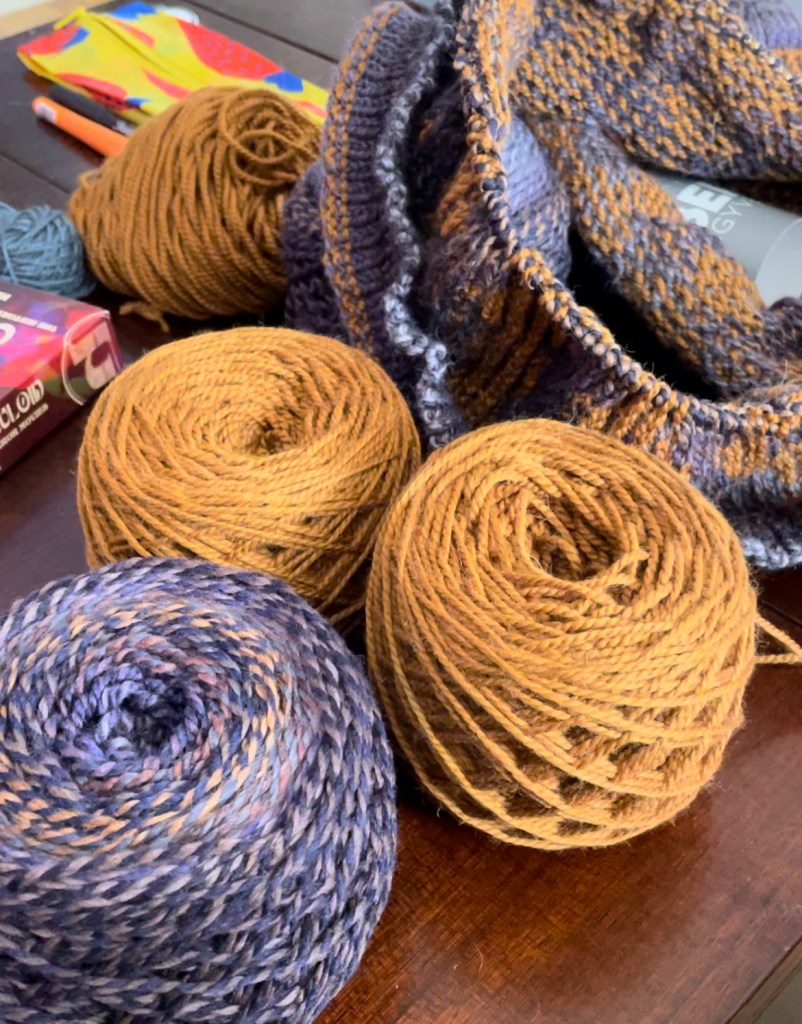
    Some wound up cakes of “Constellation” and “Roasted Pecan” sit next to my work-in-progress on Junco

    I also adore mosaic knitting; while I want to improve my skill at stranded colorwork, it’s just so nice (and gentler on my knuckles) to only be managing one yarn at a time. Mosaic knitting shows off fractal-spun yarns like Making Tracks so well, and there’s a pixelated, 8-bit charm to the motifs this style creates; I appreciate the juxtaposition between my digital association with mosaic knitting and the millenia-old tile art that it’s named for.

    For this project I sized up because I wanted this sweater to be roomy. As I have a 48″ bust circumference, this meant a big investment in the amount of yarn I was using and the time it would take. I also knew I wanted to add length to the body so the sweater would at least hit my hips. This bottom-up design uses an tubular long-tail cast-on for the hem and sleeves, and unfortunately my tension for this part was kind of loose, resulting in a flared silhouette. Instead of redoing it all, I sewed some elastic thread into the wrong side of the hem and sleeve cuffs, which both neatened up my ribbing and provided a stretchy edge, so I can it wear down at my hips or tuck it up under itself at my waist for a cropped look.

    I’ve knit bottom-up patterns before, but this was the first raglan I knit bottom-up instead of top-down. At first I wondered what the benefit was, but I have to say it was nice getting the sleeves done before the yoke. It really felt like I was approaching a finish line when I was casting off the collar, with the rounds getting shorter and shorter as I went.

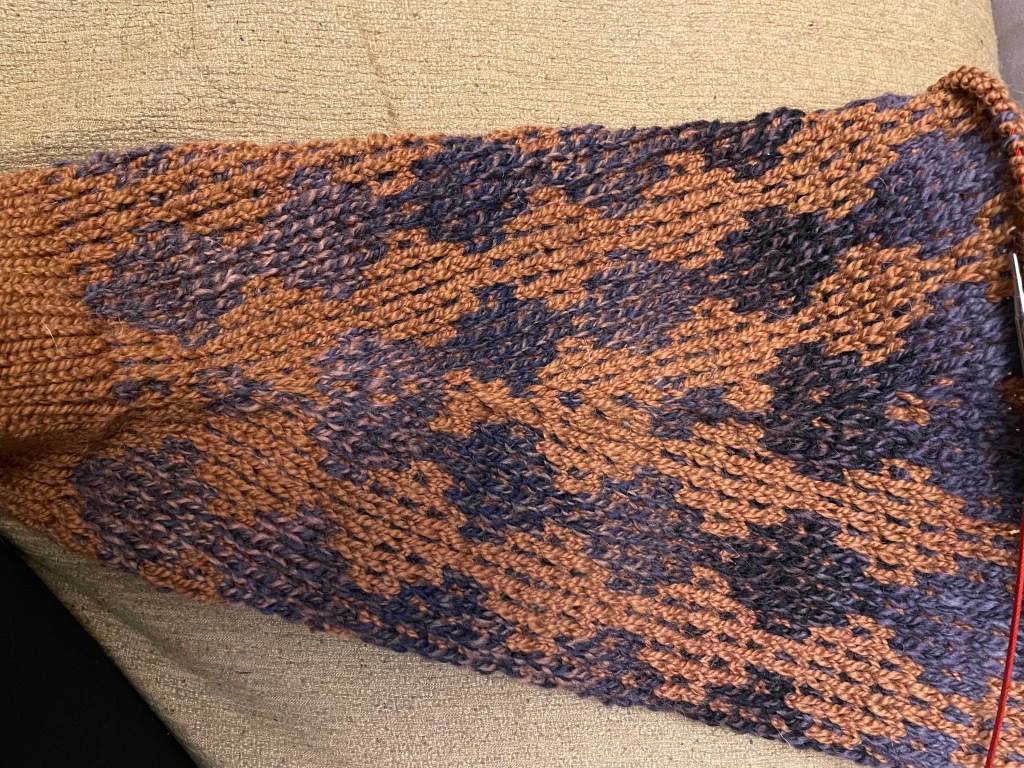
    A photo of an unfinished knitted sweater sleeve made with multicolor purple yarn and brown yarn. The pattern is a diamond motif, and as the sleeve increases in size, more diamonds are added and appear to "burst" from the origin point where the increases occur in a symmetrical pattern.
    A close-up of the sleeve in progress. I think the increases look particularly cool.

    From cast-on to blocking, Junco took me about 6 weeks to finish. The way the motif creeps from the increases of the sleeves and disappears again into the raglan decreases in the shoulders is psychedelically eye-catching, as is the shifting of colors in the yarn. I really couldn’t be happier, and I think it’s one of the projects I’m most proud of.

    Apologies for the awkward/poorly-lit photos. My partner usually photographs my modeled pics and he’s out of town, so I had to take selfies.

    Yarn

    • Junction Fiber Mill, Making Tracks in “Constellation” (MC); I used the leftover yarn in my Bookkeeper Cardigan
    • Fiber MacGyver, Merino Alpaca in “Roasted Pecan” (CC)

    Mods

    • Added 3 repetitions of the chart to the body
    • Sewed elastic thread into the hem and sleeve cuffs for fit and stretch
    • Did a flat collar instead of a folded collar

    What I’m Watching

    *CW: I discuss medical procedural shows in this section, and they deal with plotlines involving overdose and addiction, suicide, gun violence, and transphobia.

    I binged The Pitt in a day and loved it. The performances from the entire ensemble were outstanding, and I’m not surprised Noah Lyle is getting Emmy buzz. Because the season takes place over the course of a single ER shift, there’s an equally compelling supporting cast of patients and visitors who enter the ER, leave, move to other hospital wings, or tragically pass.

    Once I finished the season I caught the bug for medical procedural. My family used to watch House every week while it was airing so in addition to the exciting tension of a medical mystery, this genre is also pretty nostaligiac for me. So I started ER, which also stars Noah Wyle, de-aged from traumatized ER chief to wide-eyed intern.

    Watching the two shows back-to-back is an interesting way to compare the cultural attitudes and anxieties of today versus 30 years ago. In ER‘s first season, the writers include with gang-related gun violence perpetuated by teenagers and younger, patients with AIDs and HIV, and crack cocaine addiction. The Pitt handles a mass shooting, the fallout of Covid-19 and the collective trauma of healthcare workers, and accidental opioid overdose. ER has a recurring beat cop who flirts with one of the nurses and endearingly rushes a dog he accidentally hit with his cruiser to the OR, adopting the saved dog afterward; in The Pitt, a positive relationship with police is never guaranteed – some are helpful, some are patients, some are active obstacles to the doctors’ jobs. The Pitt portrays anti-maskers and anti-vaxxers with no patience for their nonsense, and explores a vignette of an aunt trying to secure an abortion for her niece before being interrupted by the pro-life mother; we watch the doctors perforate contemporary abortion restrictions and try to honor the pregnant patient’s choice to terminate while contending with the guardianship of her mom.

    One of the hardest ER storylines to watch was that of a transgender woman being treated for injuries following a car crash, which is later revealed to be a suicide attempt. As soon as Rena’s doctors learn she is trans, they treat her with obvious contempt: nurses jokingly use slurs, and Carter, Lyle’s character, refuses to even speak to her if not necessary. Not one character on the medical staff ever challenges these attitudes, or treats Rena with dignity.

    Rena speaks about her life experience as a trans person, describing the treatment she now faces from her doctors, but in the end she is written as a lurid interest story and not as a person. The character is played by a cis male actor, a miscasting problem that persists today – it privileges cis actors for roles when trans actors are already marginalized, and reinforces the idea that trans women are just men in women’s clothing. None of the doctors are shown to be even compassionate, let alone understanding, to her physical or mental health. At the end of episode, Rena completes suicide. Instead of coping with the fact that his mistreatment exacerbated Rena’s dysphoria, Carter is comforted by his supervisor and told that it was a simple oversight that they didn’t flag her ideation earlier. Then they go have Thanksgiving dinner together.

    I understand that this episode is 30 years old and I’m watching it with a very different perspective on sex and gender. Apparently there are other instances of transphobic writing still to come. I also know that this kind of horrible treatment is commonly experienced by trans people in real life. But this is TV, and it’s not reality, it’s not real people making real decisions. It’s writers making the conscious choice to convey something to the viewer, and in this instance, it’s that trans people are inherently tragic, doomed, and unworthy of time and attention.

    The Pitt also features a patient who is trans. Tasha, played by Eva Everett Irving, comes to the ER for a deep cut in her arm. She’s misgendered when her deadname is called to be seen, and corrects the ward clerk before going to get stitches from Dr. McKay and intern Javadi. As they clean and stitch her wound, they ask Tasha medically necessary questions, but also make small talk about her job as a high-end sommelier (Tasha’s cut is from a broken decanter). It’s cordial, relaxed, and friendly. At the end of the treatment, Javadi corrects Tasha’s medical record to reflect her name and gender so she won’t be deadnamed at future appointments, and apologizes for the error. Tasha thanks her for this, and Dr. MacKay praises Javadi’s attention to detail and empathy.

    Here, the writers want to show a trans woman who is successful and content while representing how medical settings can be fraught settings for trans people. Tasha’s medical record outed her, which can be very dangerous if she was treated by a transphobic doctor – it was fixed. There was deadnaming – Tasha didn’t stand for it. Speaking of the writers, this episode was written by Noah Lyle. I don’t know if he included this patient interaction because of ER‘s track record of trans representation, but it was good to see the 180 turn in an episode that was already very personal for him.

  • Frederick Fiber Festival: A day of sidequests

    New-to-me dyers, a hyper-specific color mission, and the importance of showing up in the rain

    I had been wanting to go to the Frederick Fiber Festival for years and never had a chance because until recently, I had always been working on Saturdays. Tough, especially because FFF happens twice a year – twice as many chances for me to get my ass there!

    During my tenure at the yarn company, we typically went to the big events, like Rhinebeck, Stitches (before it imploded), and VKL (before the thought of unloading a truck in the middle of Times Square became enough to give one hives). I developed a preference for the farm-ier, more outdoorsy events, where in addition to indie dyers and designer appearances, there were also farmers auctioning sheep and herding dog demonstrations. FFF isn’t quite large enough for the complete county fair vibe (I’ll get my fill of that when I make another small roadtrip to Maryland Sheep & Wool next weekend), but it introduced me to a number of vendors I hadn’t had the pleasure of shopping with before.

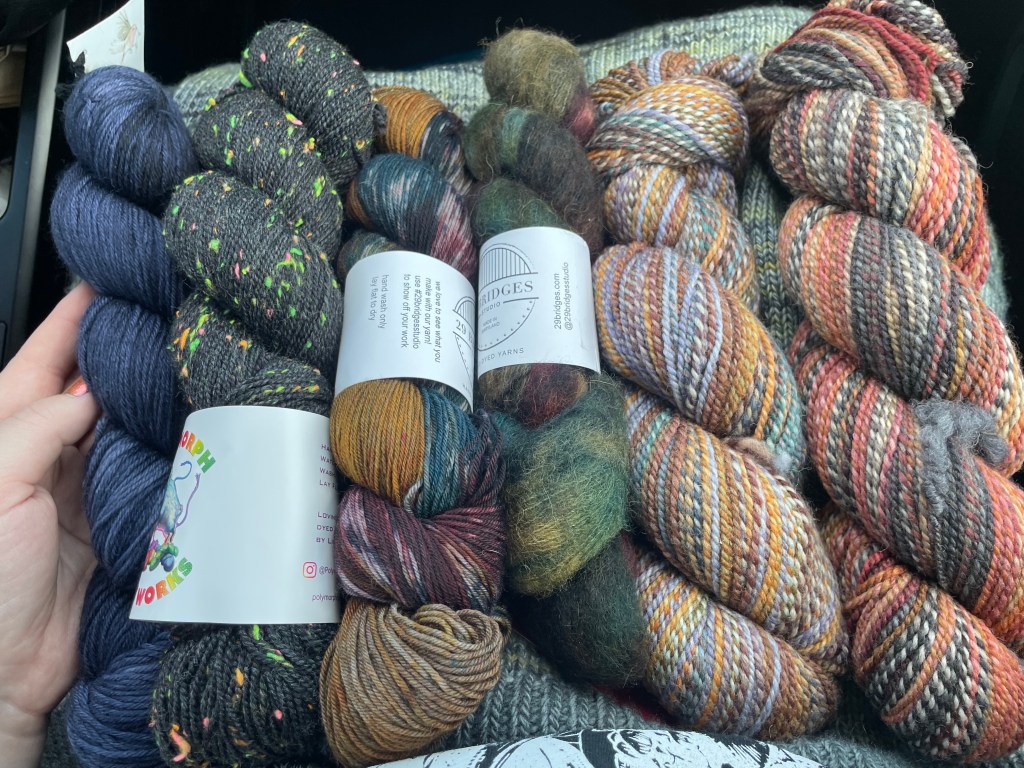
    Before I went absolutely apeshit at every shiny new booth, I had to remind myself that I had a mission. I’ve been wanting to make an Artus Shawl ever since it came out, and I have a very specific color scheme in mind that revolves around luna moth green. My partner, who loves solving problems, was with me, so I asked him to keep an eye out for a similar shade. I was fully expecting not to find it that day, but I happened to find it at Cape May Fibers. I held up a skein of mohair and said “Look for this, but not fuzzy”; I put the skein back down but my partner had the good sense to take a picture of the label to get the colorway, and wouldn’t you know it, the color was called “Luna Moth”. So while I couldn’t get the weight I needed at the festival, I placed an order in sport weight that night.

    I also made a stop at Yarn Hero’s booth, another source for color-shifting fractal-spun yarn. What I really appreciated here was that in addition to their beautiful standard skeins, Yarn Hero had flawed skeins, mill ends, and test runs for sale, sold by the gram. Not only is it a more affordable option for festival-goers, but I find this also speaks to the sustainability of the company. It’s good to see businesses not hiding away skeins that are short or have slubs just because they can’t sell them full-price. And it’s a rare opportunity for people like me who aren’t picky about a little mill knot here and there, or for folks who don’t want to buy more yarn than they actually need for a project.

    This is another perk of going to festivals like these: you get to see products that often don’t make it to the business’ websites. Plus you get to actually meet the people who run the companies, see the colorways in person, and feel the yarns. This is especially important for companies that don’t have a retail space, and rely on trade shows and trunk shows to directly sell. These events are usually the biggest money-makers, and will often keep an indie dyer in business for months.

    Which is why it’s so crucial, if you’re able, to brave the rain if the forecast calls for it. It never quite stormed on Saturday, but we had a clap of thunder and the rain was off and on, like someone was turned on the spigot every ten minutes or so while the clouds blew through. Almost all of FFF’s booths, minus a few trucks and food vendors, were indoors and sheltered, but there was still a strong gust that blew through one of the buildings and threatened some stands. In those moments, everyone comes together to brace against the poles and pick up flying shawl samples.

    At many festivals, however, booth spaces are in outdoor tents more exposed to the elements and mud, and some unluckily-placed vendor gets the short end of the stick when the weather turns sour. Rain or shine, these events are planned well in advance and can’t be canceled.

    Eventually the sun came out, and we called it a day at the Frederick Fairgrounds with my new skeins. The yarn I got from Polymorph Dye Works is especially fun, black with neon neps – it reminds me (in the best way) of 90s arcade carpet.

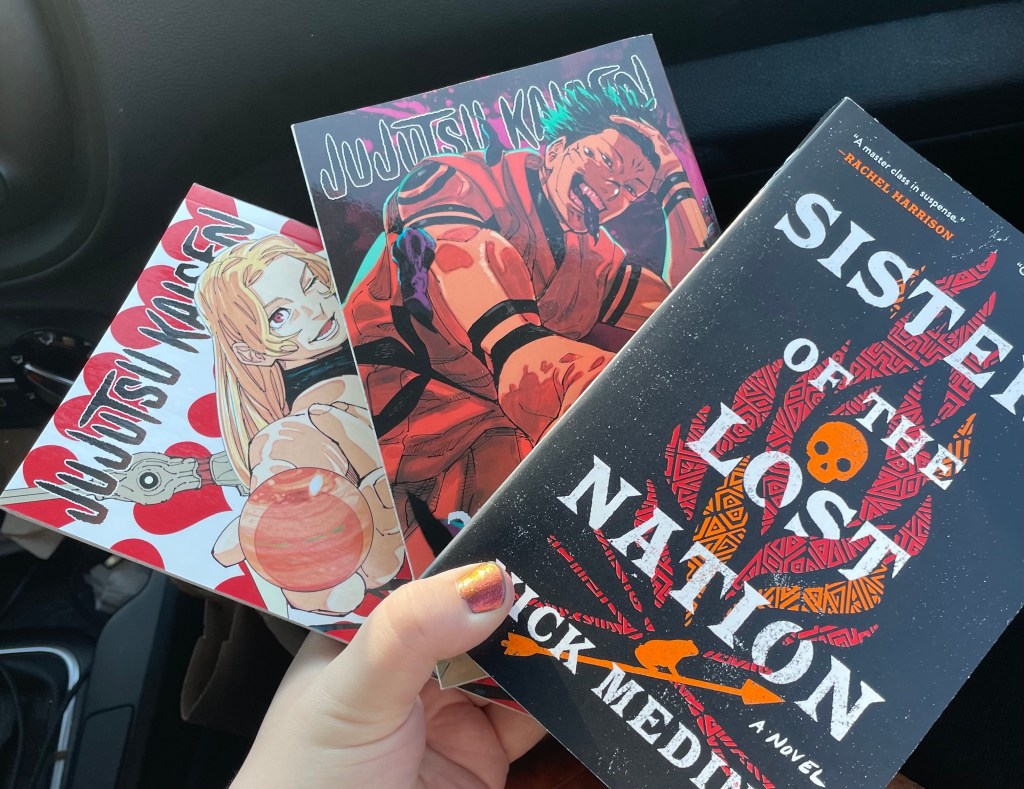
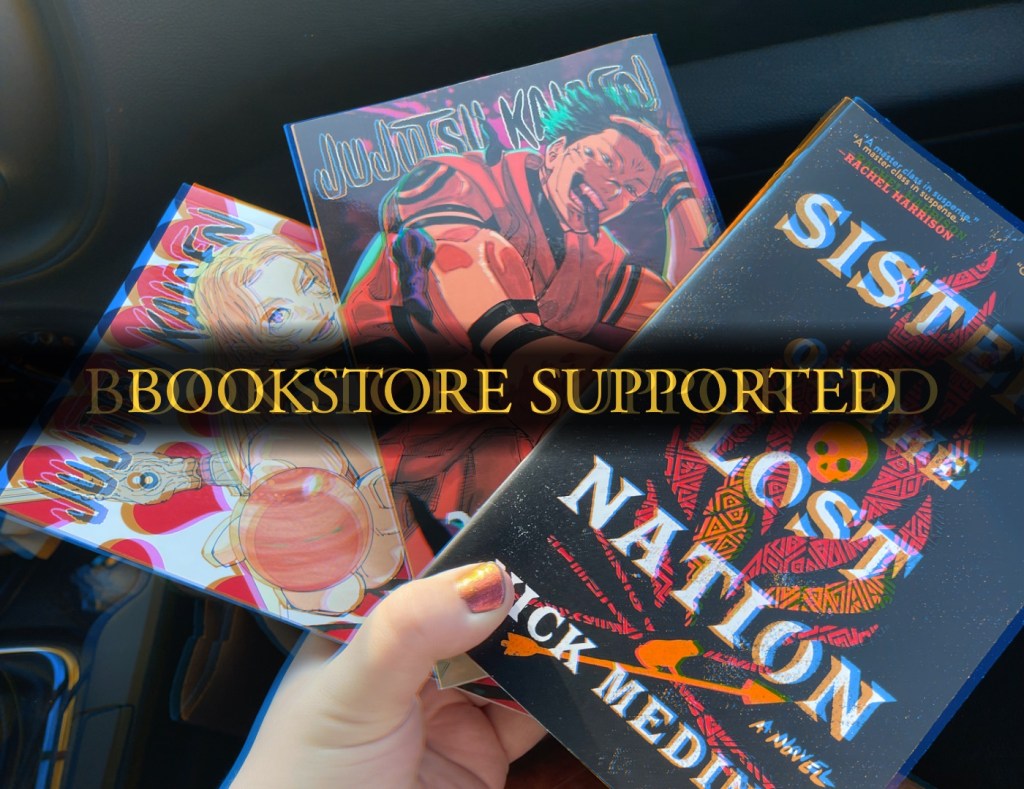
    But Frederick is a beautiful little city, so our day didn’t end just yet. My partner is a massive coffee-lover, and we made a stop at Gravel & Grind, a cafe and bike repair shop that sells great drinks and independently roasted beans. It was also Indie Bookstore Day, so while we drank our coffees we looked up the nearest bookshop to support. That turned out to be Curious Iguana on Market Street, downtown Frederick’s main drag of boutique storefronts and restaurants. I picked up volumes 23 and 25 of Jujutsu Kaisen, which were missing from my collection, as well as Sisters of the Lost Nation by Nick Medina; I had read Indian Burial Ground and I’m looking forward to reading his first novel.

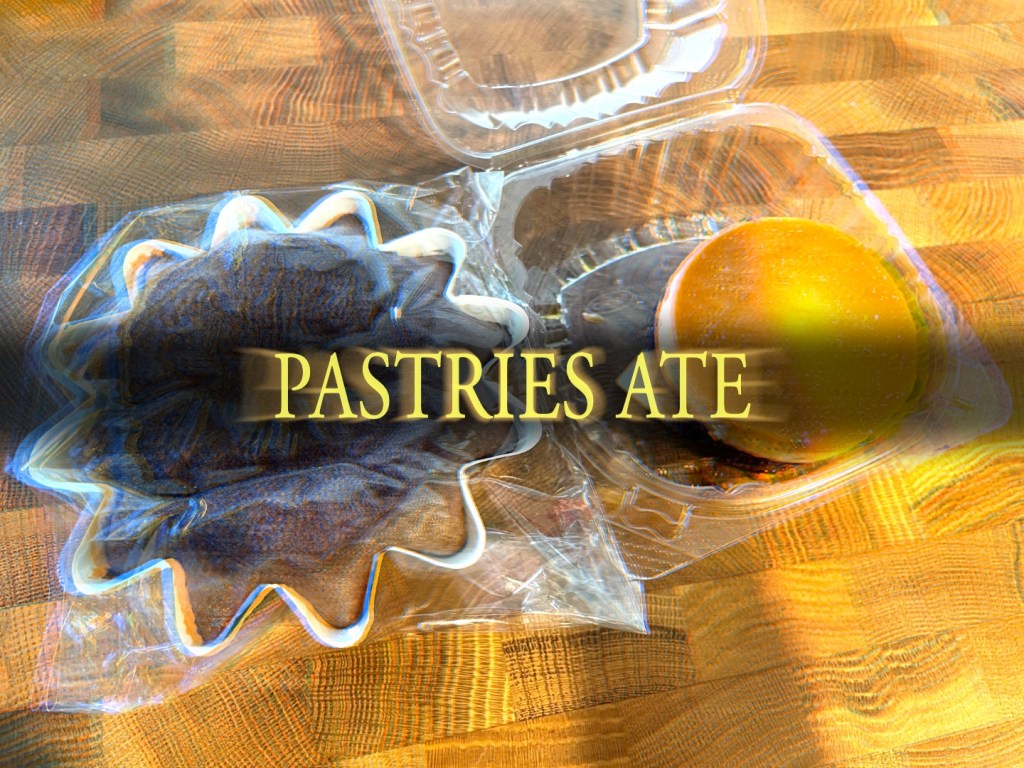
    Our last stop of the day was Gwenie’s, a Filipino bakery with a couple locations in the MD/DC metro area. We were introduced to Gwenie’s by a friend of ours, and they requested a slice of ube cheesecake if we were going to be in the area. We got there within an hour of their closing time, when everything is 30% off, so we left with an armful of of mamons and sylvanas.

    An ube mamon and ube custard cake, you guessed it, styled like a Dark Souls achievement.

    Driving home from a lovely day out, I think the highlight of my Frederick visit was running into a regular customer from my former job and exchanging excited greetings. At least now they know I didn’t just fall off the face of the planet when I quit. Closure!

    *I’ve never played a Souls game, Sekiro, Bloodbourne, Elden Ring, or even a Souls-like. I just think the title cards are funny.

  • It’s WIP Wednesday My Dudes: The Thonnan Top

    Happy WIP Wednesday! I always have multiple projects in progress, but today I’m talking about the Thonnan Top by Katt Weaver, published in Yarn – The Journal of Scottish Yarns #3.

    Let me tell you I near broke the mousepad on my laptop clicking on this pattern when I first saw it. Then I looked at Katt Weaver’s other patterns and saw that she’s a fellow D&D player (several of her designs names are references to the game or even accessories for dice). So obviously I was locked in.

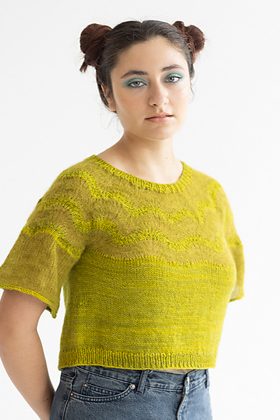
    This top-down garment has a feather-and-fan motif yoke that stripes down into the main color, mimicking breaking waves. If you like texture, that marine vibe can be amplified with a frothy alpaca laceweight, which I’ve opted to use. I can’t wait to finish this project and be orbited by something something so decadent and lofty.

    From the Thonnan Top Ravelry page, one of the model shots of the sample in an incredible charteuse.

    I found this pattern because I’m desperately trying to use up stash yarns, so I had set a number of filters on the Ravelry search to find designs that use 3 or fewer skeins of DK weight yarn. Using a mohair or alpaca laceweight wasn’t even on my mind while I was scouring the Ravelry for a pattern, but I happened to have two skeins of the Tatreez colorway from Fruitful Fusion, a fundraising colorway to support victims of the genocide in Gaza, and this felt like a perfect pattern to showcase it this yarn front and center.

    Tatreez is the style and motifs of Palestinian embroiderers. Practiced and passed down from expert to student, usually between female family members, throughout the diaspora. Probably the most recognizable example is the embroidered thobe, which I’ve often seen as a black garment embroidered with red, green, and purple thread. Tatreez is an intangible cultural marker of Palestinian identity and history.

    Michigan Representative and Palestinian-American Rashida Tlaib (top center) wears a thobe on the day she is sworn into Congress in 2019. In front of Tlaib is Deb Haaland, who was newly elected to represent New Mexico; Haaland is a member of the Laguna Pueblo tribe and also wore traditional garb and jewelry that day.

    Because I am American, it’s crucial for me to talk about the US-backed destruction of Gaza and the murder of Palestinian people. Colonial violence has been implemented in Palestine for over a century with the British Mandate starting in 1922, and the Nakba of 1948.

    I think, I hope, that anyone who loves any handicraft understands the power of how familial teaching preserves art like tatreez, and what the world loses when its artists are imperiled and killed. To learn more about the history and preservation of tatreez, please check out Tatreez and Tea. This project was started by Wafa Ghnaim to preserve examples of tatreez, research its history, and teach it to new practitioners.

    What I’m reading

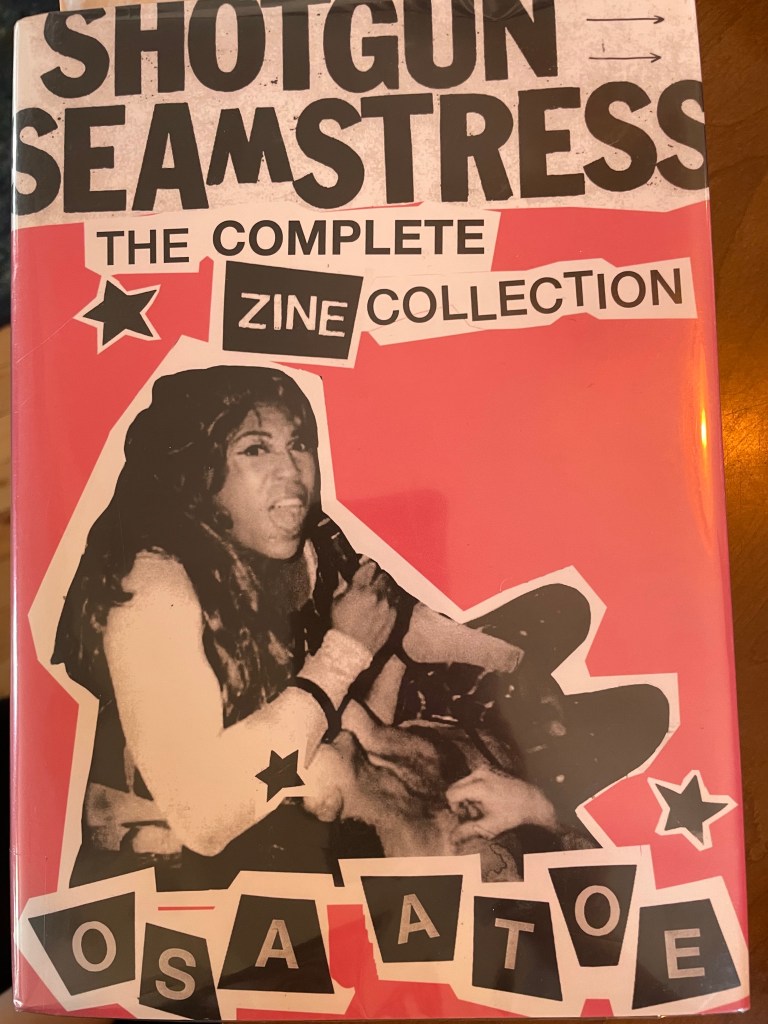
    I got Shotgun Seamstress: The Complete Zine Collection from my library this week. Osa Atoe is a musician and artist who created Shotgun Seamstress to document “the experience of being the only Black kid at the punk show”, connect and amplify other Black punk and DIY artists and musicians. Within Shotgun Seamstress‘s seven issues is Atoe’s and her collaborators’ deep knowledge of music and cultural history, a profound respect for the people who made and make the music and art that they loved. And yet, there is also the philosophy that as an artist, you can simply do whatever you want. You don’t have to wait for anyone to teach you, you don’t have to wait until you “do it right”, you don’t need the best equipment, and you don’t have to sound or, in the case of the punk scenes in majority-white cities like Portland, look like anyone else to make something.

    The cover of Shotgun Seamstress

    What I’m watching

    The newest season of Gamechanger just began on Dropout TV, which is my favorite streaming service. If you haven’t heard of it, I suggest checking them out on Youtube and then subscribing post-haste. It’s all original comedy programming with extremely talented people, and if Whose Line Is It Anyway left a hole in your heart when it went off air, then you’ll love Make Some Noise.

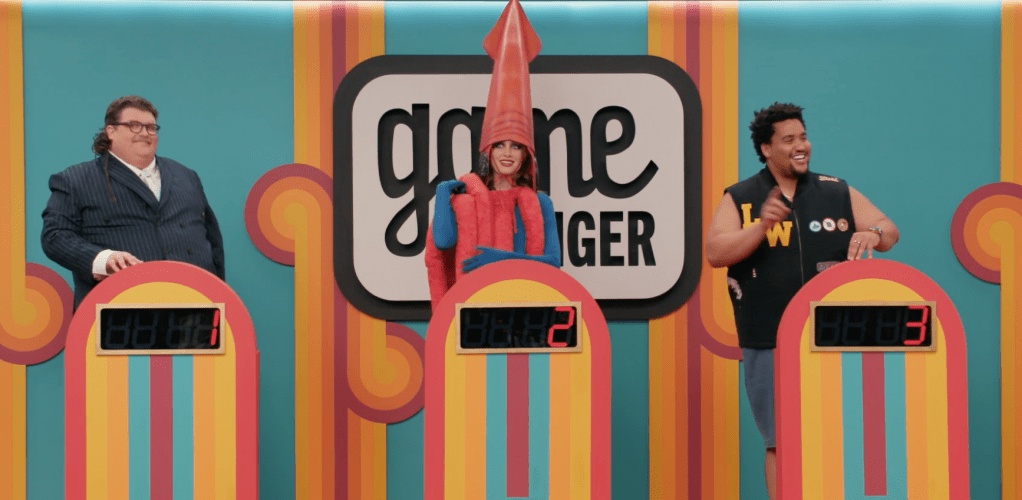
    Gamechanger is a game show where the game changes every time. The season 7 premiere stars Jacob Wysocki, Vic Michaelis, and Lou Wilson, and I don’t think I’ve laughed so loud in months.

    Jacob Wysocki, Vic Michaelis, and Lou Wilson stand behind their podiums on the Gamechanger set.

    To fully appreciate this episode though, it would behoove you to watch an episode from the previous season, “Sam Says 3”, which features the same contestants.

    That’s all for this Wip Wednesday