Tag: politics

  • Comedia dell’arte. Comedia dell’yarn-te?

    Comedia dell’arte. Comedia dell’yarn-te?

    Down to clown in Venice

    I began indulging my love for harlequin motifs with my Junco Sweater, but at the end of last month, I got to visit the harlequin homeland: Italy!

    My partner, who is a freelance assistant camera operator, worked on Cover-Up, a documentary about journalist Seymour Hersh and directed by Laura Poitras and Mark Obenhaus. He was invited to attend its premiere at the Venice Film Festival, and I got to go with!

    This event was wild. Most of the time, I felt like I had snuck into the back door of a party I hadn’t been invited to. My partner noticed Mads Mikkelsen and was tempted to tell him how much he enjoyed his work in Death Stranding. I accidentally caught Tilda Swinton on camera trying to film an art installation. Willem Dafoe was hanging out in the hotel bar. I drank Negronis while watching people I can only assume were European royalty pass by in evening gowns. Guards walked around wearing military berets and machine guns. I was nervous to make sudden moves.

    The level of wealth was strange to me. It was strange to witness in person. It was especially strange considering that Cover-Up is about a guy who blew the top off multiple war crimes committed by American’s military, namely, the My Lai massacre during the US invasion of Vietnam, and the torture at Abu Ghraib prison during the invasion of Iraq. Hersh is a truly remarkable person who pursues the truth regardless of what people think, and what enemies he makes. He’s been accused of spreading conspiracy theories. He was the subject of angry, worried phone calls between Nixon and Kissinger. He’s on the left in this photo from Reuters.
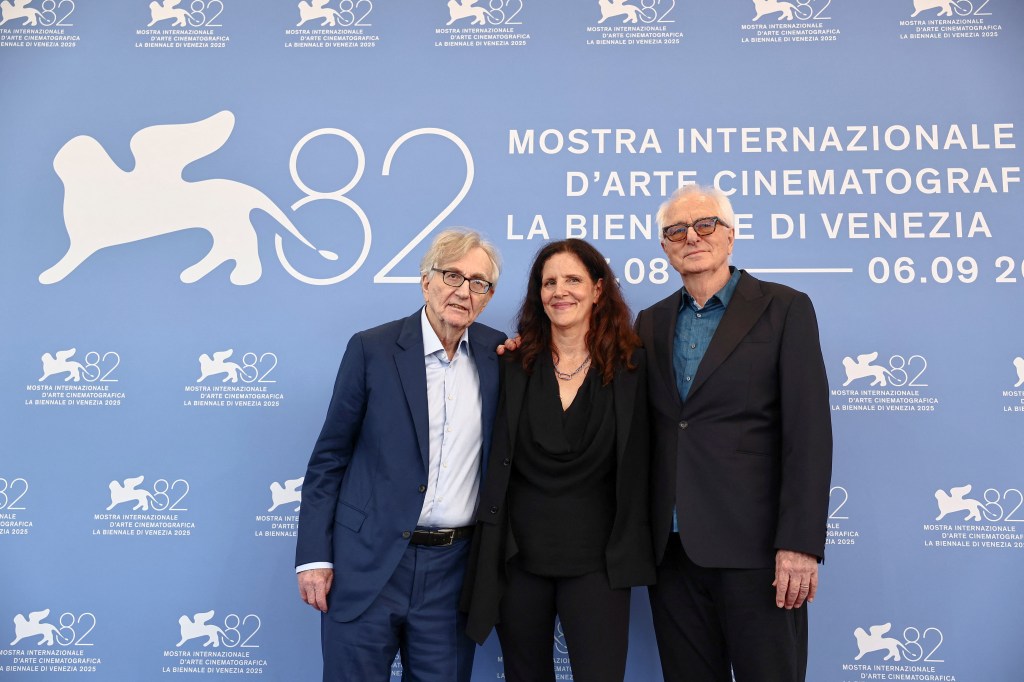
    Director Laura Poitras, director Mark Obenhaus and journalist and political writer Seymour Hersh pose during a photocall for the movie “Cover Up” out of competition, at the 82nd Venice International Film Festival, Venice, Italy, August 29, 2025. REUTERS/Yara Nardi

    The same day Cover-Up premiered, so did After the Hunt, a new Luca Guadagnino movie starring Julia Roberts and Ayo Edebiri. We passed the red carpet during their entrance but couldn’t see over the wall of photographers. But I do wish I had seen Roberts’s dress with my own eyes:
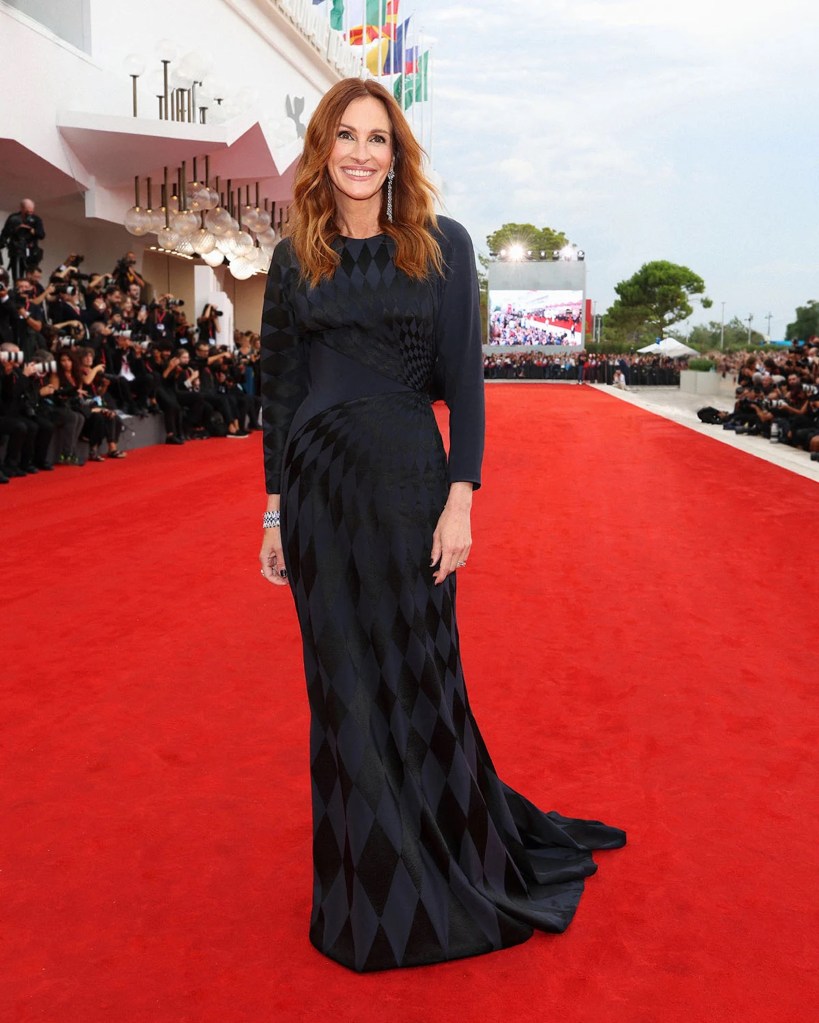
    Julia Roberts stands amiling on a red carpet. She is wearing a black gown with a low-contrast pattern of diamonds.

    Roberts wore Atelier Versace, a long blue-black gown with a low-contrast pattern of diamonds cascading down the skirt and rising up the shoulders. I thought this was a fashionable nod to the history of comedia dell’arte and Harlequin in its country of origin.

    In commedia dell’arte theater, Harlequin is a stock character, a servant and a trickster with two masters, undermining the authority of both. Which is also why Harley Quinn of DC comics makes such a good anti-hero: sometimes allied with the abusive Joker and sometimes Batman, she flips between her penchant for chaos and her moral agency.

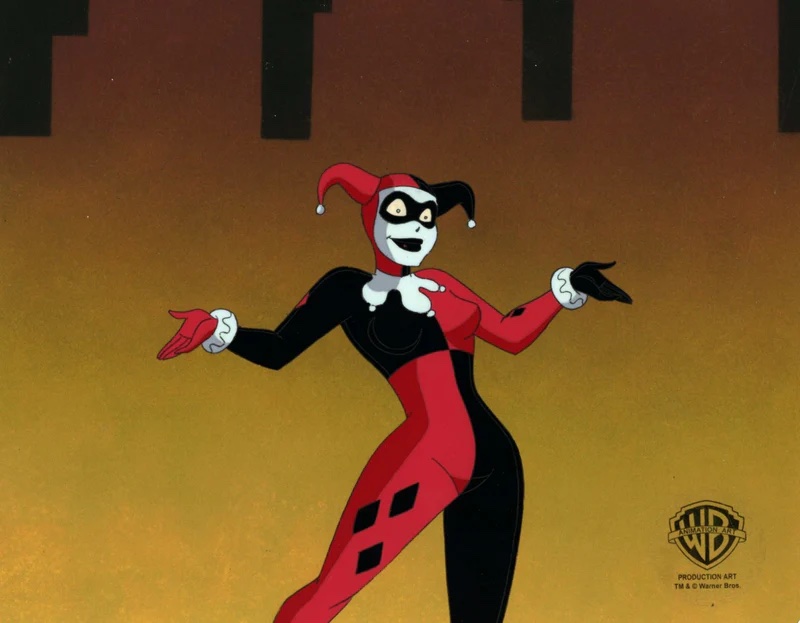
    Harlequin’s costume patterns range from diamonds to patchwork triangles, often colorful and bright, but sometimes black and red. And in Venice, those motifs manifest in Carnevale masks. As a former Catholic, I still feel drawn to the gilded imagery of Catholic religious ritual, and the way it has adapted (or appropriated, in many cases) pagan traditions. It’s catnip to a heathen like me.
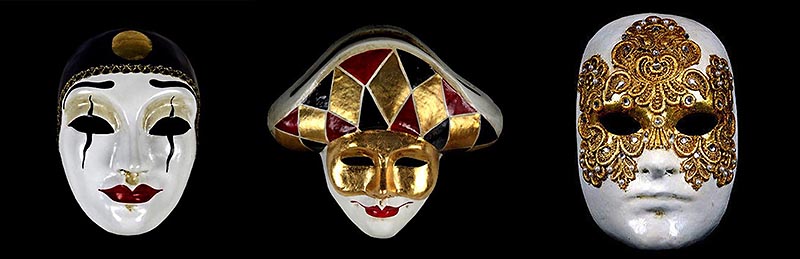
    A trio of Carnevale masks. On the left is a white mask with red lips and wavy lines crossing vertically over the eyes, and a black cap shape over the forehead. In the middle, a mask with red lips and a gold mask over the eyes - this figure wears a crescent-shaped headpiece with gold, black, and red diamonds. On the left, a mask that is completely white except for a large golden filigree covering the foreheard, eyes, nose bridge, and cheeks.

    I also got to visit the Peggy Guggenheim collection, where they happened to have a temporary exhibit featuring the work of Helena Maria Vieira da Silva, a Portuguese abstract painter who mapped space using grids of colorful squares. I was really taken by this exhibit and Vieira da Silva’s style, and I think it’s no coincidence that she also worked in tapestry and stained glass – the way those forms naturally lead toward geometry, pixelation, and abstraction probably had an influence on her painting style, the signature use of a grid to create depth and find form in her depictions of movement, cityscapes, and interiors.
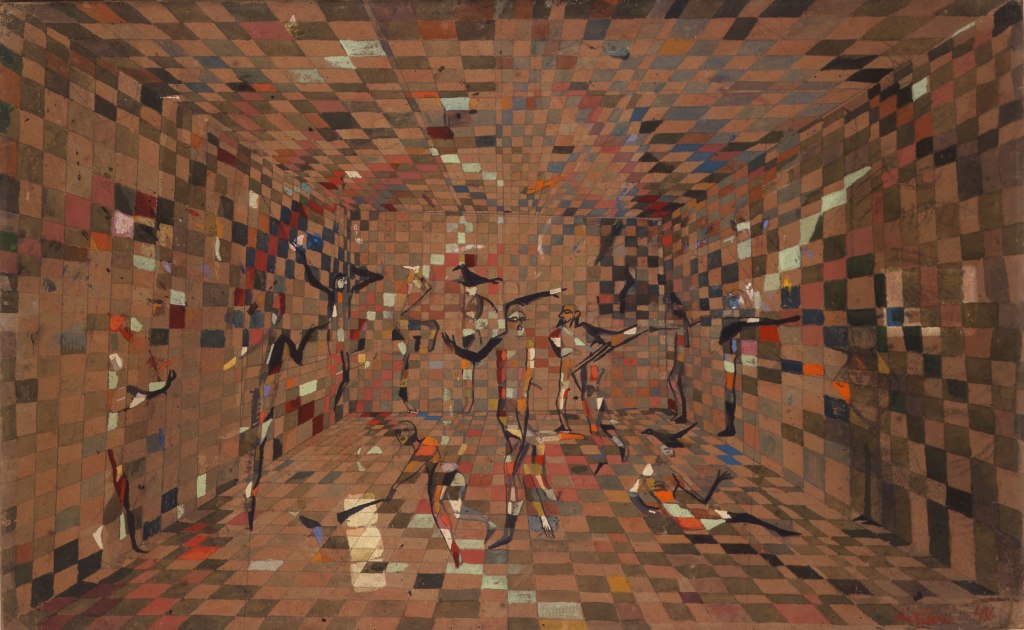
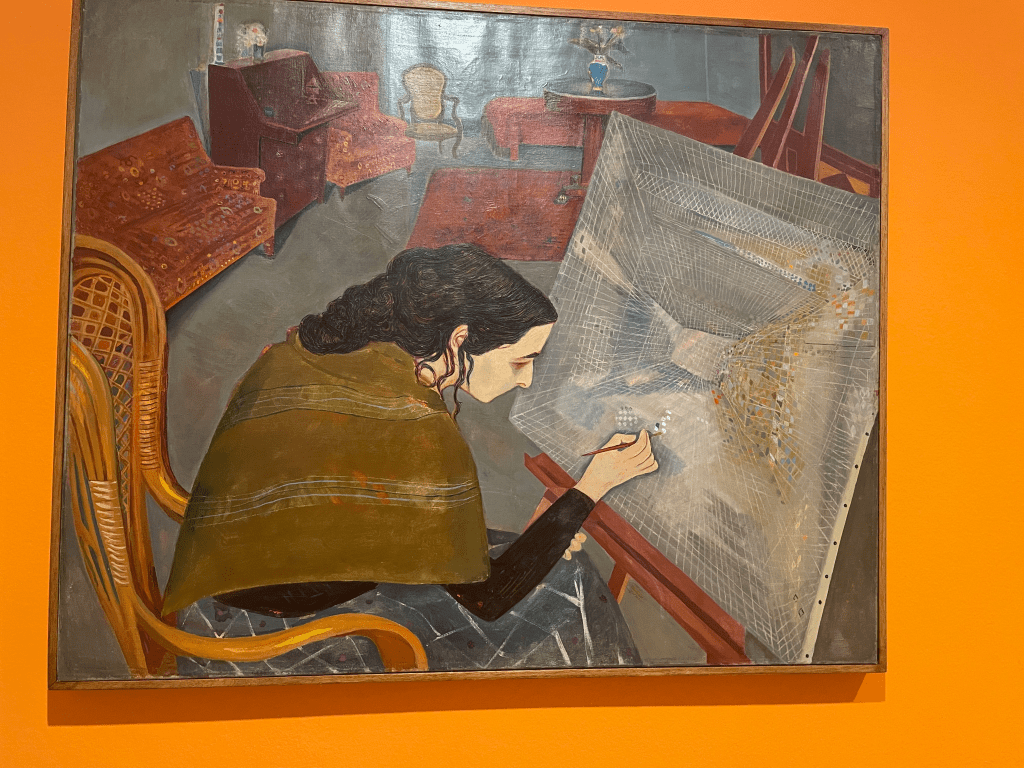
    Now that I’m back from Venice, I’ve been looking for ways to translate that interest in diamond motifs into knitwear. Through my searches on Ravelry, I came across this project by user SilasM.

    That was it, that was exactly what I wanted to make. The pattern is Harlequin Pullover by Anne Mieke Louwerens, an artist who has worked in textiles and knitwear design, painting, graphic design, and ceramics.

    But I had a small roadblock. I couldn’t find this pattern online anywhere, because it was originally published in the fall/winter 1988 issue of Vogue Knitting.
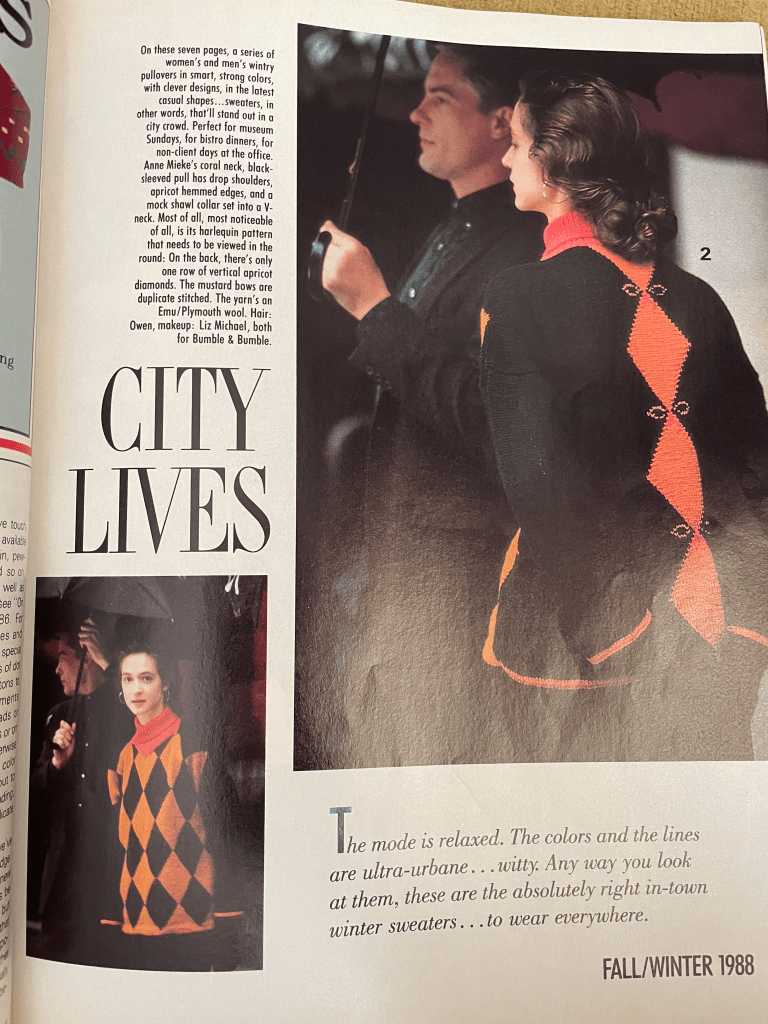
    A page from the issue of Vogue Knitting where the Harlequin sweater is modeled. Int he main photo, the model is acing away from the camera and a single line of orange diamonds on a black background is shown on the back. There are duplicate stitch bows adorning the tops of the diamonds. In the inset image on the bottom left, the models faces the front, showing the grid of orange and black diamonds and a coral cowl neck. In both photos, the model is standing next to a man in a suit, holding an umbrella. The model is a white woman with brown hair, wearing gold hoop earrings.
    The Harlequin sweater modeled in the Vogue Issue.

    But that’s why God made eBay, right? Luckily I found a hard copy of the issue from a seller on the site, who kept this magazine miraculously preserved for the last 36 years.

    After looking at the pattern directions, I’m already planning a couple mods. To feel truly in the piebald spirit of Harlequin, I want to make all the contrast color diamonds different colors. I’m also planning to add some shoulder shaping, and sleeve decreases to preserve some yardage. I’m split on the cowl neck. I love how it looks, but I’m partial to lower necklines. It’s added by picking up the stitches around the neck after the rest of the sweater pieces are grafted together, so I won’t have to make a decision until much, much later.

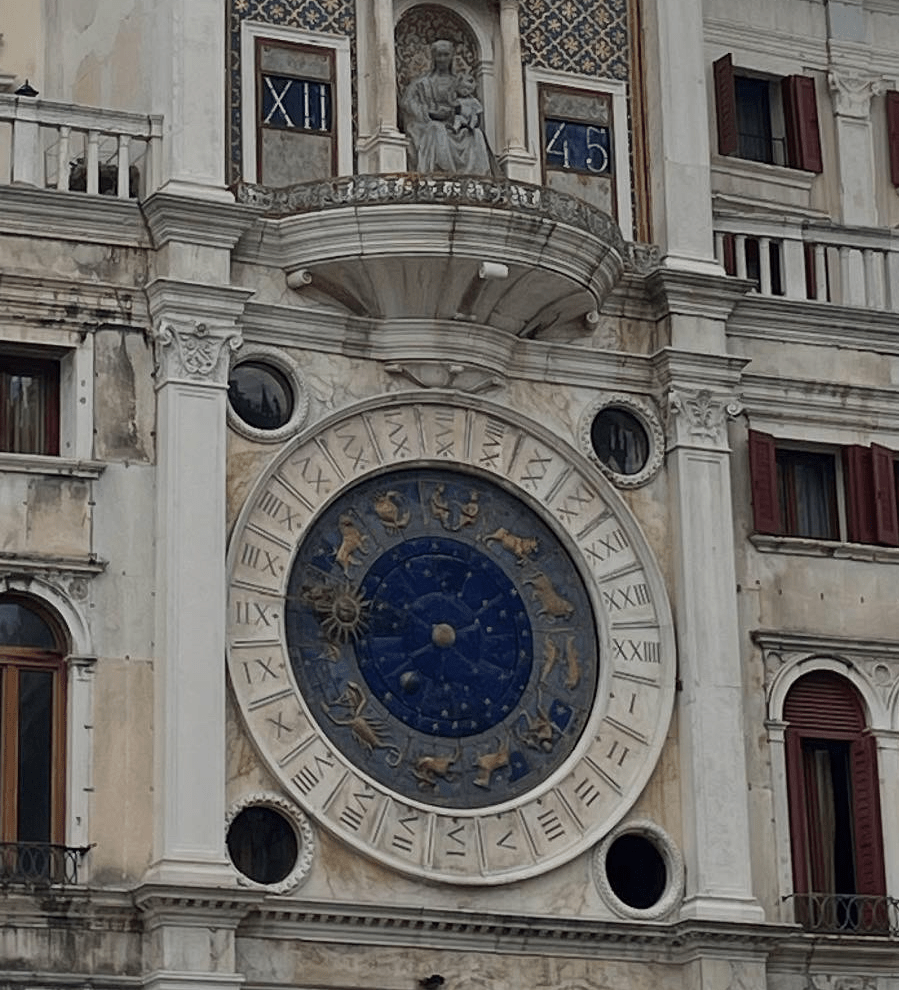
    The diamond motif wasn’t the only thing that caught my eye in Venice. Right now I’m also enamored with celestial imagery, which is all over the city (and other parts of Italy, according to my friend who has traveled more extensively there). So I was completely transfixed by the Torre dell’Orologio in San Marco Square, an astronomical clock tower depicting the 12 zodiac signs. It tells the time, and the positions of the moon, Mercury, Venus, Mars, Jupiter and Saturn, as well as the astrological position of the sun.
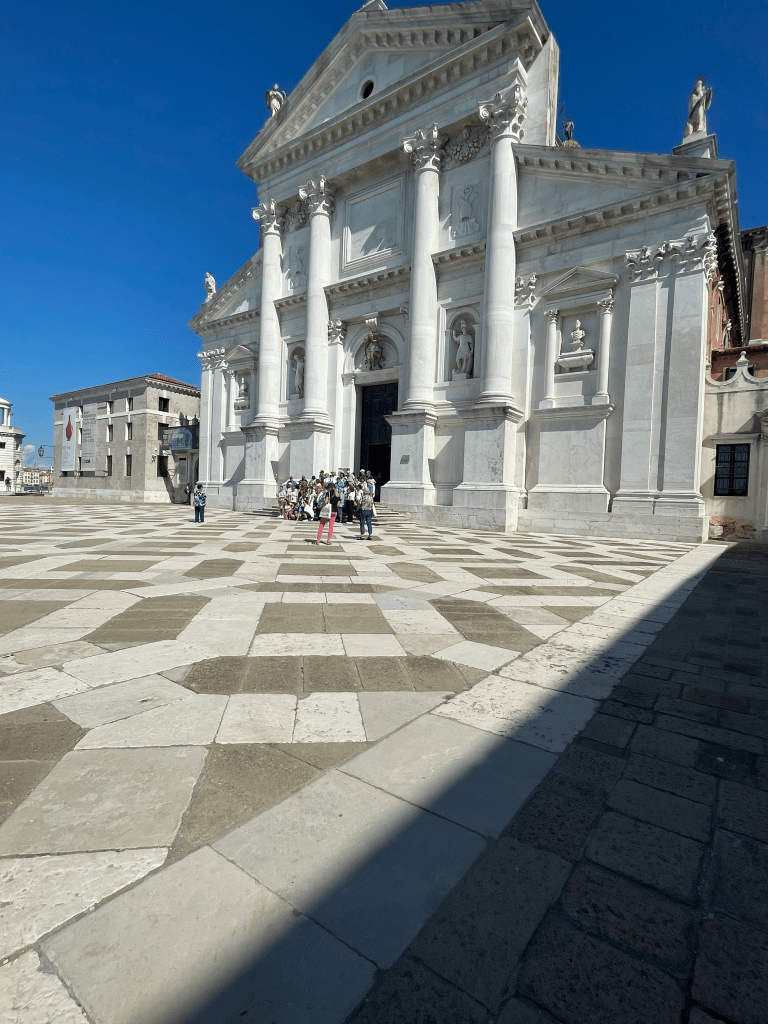
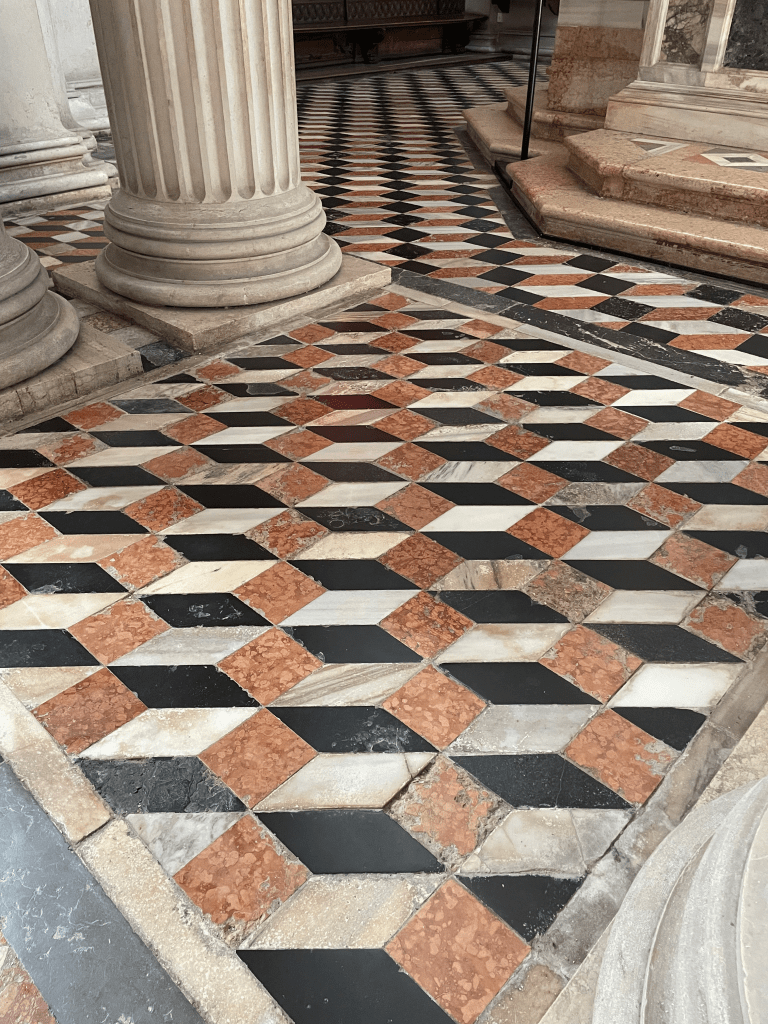
    I also found plenty of inspiration in the tile floors at San Giorgio, a church and monastery. The island, San Giorgio Maggiore, is also home to a photography gallery, which had an exhibit on Robert Mapplethorpe while we visited.
    In addition to Venice’s classic sights, we were invited by the Cover-Up production team to the Biennale Architetturra to see the installation “Calculating Empires” by Kate Crawford, a researcher who has been studying AI for the past decade, and artist Vladen Joler. I got to speak a little with Dr. Crawford, who was so extremely cool. The project is available to view online here.

    Also at the Biennale Architetturra was Necto, an installation made from knit fiber and LED lights. Read the full details here.
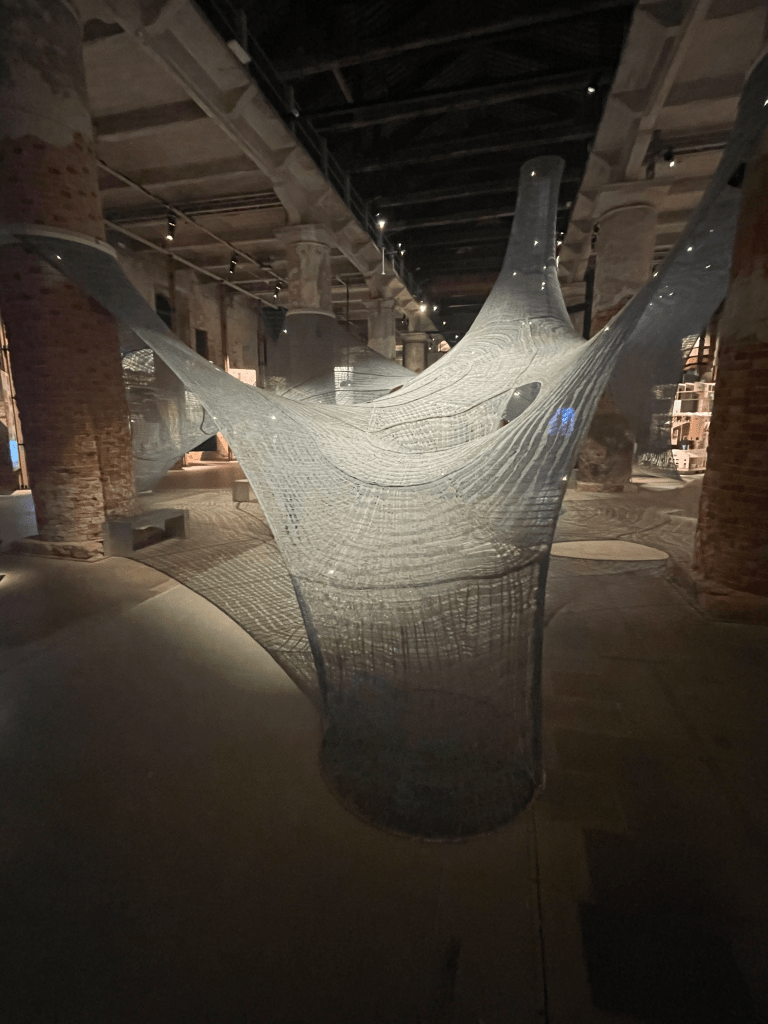
    A large knitted art piece is suspended on multiple brick columns in a large room, kind of like a giant spiderweb. Multiple lines of LED lights run through it, and dots of light can be seen throughout.
    This is what I was filming when Tilda Swinton’s tour group came through.

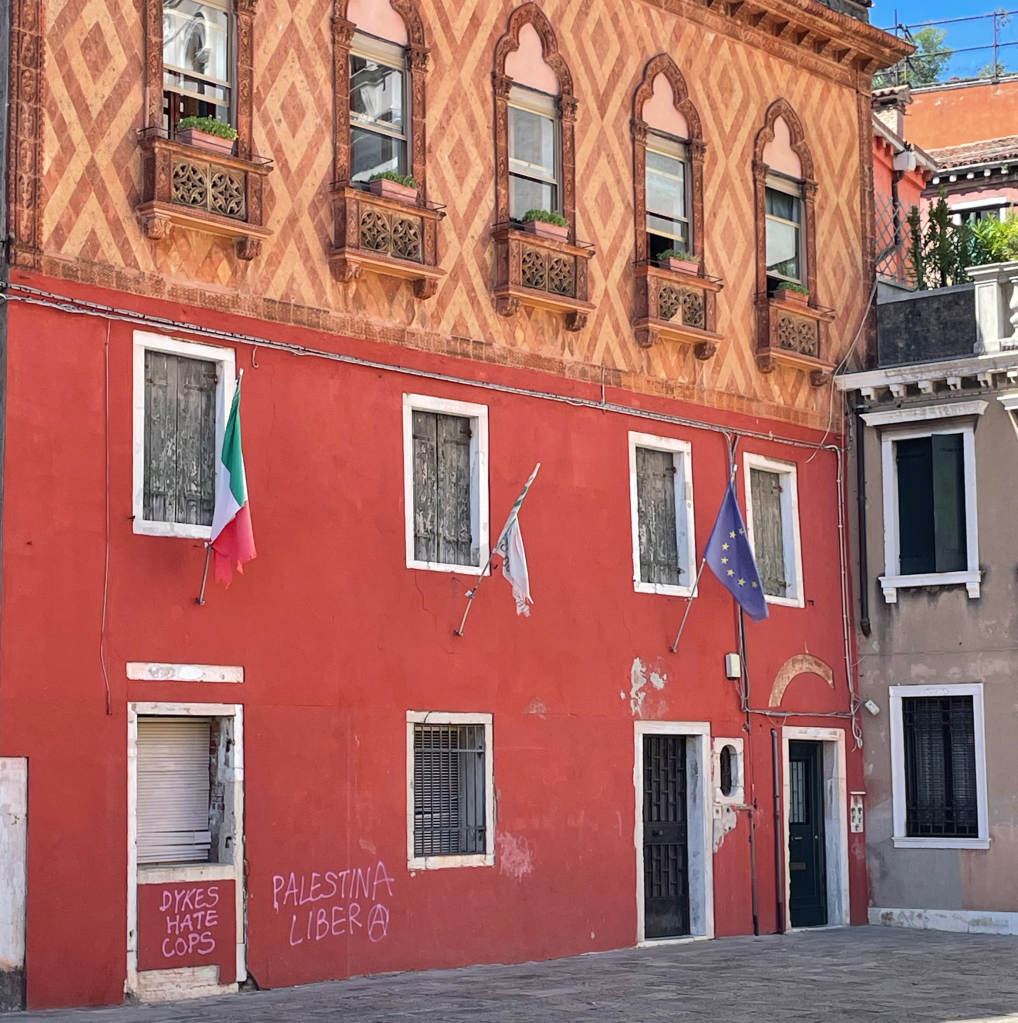
    And besides the “official” art, there were tons of murals and graffiti all around Venice. Much of it was anti-Amazon and anti-Bezos, since he had just completely shut down the city for his own wedding just a few months prior. Most of it was in support of a free Palestine and an end to the genocide in Gaza.

    And last, the two funniest images I took. On the left, a young man whose whole job is to carry a falcon around to scare pigeons away from this rooftop bar. On the right, a trio of suited, ear wire-wearing tough guy security guards at the Film Festival take a much-needed gelato break.

    There are worse gigs, probably.

  • De-influencing you (and me)

    De-influencing you (and me)

    A close up of circular knitting needles with live stitches on the cable. An aluminum can tab is being used as a stitch marker to mark the beginning of the round. The yarn in the foreground is beige and in the background is purple.

    One of the things that made me most uncomfortable about my yarn job was being a salesperson. Sometimes I would be in the middle of talking to a customer – maybe while I was recommending a yarn, or telling a stale joke – I would see myself from the outside and think: “God look how fake I’m being. They can totally tell I’m full of shit.”

    It got very uncomfortable when the items people were interested in buying were out of their price range, because a lot of times I’d agree that something was a little ridiculous to spend money on. Not necessarily the yarn, but notions. Of course, I could never say “yeah, I get it, $17 is a lot to spend on scissors and the pair in my junk drawer at home work just fine for cutting yarn.” Because both of us knew it’s my job to sell things, and that the customer was there to buy things, and at the end of the day I needed the business to make money in order to keep my job.

    I never got sleazy. I never lied about a product being able to do something it couldn’t, or promised that the experience of having it would make someone a better crafter. Once a pair of young sisters, somewhere between 14-18 year olds, came in because they wanted to make one of those mega jumbo blankets that are knit on, like, US 50 needles.

    A blanket knit from extremely thick white yarn spills out of a basket in a sunny room with a wooden floor. Beige-core at its finest.
    You know ’em from being every other pin on Pinterest for years.

    They were asking about using roving to make one of their own. I was completely honest. Roving would have fallen apart immediately, and would have been prohibitively expensive. It was one of the only times I said to someone that Michaels carried a yarn specifically manufactured for this trend and they’d be better off going there. And it’s not like I would have made a sale on roving anyway, because who’s going to shell out upwards of $500 on the amount of roving they’d need.

    I also think of my own experiences as a customer. It was hard for me to be an engaging salesperson because I HATE attracting the attention of a salesperson while I’m shopping. The affect of selling repels me, and I assume it’s just as uncomfortable for the salesperson to pretend to be my friend as it is for me. Which is why as much as I like Lush and its products, I dread shopping there.

    A storefront of Lush, which sells skin and hair care products as well as perfumes and bath bombs. The signage is black with white text, the interior is made entirely from wood, and the displays are filled with colorfully wrapped soaps and boxes.
    Inside this store is a 20-something waiting to sell you soap with a CIA-level intensity

    I’m currently job-hunting, and I’m really hoping to not find myself in retail again, even though that’s where my professional skill-set is. With that in mind, I want to use this post to do the opposite of selling you something. Let’s deinfluence.

    Deinfluencing is a reaction to overconsumption. It’s a reaction against “hauls”, unboxing videos, sponsored content, and ads in general. It’s why I always link to the designers whose patterns I use, but never the yarn. I want to give people credit, but I’m not trying to sell you anything. And I’m extremely aware of how expensive yarn can be, because I have spent too much of my own money on it over the years.

    One of the hardest things to explain to non-knitters or crocheters is the amount of brand loyalty people have for certain yarn brands. One of the oldest jokes I would have to pretend to laugh at is that “buying yarn and using it are two separate hobbies.” People buy yarn not just just because they’re excited to use it, but just to have. I’m one of those people, and I’m trying not to be. But then there’s people who buy yarn from a company just because it’s rom that company. They collect yarn from premium brands like each skein is a Berkin. Yarn, in this subculture, has become a status symbol.

    It brings to mind a time I visited a yarn shop in my city, which has been closed for a long time. The location was on the edge of a trendy neighborhood with lots of walking traffic, boutiques and bistros. Across the street from the shop was a housing project. I got talking to the owner about her selection, and she let me know that despite many potential customers from that project wishing they could shop there, they simply couldn’t afford the brands she carried. Instead of listening to them, the owner told me she just couldn’t imagine stocking acrylic. Again, this store is no longer in business, probably because the owner was catering to imaginary big spenders instead of her very real neighbors and their needs.

    The glamorization of name brands, aspiration to buy, the flooding of new products into the market are not unique to the fiber world, but it is as pervasive here as it is anywhere. So here are my alternative, low- or no-cost alternatives that I have personally used.

    Indie dyers and LYSs

    Supporting small independent businesses is wonderful, I’m not arguing that. But again, not everyone can afford the selection at these places. For an alternative, sustainable option, I suggest the growing number of consignment craft stores. SCRAP USA is a nonprofit with multiple locations, for instance, but there are plenty of smaller 501(c)(3)s with the same model. Jess Crafts compiled an extremely thorough list of over 60 locations on her site.

    Notions

    Here are some of the re-used alternatives to new tools that I’ve personally used. They might not be as fancy, or have all the bells and whistles, but they work just as well. You might already have them in your house.

    Project Bags

    • My regular purse
    • Reusable shopping totes
    • Zip-lock plastic bags – if you ever shop online for clothes, chances are you’ve gotten a ton of these.
    • Bedding packaging – new bedsets often come in clear, plastic bags, and they often come with handles!

    Stitch Markers and progress markers

    • Paperclips (classic option)
    • Safety pins (progress marker)
    • Can tabs – I drink a lot of seltzer and boy have these come in handy when I’ve inevitably lost all my stitch markers to my couch cushions.
    • Yarn scraps – just tie off a tiny loop in a contrasting color.

    Stitch Holders

    • Any scrap yarn, string, or thread you have hanging around.

    Pattern Stands

    • A clipboard and a post-it note so you can keep track of what row you’re on.
    • Your computer – I don’t own a printer and very rarely use physical copies of patterns. I usually just scroll so my row is right at the top of the screen. Obviously a computer is expensive, but since I have one for other purposes anyway, it’s what works for me.

    Blocking Boards

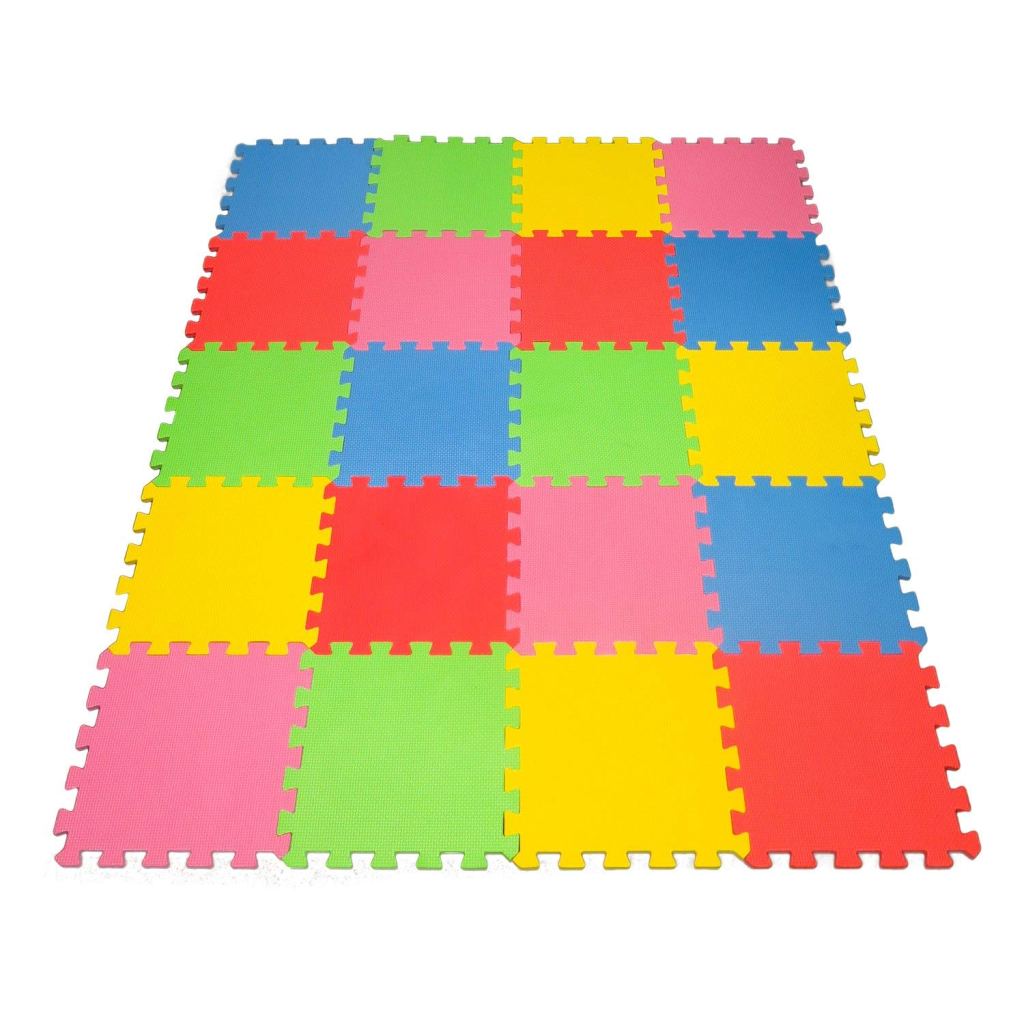
    • Interlocking playmats for kids – they may not be printed with a grid of lines 1″ part, but they do the job and are usually the same size (and a lot cheaper than the ones sold by knitting brands).
    A play mat consisting of 20 foam tiles lies on a white background. The tiles are red, blue, yellow, pink, and green.

    Stitch Stoppers

    • Save your wine corks and stick ’em on!
    • Poster putty

    There’s nothing wrong with buying notions or yarn that you know you’re going to use. As my own stash shows, I’m not one to judge. I love my needle gauge earrings, I have a strong preference for steel needles, and my swift/ball winder combo is pretty sweet. But the fanciness or aesthetics of yarn or notions will not make anyone a better crafter than they are, and that’s the most important thing to remember. And as I look at my own spending habits (especially in my time of voluntary unemployment), I think twice before pressing “checkout”.

    While I’m here, maybe I can influence you about something else.

    This past week Donald Trump made an unconstitutional decision to bomb Iran, threatening millions of innocent people with death and war. If you’ve read this far, I beg you to contact your representatives and ask them to oppose all further military action toward Iran and to stop arms sales to Israel, who instigated this conflict by attacking Iran. We also need to pressure our reps to impeach Trump. Again.

    Our government has been hanging the vague threat of Iran’s development of nuclear weapons for decades, and there’s never been evidence of it. Even if Iran did have nuclear warheads, so does the US, and we’re the only country who has every used one in war. Does that mean it’s justified to invade our country?

    It’s the same excuse we used to invade Iraq in 2002. After hundreds of thousands of Iraqi casualties and over 4,000 American servicepeople killed, we cannot fall for this lie again. I was 9 years old when 9/11 happened. Over the last 24 years, the consolidation of power under the executive office has been allowed to grow and grow, eroding our checks and balances system. Bush, Obama, Trump, and Biden are all guilty of using this power to bomb 8 countries between 2001-2025. I don’t care about governments, but I care about people, and peace should be nonpartisan.

    Find your representatives in the House and Senate here. While you’re there, you may also be interested in asking them to oppose putting 250 million acres of public lands up for sale to private corporations.

  • Craft, Art, and Gender

    What does my knitting have to do with my gender? More than I’d like. Less than you’d think.

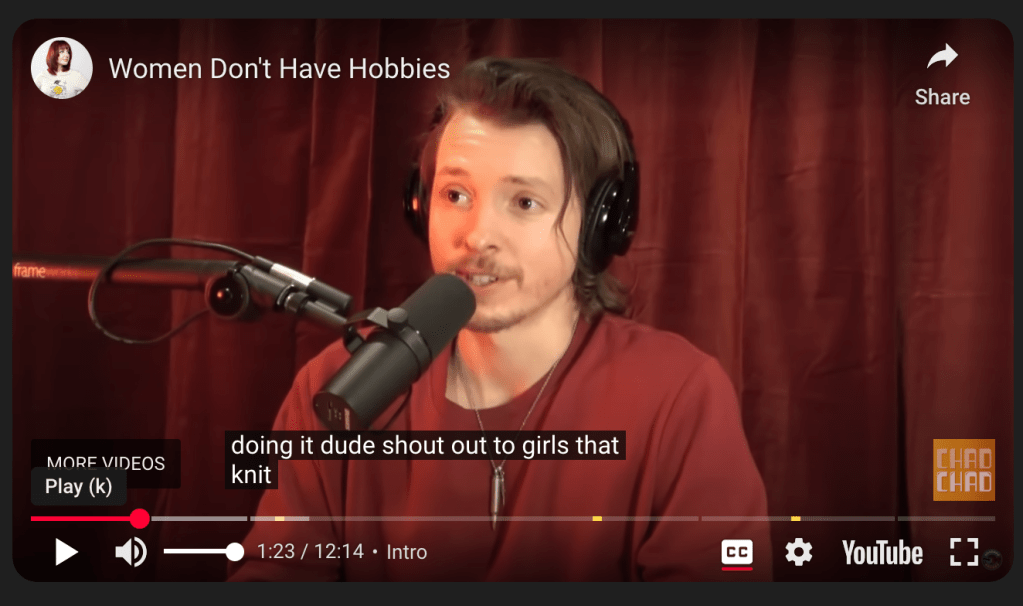
    I sometimes wonder what people assume about me when I knit in public. I wonder, and worry, if it’s assumed that I’m invested in the sort of traditional femininity that knitting seems to represent. I’ve discussed this a little in a previous post – do these so-called “alpha” manosphere assholes see knitting as a sign of the kind of woman they believe we should all be.

    A screen shot of a Youtube video. The frame is of a man in a red shirt against a red curtain background talking into a podcast microphone. The closed caption reads "dude, shout out to girls that knit"
    A clip from a manosphere Youtube channel where two men wonder if women actually have hobbies, and decide that knitting is an acceptable hobby for a woman to have because it’s “nurturing” and feminine. Don’t worry, I didn’t go to their actual YT channel to get this screenshot because I would never give them the views to poison my algorithm. Thanks to Chad Chad for taking that one for the team.

    I don’t knit because I’m a woman. I don’t knit in a feminine way. I also don’t knit in a feminist, reclaiming-the-power-of-the-craft way. I knit and crochet because I like it (and probably because I’m stimming, but that’s another blog post). I look at pretty much anything I do and wonder how much of it has to do with me being a woman.

    I feel best about myself when I feel feminine, but I recently realized that what I have been conditioned to understand as feminine is also what I have been conditioned to understand as beautiful. And chat, I do not feel beautiful. I also don’t feel nurturing, or supportive, or emotionally intelligent. I’m not motherly. I’ve never found traditional fulfillment in these traits or any power.

    So when we think of knitting and crochet, or any fiber craft, as a feminine activity, I question if my aversion to that is personal or if there really is a larger societal misattribution happening.

    Earlier this month I read an article in Art News about the burgeoning presence of fiber in the arts scene this year. “Fiber Art Has Officially Taken Over New York’s Museums and Galleries” by Alex Greenberger covers multiple exhibits, features, and retrospectives of fiber as painting and sculpture, at commercial galleries and museums like the MOMA.

    Almost all the artists mentioned and profiled in the article, as might be expected, are women. Greenberger credits the phenomenon of fiber-centered exhibits to a cultural correction of misogynist exclusion:

    Why so much fiber all of a sudden? The simple answer has to do with the changing face of recent art history. Weavings, embroideries, and the like have long been awarded an asterisk in the canon—if they’ve been accepted into the canon at all. Typically, art in those mediums has been classed separately as craft in the West or denigrated as “women’s work.” Thanks to the work of dedicated scholars, curators, and critics, fiber art has finally come in for reassessment.

    I wrote briefly in my post about chromatic politics about the shoehorning of women artists in the Bauhaus school to textile-based art forms. And how while fiber arts and decorative arts are often relegated to the superficial, their influence on the so-called “fine arts” is hard to ignore, like that of the mostly-female weavers of the Aymara on the aesthetics of architect Freddie Mamani.

    I don’t disagree with Greenberger’s theory of the gender pendulum swinging back in the direction of equity, and that the fiber art rage has been part of that. The way that the binary genders – men and women – have been separated and tiered has a lot to do with the way “art” and “craft” has been separated and tiered, which has given men a lot of fame and status and women a lot of obscurity. But I can’t help but wonder (!) what a gender utopia, a world where misogyny and queerphobia don’t exist, looks like.

    I have a list of evolving, circular desires for gender and art – a gender ouroboros maybe.

    • I want to see women included in “fine art” – painting, sculpture, architecture, etc. because women are capable of doing whatever they pursue.
    • I love seeing “craft” and the women artists who practice it included in the genres of fine art, because craft requires the same level of technique and intellect that the traditional “fine arts” require. It’s important to me that the disciplines and materials we associate with fine art gets expanded in order to perforate the gender separation that’s been engineered in the art world.
    • I don’t want to see fiber “craft” forever associated with women because not that all fiber artists are women and not all women are naturally fiber artists, and to believe so is gender essentialist in a way that gives me hives.
    • To call craft “women’s work” at all is colonial. Craft exists across the globe, in virtually every culture, and not all cultures divide labor along the same gender lines. For instance, textile crafters in West Africa were often men (Osborne, 2024), but during the trans-Atlantic slave trade, the white slave-owning class demanded that enslaved women perform it because it was more in line with the white/European division of labor by gender (Golden, 2023).
    • Not everyone lived by a gender binary like Christian Europeans did. Numerous cultures around the world recognize more than two genders, and the various nonbinary genders in those cultures also fulfilled traditional roles. Nonbinary people have also existed in binary gender cultures forever without being recognized. To only be talking about the elevation of women’s art erases the many trans nonbinary identities that are currently under attack, even by people claiming to be feminist*.
    • Even as objects previously tiered as “craft” are elevated to “art”, and artists working with materials often thought of as “craft supplies” instead of “artist materials”, are being curated for the fine arts scenes, will women and nonbinary artists be fairly represented alongside male artists without their gender or cultural background novelized alongside the medium?

    *If your brand of feminism aligns with Republican/right-wing politics or if you find that Nazis are agreeing with you, then you’re not a fucking feminist.

    To the last point, Greenberger makes a poignant criticism of the Woven Histories exhibit at the MOMA:

    The exhibition is unclear about the ties that bind many of its artists: what, for example, links an abstract painting from the ’70s by Jack Whitten and a raffia net from the ’60s by Ed Rossbach?…The exhibition also stumbles when presenting artists awaiting canonization such as Yvonne Koolmatrie, a Ngarrindjeri weaver who makes sinuous sculptures from sedge, a type of grass. These works are…lumped together with baskets by Indigenous artists, an awkward, reductive gesture that makes them feel like an afterthought.

    Here, Koolmatrie’s artistry is hitched to that of other indigenous artists with, as Greenberger suggests, no real curation as to why. Is it enough to say that “we all weave”, or does this decontextualize the places and cultures these individual artists come from? The importance of cultural specificity to art and craft cannot be overstated, and it is frequently missing from a lot of discourse about art and gender that I’ve seen and read. Race and gender are linked in systems of oppression, so they have to be discussed together in cultural criticism. After all, the Western/European art institutions that have displayed stolen precolonial indigenous art have historically not challenged the binary thinking of gender by acknowledging nonbinary artists.

    I grew up near the Baltimore Museum of Art, and even as a child I could understand the way most of the exhibits were organized. These rooms, the impressionists. Over here, the impressive collection of Matisses. In this stark white and angular wing, the contemporary exhibit. And over here… “African Art.” All the art the museum had from across the continent, from across centuries, in cramped glass display cases instead of mounted on walls or installed like the European and American paintings and sculptures. Looking back on it now, this exhibit was distinctly anthropological, archeological, in nature. These were not meant to be considered cerebrally like the Monets and Warhols. I wasn’t meant to think about the objects’ makers as individuals. It was just a room full of things with a single tenuous connection between them: the 11.7 million square mile continent of origin.

    Decades later, the BMA has gone through a total overhaul. That vague exhibit no longer exists. The new curators have gone full force into featuring living artists whose works they can fully contextualize. They’ve sold a number of extremely famous works (to the rage of many white patrons) to fund the acquisition of art by Black, indigenous, and queer artists. Last year, they installed “Walk a Mile in My Dreams” an exhibit dedicated to the work of Joyce J. Scott, a Baltimore artist who works in a plethora of different mediums and techniques, including fiber, weaving, and crochet. Scott’s work explores race, sexuality, violence, and natural destruction, and she’s as influenced by the cultures and artistic techniques of the many places she’s traveled as she is by her own family’s long history of making.

    I haven’t visited the Woven Histories exhibit myself, so I can’t speak personally to the level of explanation provided by the curator as to the connection between the different works, but it sounds like more specific context is needed to draw these connections. Maybe it takes an artist-specific installation, like “Walk a Mile in My Dreams”, to fully do justice to any artist.

    I have been thinking about my relationship to my gender for my entire life, and Greenberger’s article gave me a great vehicle to talk about it in relationship to the fiber crafts that have become such a big part of my day-to-day life (and my livelihood, at one point). This hobby, once necessary labor in a preindustrial age, taken for granted as “women’s work”; this women’s work that my own 94-year-old meat-and-potatoes mans’ man Navy veteran grandfather was taught as a boy; this women’s work that I have seen loved by cis men, gay and straight; this women’s work that I have seen relished by trans and non-binary people at fiber festivals.

    Even though us cis women are overrepresented in fiber arts, they don’t belong to us, and that makes me feel free. It’s not enough that I should feel empowered by the things that make me “feminine” – I want a femininity that demands nothing of me. The gender utopia I hope for is a decolonized one, a non-binary one. One where every singular person is recognized for their skills and artistry no matter their identity, without it having to reflect on anyone else.

  • What is a knitting community

    Reckoning with the pussy hat and engaging with art activism in Trump’s second term

    I want to talk about a customer I met when I worked at the yarn store. She was telling about a project that she was working on, or recently finished, I can’t remember. It was a stranded colorwork hat that spelled “Fuck Trump” in morse code. It was hard for me to stop myself from saying that this was useless.

    Who was it for? Who was she signaling to? How many people on the street know morse code? This is emblematic to me of a snickering cosplay mischief that many white liberals find themselves employing with a hashtag resistance. I remember thinking “At least spell out Fuck Trump in plain English. The least you could do is get in an actual confrontation.” But how would she feel like a Katniss Everdeen or a Hermione Granger, forced to use code and subterfuge under an imagined threat of censorship? Because of course, no one would question her right to free speech or citizenship, or mine.

    Years later during Trump’s second term, it’s Black and Brown people, Muslims, immigrants both documented and undocumented who are targeted for writing about and protesting genocide. Mahmoud Khalil, Rumeysa Ozturk, and more since I’ve started writing this post have been disappeared by agents, or had their green cards suddenly voided by Trump’s government. Two planes’ worth of people were flown to CECOT prison in El Salvador under suspicion of being in a gang, without due process or evidence other than having tattoos. They were used as set dressing by Kristi Noem, looking lovely with her hair extensions, designer jewelry, and fillers in the middle of a prison. She’s allowed these feminizing procedures and accessories, of course, because she was born with a vagina, unlike the incarcerated trans women who have been sent to men’s prisons over the past several months. Us cis women can have all the gender affirmation we want.

    Both during Trump’s first administration and now, crafters have loved to point to times when crafts were used to subvert fascism and oppression – anti-Nazi resistance spies carrying messages encoded in knitting patterns, for instance, or the more obscure history of Black and allied quilters using specific patterns or colors to signal to people escaping slavery on the Underground Railroad. The pussy hat of 2017 was an attempt to pay homage to the interesting ways “women’s work” was used for good and to unite crafters as a community against Trumpian fascism. It was a flashpoint that drew media attention to knitting and crochet: criticism from the right that I will not entertain, and earned criticism from the left for its dominating presence at the Women’s March without the leadership or input of Black and trans women.

    I didn’t wear a pussy hat that day. I did, however, carry a sign that said “pussy grabs back” and depicted a vulva as a bear trap. I, like a lot of other cis and white feminists, were directly responding to Trump’s “grab ’em by the pussy” line and the shameless joy he took in the sexual assault of cis women. Cis women felt attacked. It was an attack. But then our response to this attack swallowed every other way Trump was attacking marginalized people. The pink pussy hat and its symbolism became a black hole, spaghettifying all other insights, experiences, and needs in that moment. It’s true that there was immense fervor for the image of thousands of women wearing pink pussy hats. It’s also true that the kind of person who wears one is the kind of person the media is more likely to pay attention to. I also think it was very emblematic of the way knitters tend to “build community”: through sameness and FOMO.

    Obviously knitting is important to us, so when it has a big global moment, we want to be involved. When the Women’s March was being planned, it attracted many people who had never been to a march or protest in their life, which is a success. And a lot of freshly enraged knitting people saw the pussy hat project and thought, “here is another way for me to belong in this movement, with other people with this same skill”. And then the pussy hat attracted people who didn’t knit or crochet, but got their pussy hats from donation stations set up at yarn shops or from crafting friends. Maybe these non-crafty enraged people saw the media attention around the pussy hat and thought, “hey, maybe I should try this too.” A success for knitting, but what about for organizing?

    I see the popularity of the pussy hat, and the avenues used to popularize it, as the same as any other hit knitting pattern. It was being made by many big-name designers, whose orbits of fans then made their own. KALs and CALs were organized, and how could we miss out on that? About a year and half after the Women’s March is when I got my job in the yarn business, and I saw the same enthusiasm for the pussy hat applying to so many other patterns and designers. The same dozen or so designers on the first page of Ravelry’s “Hot Right Now” search; hundreds of people gathered on the hill at Rhinebeck in the same sweater. There’s a commonality created by a shared art and interest, but not necessarily community.

    The pussy hat, or any handmade object, can’t accomplish what its creators wanted: solidarity. People have to do that. An object a just a symbol, and a symbol has to stand for something that already exists. In that way, the pussy hat was the cart placed before the horse.

    I am not writing off crafting’s potential for community-building. But stitches alone don’t foster solidarity, and knitting communities are just as good at excluding as including. Black yarn crafters have frequently reported being followed in yarn shops, a problem of racist profiling common across the retail industry, or just treated as though they don’t know what they’re doing. Ruth Terry’s article “Black People Were the Original Craftivists” points out the harsh irony that white Americans exploited the textile expertise of enslaved people, just to push their descendants from craft spaces once knitting and sewing became leisure activities after WWII. A meaningful resistance movement in crafting, or any discourse, cannot be fomented without direct, vocal anti-racism. There are a lot of crafters willing to ignore racism, or any criticism levied against them about race, for the illusion of unity.

    Another problem with trying to publicly proclaim crafters as the resistance is that we are largely not. There are plenty of highly traditional “alpha males” who might see me knitting and agree that’s what I should be doing with my time because I’m a woman. They might assume that I am interested in a narrow role of homemaking and motherhood because knitting is symbolic of “good old days” that never really existed. They might assume I share values of gender essentialism, natalism, patriarchy, and white supremacy. And there are certainly women who knit who do share those values.

    I notice the incredible spectrum people at fiber festivals: the highly conservative women and their husbands, the visibly queer, the feminists who feel artistic pride in “women’s work”, rural livestock farmers who symbolize a pastoral America, even as the country becomes increasingly hostile to their livelihoods. Don’t forget, too, that agriculture in this country is hugely supported by immigrants’ intense labor. Fiber festivals have an amazing ability to pull all these different people together based on a shared interest/hobby/career/trade. To actually build solidarity there, I return to my thoughts on the morse code Fuck Trump hat: we need to use our words.

    I was sounding out my ideas for this blog post with a friend, about how crafting can create community, or if it even can. They suggested I look outside of fiber to zines, and I have found zine culture to be particularly inspiring. While zines exist in many scenes and for many reasons (sharing creative writing, art, comics, political manifestos) they’re probably most heavily associated with punk and riot grrl subculture. Zines are works of art in themselves that also take advantage of art-centered gatherings for dissemination. I wrote about Shotgun Seamstress a few weeks ago, a zine started by musician and artist Osa Atoe to platform and unify other Black punks and musicians. The scene existed, but Atoe was tired of punk being presented as a largely white subculture, and therefore fraught with racism and implicit bias against Black musicians and fans. Just being at the shows and enjoying the music isn’t enough for a strong community – ideas and the leadership of the most marginalized are essential for creating the solidarity left-leaning crafters want to celebrate. Zines can be an excellent model for idea-sharing in the fiber world, a way to make the most of packed gatherings of fiber crafters to find new coalitions and allies.

    This is why my post is so front-packed with the issues that are crucial to me and my friends at this moment, and why I don’t see fiber crafts, this thing that brings me so much joy, as an escape from the worries of the world. The phrase “stick to knitting” doesn’t just feel condescending, it feels impossible. I can’t extract anything I love doing from who I am or what I believe in. So when I enter fiber festivals, knitting/crochet/quilting/sewing circles, yarn stores, craft guilds, I want to make it 100% clear where I stand and who I want to unite with.

  • Color Advocate Part II

    A deeper dive into color politics, philosophy, and art criticism.

    In my first color post I wrote about the tension between beauty and color, and all its associations. Sometimes in the pursuit of a pleasant palette, it’s not just “ugly” colors that get rejected, but any colors with negative, disturbing, or gross connotations. Occasionally this results in the rejection of color completely.

    I needed some wiser insight, so now I’m reading Chromophobia by artist David Batchelor. Batchelor explores how Western perception and use of color is tinted (pun intended) by fear and domination, stemming from Western philosophers’ and critics’ colonialist, racist, and misogynist associations with color. From ancient Greece to modern misconstructions of minimalism, Batchelor points out how color is simultaneously revulsed and seducing, and in order to achieve a Platonic ideal of art and the body, color must be carefully controlled. Color is relegated to the cosmetic and vulgar, so its careful use or disuse becomes a class signifier of moral superiority.

    From Architectural Digest, a room in the home once shared by Kim Kardashian and Kanye West

    But Batchelor points out many times how these chromophobes contradict themselves, downplaying color as secondary and minor, and yet essential to arts like painting. Scholars will completely disregard an artwork’s use of color to analyze its form and composition in a sort of “negative hallucination”, a term Batchelor borrows from psychology, even though color is one of the first things our eyes perceive. Color is seen as a distraction, something that covers up form that is perceived as truth.

    Which is why chromophobes were shaken when historical and chemical research showed that classical statues from Greece and Rome, the origin point for that white platonic ideal, were not originally pure white stone, but colorfully painted. And racists were invested in the belief that these statues were white because pigment meant acknowledging that some Greeks and Romans had melanin. This article from The New Yorker (which also cites Batchelor) explores of the public’s reaction to these painted statues, and how contemporary racism tries to warp history to its benefit, to the myth of the “great western civilization” completed separated and above the rest of the world.

    Experimental color reconstruction of a bronze statue, from the Gods in Color exhibition

    The fact that the ancient world was happily polychrome subverts the form-first philosophy, which also subverts who has been excluded from the canon by chromophobia. By disqualifying the use of color as a true artistic expression, a person can also disqualify any cultural or artistic importance placed on color, which for the chromophobic, is a great way to discredit women’s art as “decorative” and therefore unserious, and non-white people’s art as unintellectual.

    Women in western culture, in my experience as a womanish person in western culture, are charged with being beautiful and then condemned as vain and superficial. They are associated with the colors of cosmetics, which as Batchelor discusses, are condemned as deceptive. We’ve been charged with making the home beautiful because no one wants to live in a colorless shoebox, and then the “domestic arts” are called “crafts” and then undervalued. The Bauhaus school, which while progressive for its time, split itself by gender by capping women’s admission and attempting to shoehorn them into the “feminized” subject of weaving, the only department led by a woman, Gunta Stölzl, who was significantly underpaid.

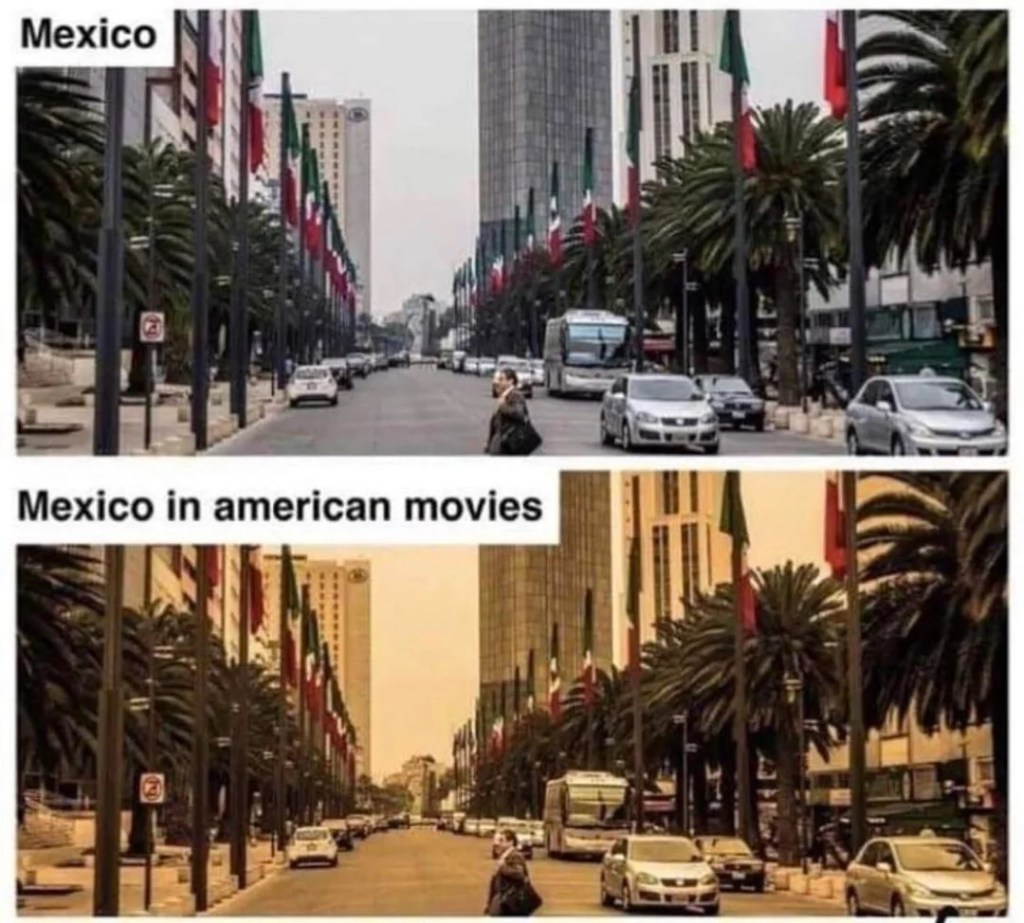
    The addition of color is even used to signify exotic locales and then subliminally deprecate them. I can’t think of a better example than the “Mexican filter”, a notorious phenomenon in color grading that renders non-Western settings in a yellow haze. Maybe this yellow tint was meant to evoke heat and sun, but as we all know, the world does not get visually yellower with heat. For a culture that associates whiteness with clarity and goodness, critics have pointed out that the sepia filter implies grime and toxicity. And it’s not exclusive to depictions of Mexico either.

    The Mexican filter is much-memed.

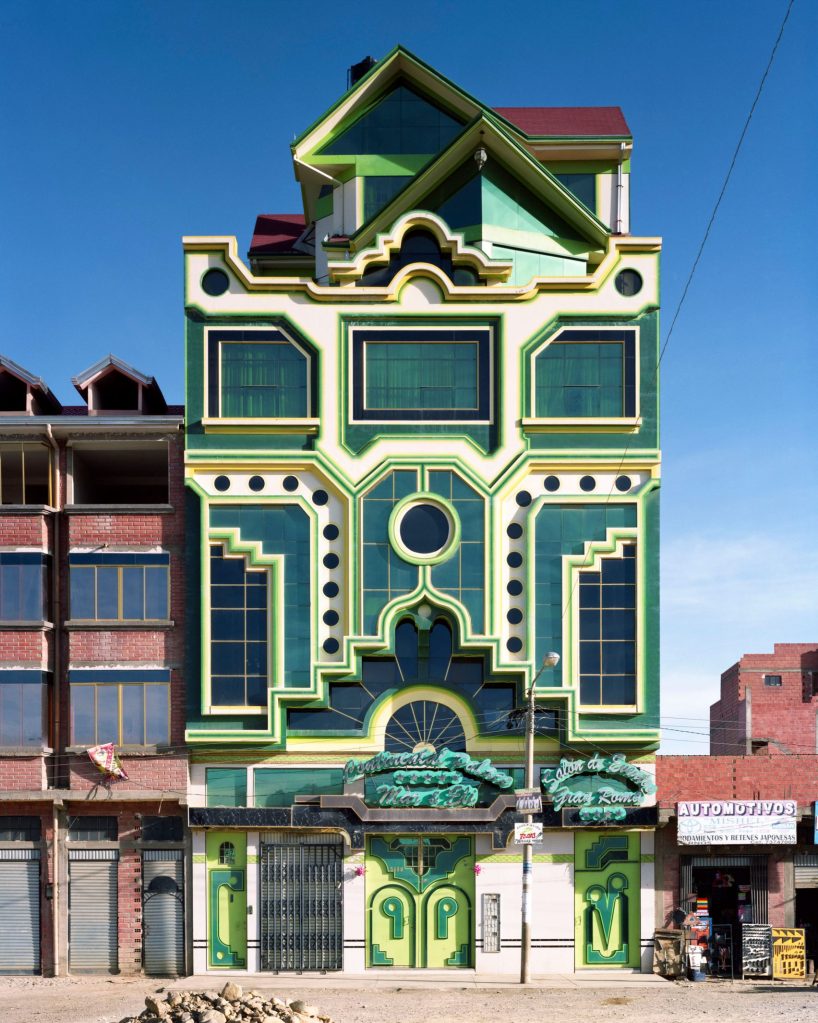
    If you’re looking for the antidote for western chromophobia, I’ll point you to the work of architect Freddy Mamani, who has spearheaded the New Andean style in El Alto, Bolivia. Mamani is Aymara, along with about 75% of El Alto’s population. He incorporates motifs and imagery from centuries-old pre-Columbian structures (he specifically talks about the city of Tiwanaku) and also the vivid color schemes used by Aymara weavers. These buildings, called cholets, combine sharp geometric patterns with curving botanical lines, and stand out against most of El Alto’s red-brick buildings.

    One of Mamani’s cholets.

    One of the most striking things about Mamani’s vision is his use of color in pursuit of modernity. Many of critics and aesthetes quoted by Batchelor think of color, either positively or pejoratively, as belonging the realm of the primordial and pre-linguistic. That purest color both exceeds and predates our use of language, and is associated with genesis – but isn’t that infantilizing? In El Alto, the cholets’ colors are the articulation of Aymara presence and influence. It’s a visual declaration that indigenous people are not relegated to history, have not been wiped out by colonialism, and thrive.